Ranikhet disease in poultry (also called Newcastle disease) is a fast-spreading viral disease of chickens and other birds. It is caused by avian paramyxovirus type 1 (APMV-1). It brings breathing trouble, green watery diarrhoea, twisted neck, paralysis and a sharp fall in egg production. Severe strains can kill close to 100% of an unvaccinated flock.
There is no medicine that kills the virus. Treatment only supports sick birds and controls secondary bacterial infections. The real protection is a timely vaccine schedule plus strict farm biosecurity.
Why this matters for Indian farmers
India produced about 149.11 billion eggs in 2024-25, up 4.44% from the year before (BAHS 2025 via GS Times). Poultry also gives about half of the country’s meat. One uncontrolled Ranikhet outbreak can wipe out months of this income on a single farm.
The risk is highest in village flocks. India had about 317 million backyard birds in the 2019 census, a 45.8% rise over 2012. Yet vaccination in these flocks is often missing or not recorded (Puro & Sen, Frontiers in Veterinary Science, 2022).
This guide explains, in simple words:
- what causes Ranikhet disease and how it spreads
- how to spot it early and tell it apart from look-alike diseases
- what treatment and medicine can (and cannot) do
- the vaccine schedule for broilers, layers and backyard birds
- a practical outbreak action plan for your farm
What is Ranikhet disease in poultry?
Ranikhet disease is a viral infection of the bird’s breathing, gut and nervous system. In India it is named after Ranikhet in Uttarakhand, where it was first reported in the country. The rest of the world calls it Newcastle disease (ND), after Newcastle upon Tyne in England, where it was described in 1926.
It is a WOAH-listed disease. That means outbreaks of virulent strains must be reported to the World Organisation for Animal Health (WOAH).
Ranikhet disease in poultry is caused by
The cause is Newcastle disease virus (NDV), also known as avian paramyxovirus type 1 (APMV-1). It belongs to the paramyxovirus family (WOAH disease card).
Chickens are the most affected. Turkeys, ducks, geese, pigeons, guinea fowl and quail can also catch it, though ducks and geese often show few signs.
Types (strains) of Ranikhet virus
Not every Ranikhet outbreak looks the same. The strain decides how bad it gets.
| Strain type | How severe | Main signs | Typical death rate |
|---|---|---|---|
| Velogenic (viscerotropic) | Very severe | Bleeding in gut, green diarrhoea, swollen head, sudden death | Up to ~100% in unvaccinated chickens |
| Velogenic (neurotropic) | Very severe | Breathing trouble, then twisted neck, paralysis | Up to ~100% in unvaccinated chickens |
| Mesogenic | Moderate | Breathing signs, some nervous signs, egg drop | Usually below 10% |
| Lentogenic | Mild | Light cough, sneezing | Negligible |
Source: WOAH Newcastle disease card.
The mild lentogenic strains matter too. Weakened forms of them (such as La Sota and B1) are used to make the vaccines given to chicks.
How Ranikhet disease spreads
- Bird to bird: through droppings, nasal discharge and breath of sick birds.
- Feed and water: contaminated drinkers and feeders spread it through the whole shed.
- People and objects: boots, clothes, egg trays, crates, sacks and vehicles carry the virus between farms.
- Wild birds and new stock: pigeons, crows and newly bought birds can bring it in.
- Eggs: some strains can pass to chicks at hatching.
The virus survives a long time in droppings at normal temperature. That is why a shed that is not cleaned properly can infect the next batch.
Incubation period: usually 2 to 15 days, average 5 to 6 days. WOAH uses 21 days for trade and quarantine rules.
Ranikhet disease symptoms
The most telling signs are gasping, green watery diarrhoea and a twisted neck, together with a sudden drop in eggs. Signs often start 5 to 6 days after the virus enters the farm.
Breathing signs (often first)
- Gasping, coughing and sneezing
- Gurgling sound from thick mucus in the throat
- Watery eyes and swollen eyelids
Gut and general signs
- Dullness, ruffled feathers and huddling
- Low feed and water intake
- Greenish or whitish watery, foul-smelling diarrhoea
- Swelling and bluish colour of the head, comb and wattles
Nervous signs (later stage)
- Twisted neck (torticollis), head drawn back between the legs
- Walking in circles, tremors
- Paralysis of legs or wings
Birds that survive can keep these nervous signs for life.
Signs in laying hens
- Egg production can fall sharply within days
- Soft-shelled, thin-shelled or misshapen eggs
- Watery egg white
What the vet finds at post-mortem
No single lesion confirms Ranikhet. But severe (velogenic) cases often show pin-point bleeding on the proventriculus (glandular stomach), ulcers in the intestine, and a congested trachea (WOAH).
Confirm before you act. Signs alone cannot separate Ranikhet from bird flu. Send 2 to 3 freshly dead or sick birds to the nearest government veterinary diagnostic lab for virus testing (PCR or virus isolation).
Ranikhet vs look-alike poultry diseases
Many farmers mistake Ranikhet for bird flu, CRD or IB. Use this table as a first guide, then confirm with a lab.
| Feature | Ranikhet (ND) | Bird flu (HPAI) | CRD (Mycoplasma) | Infectious bronchitis (IB) |
|---|---|---|---|---|
| Cause | Virus (APMV-1) | Virus (influenza A, e.g. H5N1) | Bacteria (Mycoplasma gallisepticum) | Virus (coronavirus) |
| Speed of spread | Fast | Very fast | Slow, builds over weeks | Fast |
| Death rate | Up to ~100% (velogenic) | Up to ~100% | Low, unless mixed with E. coli | Low in adults, higher in chicks |
| Twisted neck / paralysis | Common | Sometimes | No | No |
| Green diarrhoea | Common | Common | Rare | Rare |
| Face and wattle swelling | Sometimes | Common, with bluish combs and leg bleeding | Swollen face/sinus | No |
| Egg changes | Drop, soft shells | Drop, near stop | Gradual drop | Wrinkled eggs, watery albumen |
| Responds to antibiotics? | No (virus) | No (virus) | Yes | No (virus) |
| Must report to authorities? | Yes (virulent strains) | Yes | No | No |
If you see high deaths plus bluish combs and leg bleeding, treat it as possible bird flu. Isolate the shed and inform the district animal husbandry office at once. Read our poultry farm biosecurity checklist for the steps.
Treatment of Ranikhet disease in poultry
There is no cure for Ranikhet disease. No antibiotic or antiviral kills the virus (WOAH; TNAU Agritech). Treatment aims at three things: keep birds eating and drinking, stop secondary bacterial infections, and stop the spread.
What supportive treatment includes
| Goal | What is used | Why it helps |
|---|---|---|
| Stop dehydration | Electrolytes in drinking water | Diarrhoea and fever drain water and salts |
| Restore strength and immunity | Vitamin A, D3, E, B-complex and vitamin C | Supports recovery and feed intake |
| Protect the liver | Liver tonics | Sick birds stop eating; the liver carries the load |
| Control secondary infections | Broad-spectrum antibiotics, only on a vet’s prescription | E. coli and Mycoplasma often join in and raise deaths |
| Reduce stress | Warm, dry, well-ventilated shed; fresh water at all times | Stress lowers immunity |
Important: antibiotics do not treat the virus itself. Use them only when a vet confirms secondary bacterial infection. Wrong or extra use builds antibiotic resistance and leaves residues in eggs and meat. Always follow the withdrawal period of veterinary drugs before selling eggs or birds.
Ranikhet disease in poultry medicine: what to keep ready
Keep these on the farm before the risky winter months:
- Electrolyte powder or liquid
- Multivitamin and vitamin C supplement for water
- Liver tonic
- An approved farm disinfectant
- Ranikhet vaccine stock kept in a cold chain (2–8°C)
How PetVet can help: PetVet Healthcare manufactures feed supplements such as liver tonics, multivitamins and electrolytes under WHO-GMP conditions in Ambala Cantt, Haryana. See the full PetVet product list or our guide to choosing a poultry medicine company. Supplements support recovery; they do not replace vaccination.
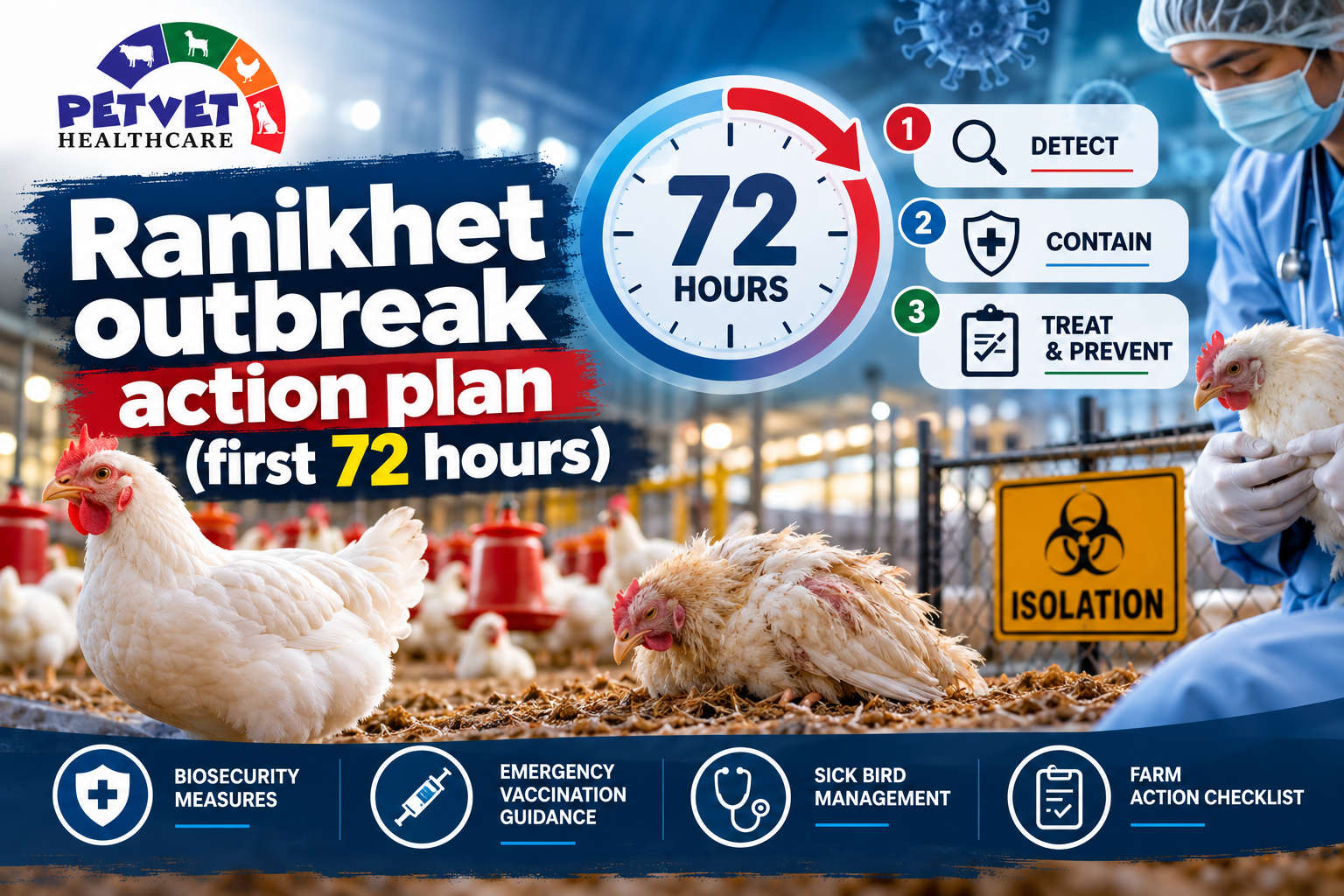
Ranikhet outbreak action plan (first 72 hours)
If you suspect Ranikhet on your farm, act in this order:
- Isolate. Lock the affected shed. Stop all movement of birds, eggs, litter and staff to other sheds.
- Call a vet and send samples. Send 2–3 fresh carcasses to the nearest veterinary diagnostic lab.
- Remove dead birds daily. Burn or bury them deep, with lime. Never throw them in open fields or water.
- Start supportive care. Give electrolytes and vitamins in water, as advised by the vet.
- Disinfect. Clean drinkers, feeders and footbaths daily. Change footbath disinfectant every day.
- Protect the healthy flocks. If the vet advises, give an emergency booster vaccine to unaffected sheds on the farm.
- Inform the authorities. Report to the district animal husbandry office, as virulent ND is a notifiable disease.
- After the outbreak. Remove all litter, wash and disinfect the shed, and keep it empty for at least 2–3 weeks before new chicks arrive.
Ranikhet disease vaccine: types and schedule
Vaccination is the single most effective way to control Ranikhet disease. It does not stop the virus from circulating completely, but it sharply cuts deaths and egg loss (WOAH).
Types of Ranikhet vaccine
| Vaccine | Strain type | Given to | Route | Key point |
|---|---|---|---|---|
| F1 / B1 (Hitchner B1) | Live, mild (lentogenic) | Chicks, 5–7 days | Eye or nose drop | Gentle first dose |
| La Sota | Live, mild (lentogenic) | Chicks and boosters | Eye/nose drop or drinking water | Stronger immunity than F1/B1 |
| R2B (Mukteswar) / RDVK | Live, moderate (mesogenic) | Growers, 8 weeks and above | Injection under the skin or wing-web | Long immunity; never use in young chicks |
| Killed (oil-based) | Inactivated | Layers before lay, 16–18 weeks | Injection | No vaccine reaction; long-lasting |
| I-2 thermostable | Live, mild | Backyard / village birds | Eye drop or in feed | Tolerates heat; less cold chain needed |
The R2B (Mukteswar) vaccine was developed at the Indian Veterinary Research Institute. Birds vaccinated at 6 weeks or older can stay immune for 1 to 3 years (TNAU Agritech). The thermostable I-2 vaccine is recommended for rural flocks where keeping vaccines cold is hard (Puro & Sen, 2022).
Ranikhet vaccination schedule for layers
| Age | Vaccine | Route |
|---|---|---|
| 5–7 days | La Sota or F1 | Eye or nose drop |
| 8th week | R2B / RDVK | Under the skin |
| 16–18 weeks | Killed or live booster | Under the skin |
Source: TNAU Agritech layer schedule. Many farms in high-risk areas also repeat a La Sota booster every 6–8 weeks during lay, on vet advice.
Common schedule for broilers
| Age | Vaccine | Route |
|---|---|---|
| 5–7 days | F1, B1 or La Sota | Eye or nose drop |
| 21–28 days | La Sota booster | Drinking water or eye drop |
Schedules change with local disease pressure and the vaccine brand. Always follow the vaccine label and your vet. For the full chart with Marek’s, Gumboro (IBD) and other vaccines, see our poultry vaccination schedule in India.
Why vaccines sometimes fail
- Broken cold chain: live vaccines die if not kept at 2–8°C.
- Chlorinated water: chlorine kills live vaccine. Use clean, non-chlorinated water and stop sanitisers 24–48 hours before and after.
- Worms and coccidiosis: heavily infected birds may not build immunity. TNAU advises deworming from one week before R2B vaccination (TNAU).
- Wrong dose or timing: half-dosing or late boosters leave gaps.
- Vaccinating sick birds: vaccinate only healthy flocks.
The R2B strain can also cause incoordination or paralysis in 1–3% of birds, more often in weak or wormy birds (TNAU). This is another reason to deworm first.
How to control and prevent Ranikhet disease
Vaccines work best with good biosecurity. Follow these steps every day:
- Control entry: one gate, a footbath with fresh disinfectant, and no outsiders in the sheds.
- Quarantine new birds for at least 10 days before mixing (TNAU).
- Keep out wild birds and rodents with wire netting and closed feed stores.
- Use separate staff, boots and tools for each shed.
- Clean and disinfect between batches. The virus is killed by common disinfectants such as phenolics, oxidising agents, chlorhexidine and sodium hypochlorite (WOAH).
- Follow all-in, all-out placement so ages do not mix.
- Keep vaccination records for every batch: date, vaccine, batch number and route.
For a full step-by-step list, use our 15-step poultry farm biosecurity checklist.
Frequently asked questions
What is Ranikhet disease caused by?
Ranikhet disease is caused by Newcastle disease virus, also called avian paramyxovirus type 1 (APMV-1). It spreads through droppings, nasal discharge, contaminated feed, water, equipment, people and wild birds. Velogenic (highly virulent) strains cause the deadly outbreaks, while mild lentogenic strains are used to make vaccines such as La Sota and B1.
How is Ranikhet disease in poultry treated?
There is no direct cure because no drug kills the virus. Farmers give electrolytes, vitamins and liver tonics in water to support sick birds. A vet may prescribe antibiotics only to control secondary bacterial infections like E. coli. At the same time, isolate the shed, remove dead birds daily and vaccinate healthy flocks on vet advice.
What is the best treatment for CRD in poultry?
CRD (chronic respiratory disease) is caused by Mycoplasma gallisepticum bacteria, so unlike Ranikhet it responds to antibiotics. Vets commonly use drugs such as tylosin, tiamulin or doxycycline in water for a set number of days. Add vitamins, good ventilation and low ammonia. Buy Mycoplasma-free chicks and follow the drug’s withdrawal period.
Which poultry disease has no treatment?
Viral diseases have no specific treatment. These include Ranikhet (Newcastle) disease, bird flu, Marek’s disease, Gumboro (infectious bursal disease), infectious bronchitis and fowl pox. For all of them, vaccination and biosecurity are the only real protection. Antibiotics help only when bacteria cause a secondary infection on top of the virus.
How do we treat Newcastle disease in poultry?
Newcastle disease and Ranikhet disease are the same illness, so the approach is identical. Give supportive care with electrolytes and multivitamins, keep birds warm and dry, and use vet-prescribed antibiotics only for secondary infections. Report virulent outbreaks to the district animal husbandry office, because Newcastle disease is a notifiable disease under WOAH rules.
What are symptoms of Newcastle disease in chickens?
Common symptoms are gasping, coughing, sneezing, ruffled feathers, low appetite and green watery diarrhoea. Later, birds may show a twisted neck, circling, tremors and paralysis. Laying hens produce fewer eggs, with soft or misshapen shells. Severe strains can cause sudden death of almost the whole unvaccinated flock within days.
What is the best vaccine for Newcastle disease?
No single vaccine fits every bird. For chicks, live La Sota or F1/B1 by eye or nose drop at 5–7 days works well. Growers get R2B (Mukteswar) at around 8 weeks for longer immunity. Layers get a killed oil vaccine before lay, and backyard birds do well with thermostable I-2 vaccine.
How long does Newcastle disease last in chickens?
With severe strains, sick birds often die within 3 to 4 days of showing signs. Survivors usually recover over 1 to 3 weeks, but nervous signs like a twisted neck may stay for life. Recovered birds can keep shedding virus for some weeks, so keep the flock isolated and the shed disinfected.
The hidden cost of Ranikhet
Deaths are only part of the loss. A 2023 study of commercial layer farms in subtropical India found that losses from illness (lower egg output, lower feed intake, longer infection) were much larger than losses from bird deaths (Sharma et al., Indian Journal of Animal Sciences, 2023). Losses were higher when birds were infected at a younger age and when the farmer had less experience.
So a flock that “only” drops eggs for three weeks may still cost more than a few dead birds. Vaccination and biosecurity cost far less than either.
Need reliable poultry health supplies?
PetVet Healthcare is a WHO-GMP certified veterinary medicine manufacturer in Ambala Cantt, Haryana, supplying farms, vets and distributors across India. Call +91 86074 15111 or email petvetindia@gmail.com for bulk supply, a veterinary PCD pharma franchise or third-party manufacturing.
Disclaimer: This article is for general information. Diagnosis and treatment of any flock should be done by a registered veterinarian.
Related reading
- Poultry vaccination schedule in India
- Poultry farm biosecurity checklist: 15 steps
- Withdrawal period of veterinary drugs in milk, meat and eggs
- Poultry medicine procurement guide
- Best poultry medicine company in India
Sources
- WOAH – Newcastle disease card (PDF)
- WOAH – Newcastle disease, listed disease page
- TNAU Agritech – Poultry disease management
- Puro K, Sen A. Newcastle disease in backyard poultry rearing in the north-eastern states of India. Frontiers in Veterinary Science, 2022
- Sharma R et al. Economic losses due to Newcastle disease in layers in subtropical India. Indian Journal of Animal Sciences, 2023
- Basic Animal Husbandry Statistics 2025 summary – GS Times