Day 18 of the cycle. Birds are eating well, weight gain is bang on target, and then overnight the mortality count jumps from four to thirty-one.
The farm manager calls his supplier at 6 in the morning. The supplier picks up, listens patiently, and says the sentence every poultry farmer has heard at least once: “Stock nahi hai sir, agle hafte aayega.”
By next week, it won’t matter.
That one conversation — repeated on thousands of farms across Andhra Pradesh, Telangana, Tamil Nadu, Punjab and Haryana every season — is what poultry medicine procurement is actually about. Not price lists. Not discounts. Availability at the exact moment a flock needs it.
What is poultry medicine procurement?
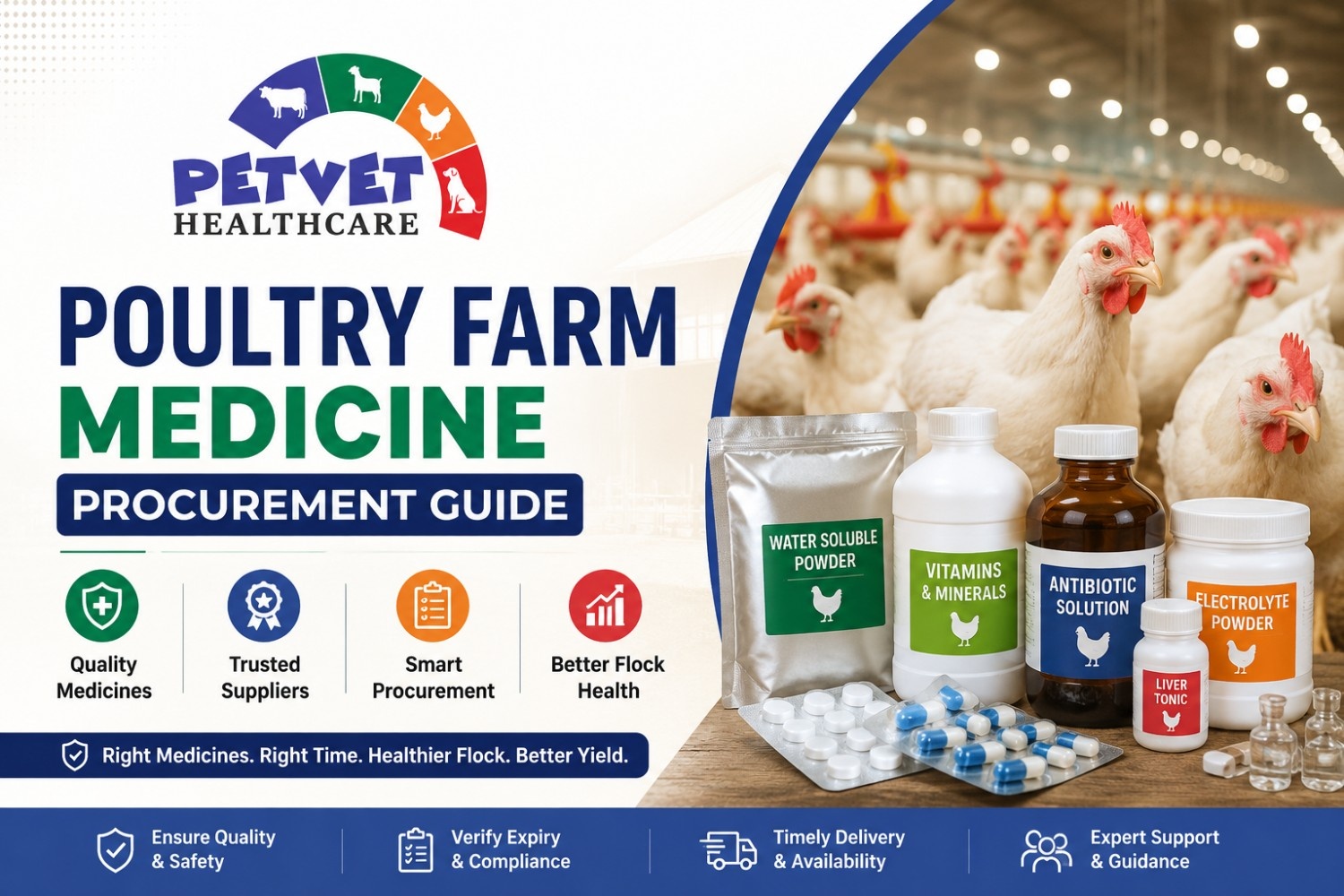
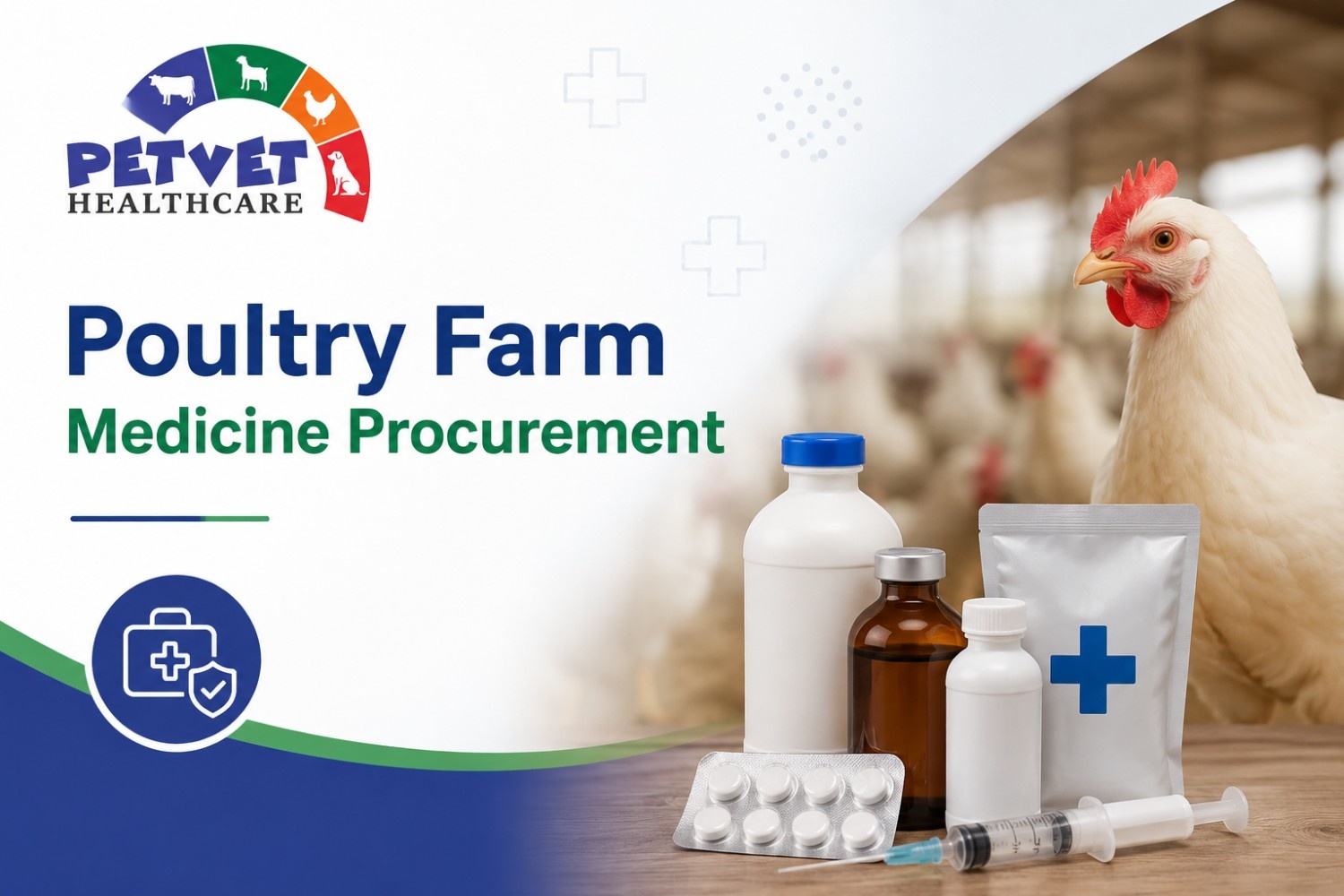
Poultry medicine procurement is the process of planning, sourcing and stocking veterinary medicines and supplements for a poultry farm so the right product is available at the right stage of the flock cycle. It covers supplier selection, licence verification, quantity forecasting, storage and reorder timing — not just placing an order.
PetVet Healthcare is a WHO-GMP and cGMP certified veterinary medicine manufacturer in India, based in Ambala Cantt, Haryana, producing injections, boluses and feed supplements for poultry, livestock and companion animals since 2019. We supply farms, veterinarians, wholesalers and distributors across India — which means we watch procurement go wrong from the manufacturing side of the table, and we see the same three or four mistakes repeat. This guide comes from that vantage point. Browse our full veterinary product range if you want to see what a complete poultry portfolio looks like.
Why procurement matters more in poultry than in any other livestock
Because the clock is different.
A broiler batch reaches market weight in roughly 35 to 42 days. Layers stay productive for 72 to 80 weeks. So a cattle farmer who runs out of a calcium bolus has days to fix it; a broiler farmer who runs out of a coccidiostat on day 16 has hours. India produces around 5 million tonnes of broiler meat a year and ranks third globally in egg production according to FAOSTAT data, and almost all of that volume runs on tight, repeating cycles where a two-day delay lands squarely on your feed conversion ratio.
The money side is just as tight. Feed already eats 60 to 70 percent of your running cost. Medicine is a much smaller line — usually somewhere between 3 and 6 percent — but it is the line that protects the other 70 percent. A batch lost to an untreated outbreak doesn’t just cost you the medicine you didn’t have. It costs you every rupee of feed already eaten by birds that will never reach the market.
Industry context: India’s poultry market was valued at roughly ₹2,099 billion in 2023 and is projected to grow at about 8.9% CAGR through 2032. Poultry meat production has been rising at an average 8% a year. More birds, faster cycles, tighter margins — which is exactly why sloppy procurement gets expensive faster than it used to.
What a broken supply chain actually costs you
Most farms underestimate this because they only count the invoice.
Here’s a rough working from a 10,000-bird broiler unit. A respiratory infection hits on day 20 and the antibiotic isn’t on the shelf. Two days pass before treatment starts. Mortality climbs from a normal 3–4% to around 9%. That’s roughly 500 extra dead birds, plus poorer weight gain across the survivors, plus a longer cycle.
At ₹110–130 per kg live weight and an average 2 kg bird, those 500 birds alone are somewhere near ₹1.1–1.3 lakh gone. The medicine that would have prevented it might have cost ₹6,000.
And that’s the arithmetic almost nobody does before switching to a supplier who quoted eight rupees less per bottle.
How to plan poultry medicine requirements by flock stage
The single biggest procurement upgrade any farm can make is to stop ordering reactively and start ordering against the calendar. Your flock cycle is predictable. Your medicine requirement should be too.
Here is the planning frame we hand to farms that ask us how to structure a purchase schedule for broilers:
| Stage | Days | Typical requirement | When to order |
|---|---|---|---|
| Brooding | 0–10 | Electrolytes, multivitamins, liver tonic, probiotics, vaccination support | 7 days before chick placement |
| Early grower | 11–21 | Coccidiostats, antibiotic cover, immunity boosters, growth supplements | Day 1 of the cycle |
| Late grower | 22–32 | Respiratory support, liver tonic, mineral mixture, stress management | Day 12–14 |
| Finisher | 33–42 | Withdrawal-compliant supplements only, electrolytes for heat stress | Day 22–24 |
| Between batches | — | Disinfectants, sanitisers, shed cleaning chemicals | Day 30 of running cycle |
Layer farms run on a different rhythm — pre-lay preparation, peak production support, then post-peak calcium and shell-quality management — but the principle holds: order against the calendar, not against the crisis.
For layers specifically, calcium supplementation and liver support are the two categories farms underestimate most often. Our feed supplement and bolus range covers both in bulk pack sizes.
Manufacturer, distributor or trader — who should you actually buy from?
This question decides most of your procurement quality, and most farms have never had the difference laid out clearly.
| Direct from manufacturer | Authorised distributor | Trader / local shop | |
|---|---|---|---|
| Price on bulk | Lowest | Moderate, includes margin | Often highest per unit |
| Batch traceability | Full — batch no., COA, mfg date | Usually on request | Frequently unavailable |
| Stock reliability | Production-linked, plannable | Depends on their stocking | Unpredictable |
| Custom / private label | Possible | No | No |
| Technical support | Direct access to formulation team | Limited | Rarely any |
| Best suited for | Farms above 5,000 birds | Mid-size, mixed requirements | Emergency top-ups only |
Not every farm should buy direct. A 2,000-bird unit ordering small quantities across fifteen product categories is usually better served by a good distributor who can consolidate. But once volume crosses a certain point — in our experience somewhere around 5,000 birds per batch — buying from the manufacturer changes both your cost structure and your ability to plan.
The traceability point deserves more attention than it gets. When a batch of birds reacts badly and you need to know exactly what went into a bottle, a batch number and a certificate of analysis is the difference between a solvable problem and a guess.
What to verify before your first order with any poultry medicine supplier
Run this check once, properly, and you won’t need to run it again for that supplier.
Start with the manufacturing licence. Any genuine veterinary medicine manufacturer in India holds a drug manufacturing licence issued by the State Drug Controller under the Drugs and Cosmetics Act, 1940. Ask for the number. A supplier who hesitates on this question has already answered it. Regulatory frameworks can be cross-checked through the Central Drugs Standard Control Organisation (CDSCO).
Then WHO-GMP or cGMP certification. This tells you the facility follows documented quality processes rather than informal ones — raw material testing, batch records, in-process checks, finished product analysis. It isn’t a formality. It’s the difference between consistent potency batch after batch and a bottle that works brilliantly one month and does nothing the next.
After that: does the company send a Certificate of Analysis with the consignment? Is the batch number printed clearly with manufacturing and expiry dates? Will they give you a written quotation with GST, delivery timeline and payment terms spelled out?
And one more, which farms skip constantly — ask about withdrawal periods. Every antibiotic and several supplements carry a withdrawal period before slaughter, or before eggs can enter the food chain. A supplier who can’t tell you the withdrawal period for a product they’re selling you is not a supplier you want during an FSSAI compliance check or an export inspection.
How much medicine stock should a poultry farm keep?
Enough to survive a supply gap. Not so much that you’re throwing away expired product every year.
The working rule most well-run farms settle on looks roughly like this:
| Category | Buffer to hold | Why |
|---|---|---|
| Emergency antibiotics | Full course for 20% of flock | Outbreaks don’t wait for delivery |
| Electrolytes / vitamins | 2–3 weeks of normal use | High turnover, cheap to hold |
| Coccidiostats | One full cycle requirement | Stage-critical, no substitute window |
| Disinfectants | One complete shed clean-out | Between-batch cleaning cannot slip |
| Specialised / slow-moving | Order on need only | Expiry risk outweighs stockout risk |
Two things break this in practice. Farms hold far too much of the cheap stuff and far too little of the emergency stuff, because the cheap stuff is easy to buy. And almost nobody tracks expiry systematically, so a dead stock pile worth ₹40,000 gets discovered during an annual clean-up.
Fix the second one with a simple register. Product, batch number, quantity in, date received, expiry, quantity out. A notebook works. A spreadsheet works better.
Storage: where good medicine quietly becomes useless
You can procure perfectly and still lose the value of what you bought.
Most veterinary formulations are labelled for storage below 25°C, away from direct sunlight. In Nanhera, where our facility sits, shed temperatures in May routinely cross 42°C. Now picture a carton of antibiotic vials sitting on a shelf in that shed for three weeks. The label still says the right thing. The potency doesn’t.
Vaccines are stricter still — most need an unbroken 2–8°C cold chain, and a single afternoon outside a working refrigerator can inactivate an entire consignment with no visible change to the vial.
So: a dedicated cool, dry store away from feed and chemicals. A working refrigerator with a thermometer inside it, not just a plug point. First-expiry-first-out rotation. And one rule nobody breaks — opened multi-dose vials get dated on the label the moment they’re opened.
How to build a reliable poultry medicine supply chain, step by step
Step 1 — Map your annual requirement
Take last year’s purchase records, or one full cycle if you’re newer, and total what you actually consumed by category. Not what you ordered. What you used. The gap between those two numbers is usually where the waste is hiding.
Step 2 — Split into planned and emergency
Roughly 80 percent of your medicine spend is predictable. You know you’ll need electrolytes, you know you’ll need coccidiostats, you know the cycle. That 80 percent belongs on a standing order or a scheduled bulk purchase. Only the remaining 20 percent should ever be reactive.
Step 3 — Choose a primary and a backup supplier
Single-sourcing is the most common procurement mistake in Indian poultry and the most expensive one. Keep a primary supplier for volume and pricing, and a secondary one who knows your farm and can move fast in an emergency. The backup will cost more per unit. That’s the point of a backup.
Step 4 — Negotiate on terms, not just rate
Rate matters less than people think. Credit period, delivery timeline, minimum order quantity, replacement policy for damaged stock, and whether they’ll hold buffer stock for you — these decide whether the relationship still works in month eleven.
Step 5 — Review every quarter
Track fill rate: of every ten items you ordered, how many arrived on time and complete? A supplier consistently below 90 percent is costing you more than their discount is saving you.
Five procurement mistakes we see repeatedly
Buying on price alone is the obvious one, and it earns its reputation. A ₹15 saving on a 100 ml bottle looks like real money on a purchase order and vanishes entirely the first time under-potent product stretches a treatment by three days.
Ordering only when stock runs out is the second. By the time you notice the shelf is empty, you’ve already lost your lead time.
Then there’s ignoring paperwork — no batch numbers, no COA, no proper invoice. Feels harmless right up until a regulatory inspection or a rejected export consignment.
Fourth: no cold chain discipline for vaccines. Farms that would never dream of skipping a vaccination will happily store that vaccine badly, which amounts to the same thing.
And fifth, the quiet one — not asking about withdrawal periods. With antimicrobial resistance under increasing regulatory scrutiny in India, residue compliance is heading in one direction only. Farms that build the habit now won’t have to scramble later.
Where PetVet Healthcare fits into your procurement plan
PetVet Healthcare is a WHO-GMP certified veterinary medicine manufacturer in India operating from Ambala Cantt, Haryana, with a poultry portfolio built around the cycle problems described above — antibiotic and anti-inflammatory injections, calcium and appetite boluses, and feed supplements including liver tonics, electrolytes, multivitamins and mineral mixtures. Every batch is tested in-house against pharmacopeial standards before it leaves the facility. See the full product list.
For poultry farms specifically, buying direct from a manufacturer gives you three things a trading chain can’t: bulk pricing without layered margins, full batch traceability with certificates of analysis, and a formulation team you can actually reach when you need a technical answer on dosage, combination or withdrawal period.
We also work with businesses on the other side of the counter. Distributors and entrepreneurs can partner through our veterinary PCD pharma franchise with monopoly rights and marketing support, and established brands can use our third-party veterinary manufacturing service to produce under their own label with full regulatory documentation.
If you run a poultry unit and want to move from reactive buying to a planned schedule, send us your flock size and cycle length. We’ll work back a quarterly requirement estimate with indicative bulk pricing. No obligation attached to it.
Call +91 86074 15111 | Email petvetindia@gmail.com | Request a bulk quote
Frequently Asked Questions
How do I find a reliable poultry medicine supplier in India?
Verify three things first: a valid drug manufacturing licence under the Drugs and Cosmetics Act, WHO-GMP or cGMP certification, and willingness to supply batch numbers with a certificate of analysis. Then test them with a small order before committing to volume. Delivery reliability on a trial order tells you more than any price list will.
Is it cheaper to buy poultry medicines directly from the manufacturer?
On bulk quantities, yes — usually meaningfully so, because you remove distributor and retailer margins from the chain. The trade-off is minimum order quantities. Farms running above roughly 5,000 birds per batch generally clear those minimums comfortably. Smaller units often do better with a good distributor, or by consolidating orders with neighbouring farms.
What is the minimum order quantity for bulk poultry medicines?
It varies by product category and by manufacturer. Feed supplements and electrolytes usually have lower thresholds because they move in volume, while specialised injections carry higher minimums. At PetVet Healthcare we set MOQs product-wise rather than as a blanket rule — share your requirement and we’ll tell you exactly where you stand.
How far in advance should a poultry farm order medicines?
Plan your standing requirement one full cycle ahead and place the order at least 10 to 14 days before you need it in hand. For products tied to a specific flock stage — coccidiostats being the clearest example — order on day one of the cycle. Emergency buffer stock should already be on the shelf before the batch is placed.
What documents should come with a poultry medicine consignment?
A GST invoice, clearly printed batch numbers with manufacturing and expiry dates, and a Certificate of Analysis for that batch. For antibiotics, the withdrawal period should appear on the label or in the accompanying literature. If any of these are missing, ask before accepting the consignment rather than after.
How should poultry medicines be stored on a farm?
In a dedicated cool, dry area below 25°C, out of direct sunlight, kept separate from feed and disinfectants. Vaccines need an unbroken 2–8°C cold chain with a thermometer inside the refrigerator. Rotate stock first-expiry-first-out, and date every multi-dose vial the moment it’s opened.
Can I get poultry medicines manufactured under my own brand?
Yes. It’s called third-party or contract manufacturing, and it’s how most regional veterinary brands in India actually operate. You choose the formulation and packaging; the manufacturer produces it under their WHO-GMP licence with full documentation. PetVet Healthcare offers third-party veterinary manufacturing across injections, boluses and feed supplements.
What is a withdrawal period and why does it matter for poultry?
A withdrawal period is the minimum time between the last dose of a medicine and the point at which meat or eggs can enter the food chain. It exists so drug residues fall below safe limits. Ignoring it risks rejected consignments, failed residue testing, and — for exporters — losing market access entirely.
Conclusion
Reliable poultry medicine procurement isn’t complicated. It’s just unglamorous.
Order against your flock calendar instead of against emergencies. Verify your supplier’s licence and GMP status once, properly. Hold a real buffer of the things that matter and stop hoarding the things that don’t. Store it like it cost you money, because it did. Keep a backup supplier you’ve actually used at least once.
Do those five things and the 6 AM phone call stops being a crisis. It becomes a routine reorder.
PetVet Healthcare supplies poultry, cattle and companion animal medicines to farms, veterinarians and distributors across India from our WHO-GMP certified facility in Ambala Cantt, Haryana. To discuss a bulk requirement or a supply schedule for your farm, get in touch with our team on +91 86074 15111.