What Is Brucellosis in Cattle?
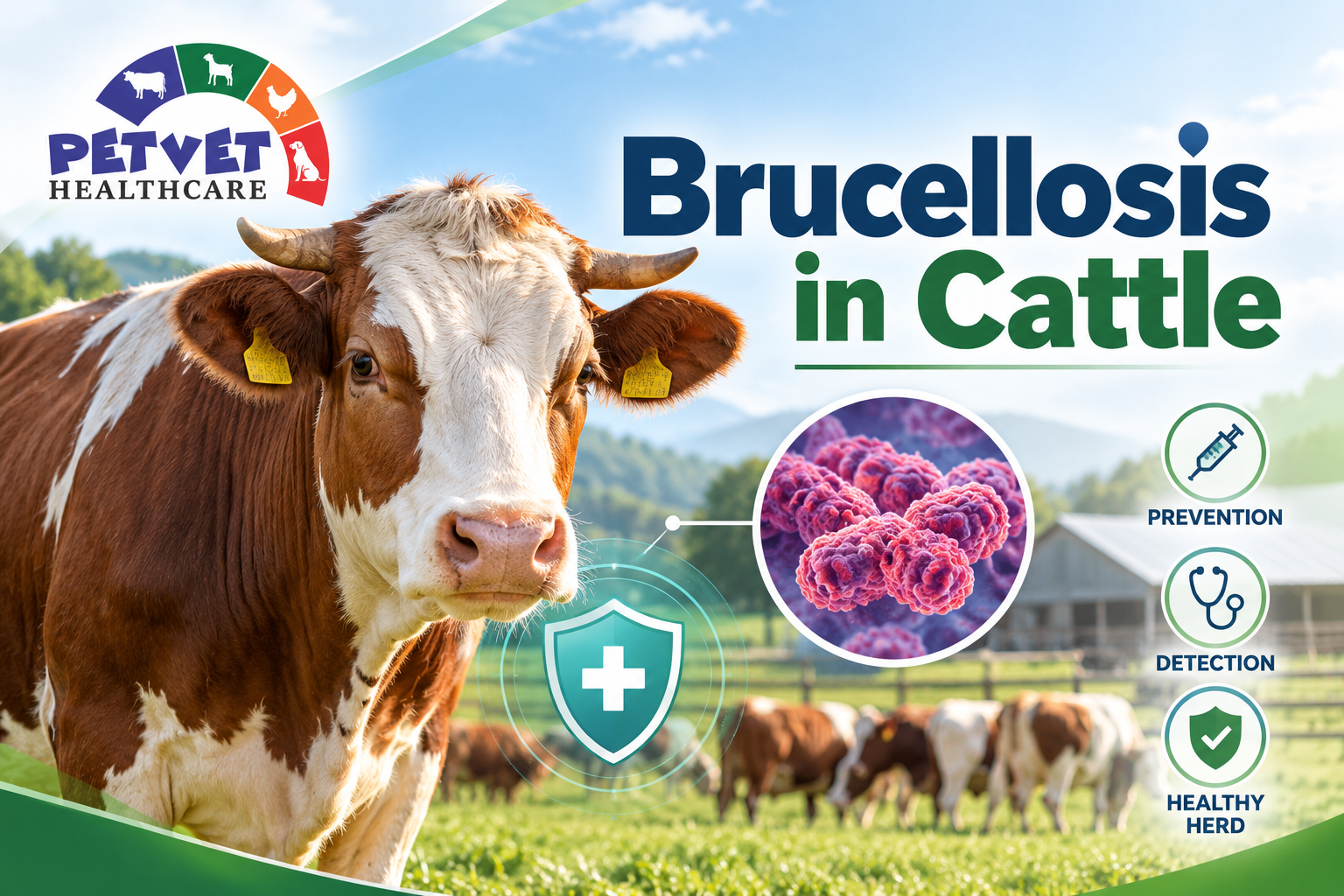
Brucellosis in cattle is a contagious bacterial disease caused mainly by Brucella abortus. It makes pregnant cows abort, usually in the last three months of pregnancy. It also causes retained placenta, weak calves, infertility and lower milk yield. There is no practical cure, but a one-time S19 vaccine given to female calves at 4–8 months of age prevents most losses.
Brucellosis is also called “contagious abortion” or “Bang’s disease.” It is a zoonotic disease, which means it can pass from animals to people. Humans usually get it from raw milk or by handling an aborted calf, placenta or birth fluids with bare hands.
In India, the disease is common. A 2023 meta-analysis of 69 studies found that about 1 in 6 cattle (16.6%) tested positive. That is why the Government of India includes brucellosis in its free national vaccination programme, the NADCP.
This guide explains, in simple words:
- What causes brucellosis and how it spreads on a farm
- The signs to watch for in cows and bulls
- Which tests confirm it
- Whether cattle can be treated
- The vaccine schedule and how to prevent it
- How it affects humans and how to keep your family safe
Brucellosis in Cattle: Key Facts at a Glance
| Fact | Figure | Source |
|---|---|---|
| Main cause in cattle | Brucella abortus bacteria | MSD Veterinary Manual |
| Positive cattle in India (pooled) | 16.6% (95% CI 13.0–21.1%) | Jaismon et al., Veterinary Quarterly, 2023 |
| Positive buffaloes in India (pooled) | 14.2% | Jaismon et al., 2023 |
| Yearly livestock loss in India | US$3.4 billion (median) | Singh, Dhand & Gill, Preventive Veterinary Medicine, 2015 |
| Share of that loss from cattle and buffalo | 95.6% | Singh et al., 2015 |
| Female calves vaccinated under NADCP (to 2024) | about 4.4 crore | DAHD, Lok Sabha reply, March 2025 |
| Brucella vaccine doses given in 2024 | about 1.6 crore | DAHD, Lok Sabha reply, March 2025 |
| Reported outbreaks in India | 22 (2019) → 15 (2025) | IANS, Aug 2026 |
| New human cases worldwide each year | 1.6–2.1 million | Emerging Infectious Diseases study, via Food Safety News |
| Human incubation period | 1 week to 2 months (usually 2–4 weeks) | WHO fact sheet |
Brucellosis in Cattle Is Caused By: Brucella Bacteria
Brucellosis in cattle is caused almost entirely by Brucella abortus. In countries like India, where cattle often live near goats and sheep, Brucella melitensis can also infect cattle, according to the MSD Veterinary Manual.
| Brucella species | Main host | Risk to humans |
|---|---|---|
| B. abortus | Cattle, buffalo | Yes, through raw milk and birth fluids |
| B. melitensis | Goats, sheep (sometimes cattle) | Highest; most common cause of human disease worldwide (WHO) |
| B. suis | Pigs | Yes |
How Brucellosis Spreads on a Farm
The biggest danger is the aborted calf, placenta and birth fluids. One infected abortion releases huge numbers of bacteria onto the floor, feed and water.
Cattle get infected mainly by:
- Licking an aborted fetus, afterbirth or the genitals of an infected cow
- Eating feed or drinking water soiled with birth fluids
- Calves drinking infected milk
- Artificial insemination with infected semen placed in the uterus
- Buying a new animal that carries the infection without showing signs
The bacteria can survive in cool dung for more than 2 months. In direct sunlight, they die within hours. This is why dark, damp calving areas keep the disease going, while clean, sunny pens help break the chain.
Brucellosis in Cattle Symptoms
The main sign of brucellosis in cattle is abortion in the second half of pregnancy, often followed by retained placenta. Most infected cows look healthy otherwise. They eat normally and may not show fever, which is why the disease spreads quietly.
Signs in Cows and Heifers
- Abortion, usually after the 5th month of pregnancy
- Retained placenta (afterbirth not dropping within 12–24 hours)
- Stillborn or weak calves that die soon after birth
- Uterine infection (metritis) and repeat breeding
- Drop in milk yield
- Swollen knee joints (hygroma) in long-standing cases
An infected cow often aborts only once. Her later calvings may look normal, but she can still shed bacteria in milk and birth fluids. In a newly infected herd, many young animals may abort within weeks. Vets call this an “abortion storm.”
Signs in Bulls
- Swollen, painful testicles (orchitis) or epididymis
- Lower fertility and poor conception in cows he serves
- Bacteria in semen
- Joint swelling in chronic cases
Brucellosis vs Other Causes of Abortion and Retained Placenta
Many problems look similar. Only a lab test can confirm brucellosis, but this table helps you spot the difference.
| Condition | Main sign | Abortion stage | Fever | Spreads to humans? |
|---|---|---|---|---|
| Brucellosis | Abortion, retained placenta | Late (after 5 months) | Usually no | Yes |
| Leptospirosis | Abortion, red urine, milk drop | Mid to late | Sometimes | Yes |
| Milk fever | Weakness, cold ears near calving | Not a cause of abortion | No (low temperature) | No |
| Nutritional deficiency | Retained placenta, weak calves | Any | No | No |
| Mastitis | Swollen udder, clots in milk | Not a cause of abortion | Sometimes | Rarely |
If a cow aborts in late pregnancy, treat it as possible brucellosis until a test says otherwise. For a wider view of herd problems, see our guide to common diseases in dairy cattle.
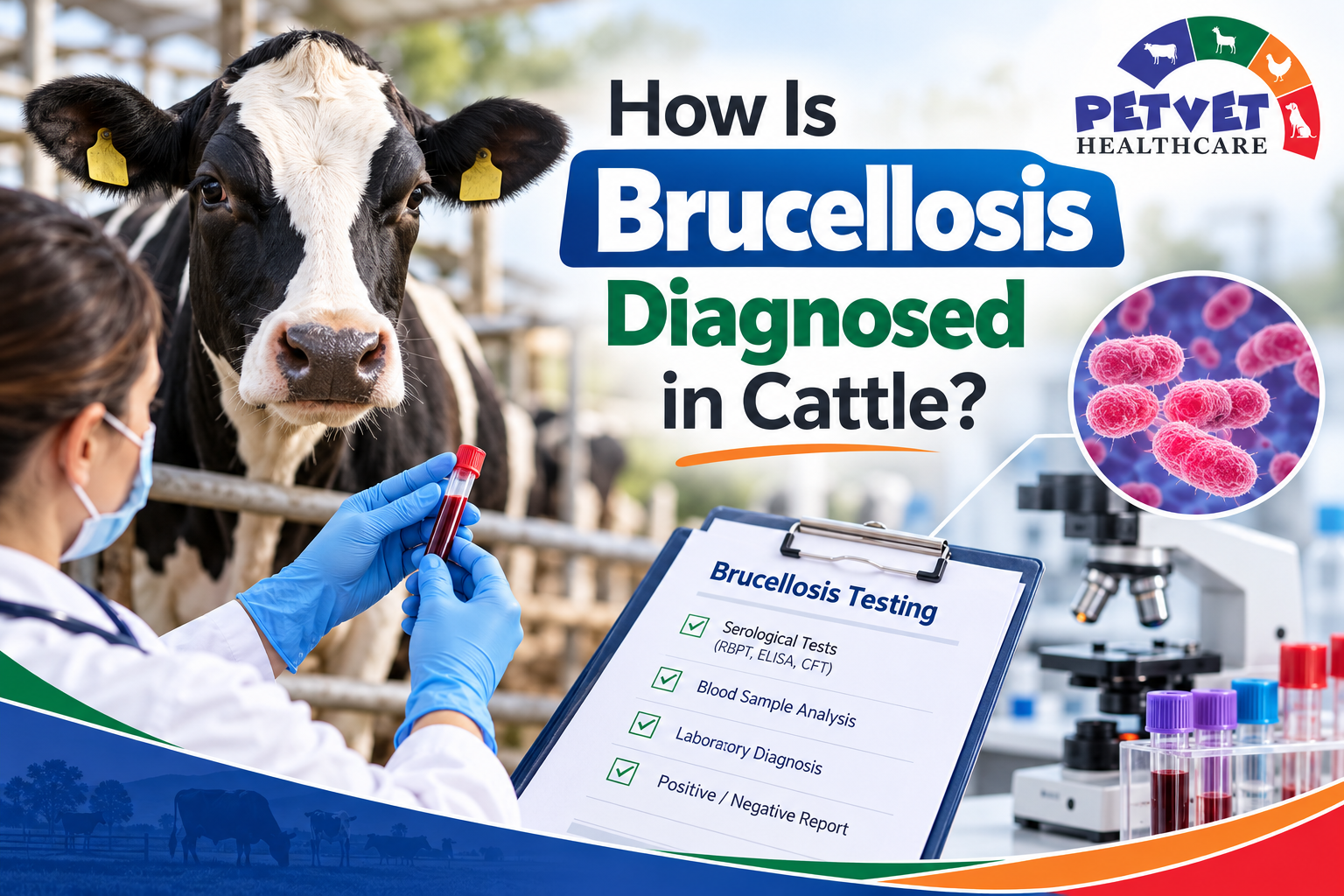
How Is Brucellosis Diagnosed in Cattle?
Brucellosis is confirmed with a blood or milk test, not by signs alone. In India, vets usually screen with the Rose Bengal Plate Test (RBPT) or the Milk Ring Test (MRT), then confirm positive animals with ELISA or another lab test.
| Test | Sample | What it is used for | Speed |
|---|---|---|---|
| Rose Bengal Plate Test (RBPT) | Blood serum | Quick field screening of individual animals | Minutes |
| Milk Ring Test (MRT) | Bulk tank or individual milk | Screening a whole dairy herd | About 1 hour |
| Serum Agglutination Test (SAT/STAT) | Blood serum | Measuring antibody level (titre) | Same day |
| Indirect ELISA | Serum or milk | Confirming results; more sensitive | 1–2 days in lab |
| Culture / PCR | Aborted fetus, placenta, milk | Finding the bacteria itself | Several days |
Two practical points for farmers:
- Screening tests can give false positives. The MSD Veterinary Manual notes that a positive milk ring test should be followed by individual blood tests.
- S19-vaccinated animals can test positive for years. Tell your vet which animals were vaccinated so results are read correctly.
When a cow aborts, do not bury or throw the fetus right away. Call your vet or the nearest government veterinary hospital. The fetus and placenta are the best samples for confirming the cause.
Brucellosis in Cattle Treatment: Is There a Cure?
There is no practical or reliable treatment for brucellosis in cattle. The bacteria hide inside cells, in the udder and lymph nodes, where antibiotics cannot clear them fully. Both the MSD Veterinary Manual and India’s Department of Animal Husbandry & Dairying say there is no effective treatment, and control relies on testing and vaccination.
An animal treated with antibiotics may look better, but it often stays a carrier. It can keep shedding bacteria in milk and at the next calving. Treatment also puts antibiotic residues in milk and adds to antimicrobial resistance.
What to Do If a Cow Tests Positive
In many countries, positive animals are culled. In India, where culling cattle is often not an option, the safer approach is test, separate and protect:
- Isolate the positive animal in a separate shed, away from pregnant cows and calves.
- Do not use her milk raw. Boil it well or discard it.
- Mark her as not for breeding, or for calving only in an isolated pen.
- Test the rest of the herd with RBPT or MRT, then repeat every 3–6 months.
- Vaccinate all female calves aged 4–8 months (see the next section).
- Support the whole herd with balanced minerals, deworming and good hygiene, so other infections do not pile on.
Supportive care helps cows that have aborted recover their body condition. Your vet may treat a uterine infection after abortion. That treats the secondary problem, not brucellosis itself. Always follow the withdrawal period before selling milk from a treated cow.
Brucellosis in Cattle Vaccine: S19 Schedule Under NADCP
Yes, you can vaccinate cattle against brucellosis. In India, female calves of cows and buffaloes get one dose of Brucella S19 vaccine between 4 and 8 months of age. This single shot gives long-lasting protection. It is free under the National Animal Disease Control Programme (NADCP).
NADCP at a Glance
- Launched: September 2019 by the Prime Minister
- Diseases covered: Foot and Mouth Disease and brucellosis
- Who gets the brucellosis vaccine: 100% of female bovine calves, 4–8 months old
- Doses: once in a lifetime
- Cost to farmer: nil (100% centrally funded for states and UTs)
- Progress: about 4.4 crore female calves vaccinated, including about 1.6 crore doses in 2024 (DAHD Lok Sabha reply, March 2025)
From FY 2026–27, NADCP sits under the umbrella Livestock Health and Disease Control Programme, as per IANS. Ask your local veterinary hospital or the vaccinator visiting your village for the next round.
S19 vs RB51: Brucellosis Vaccines Compared
| Feature | S19 (Strain 19) | RB51 |
|---|---|---|
| Type | Live, weakened B. abortus | Live, weakened B. abortus (rough strain) |
| Used in | India (NADCP) and many other countries | Mainly the United States |
| Given to | Female calves, 4–8 months | Female calves |
| Doses | One | One |
| Effect on blood tests | Can cause positive results for years | Does not react in most standard tests |
| Protection | Good, but not 100% | Good, but not 100% |
Source: MSD Veterinary Manual.
Vaccine Do’s and Don’ts
- Vaccinate female calves only, inside the 4–8 month window.
- Do not vaccinate pregnant animals or bulls with S19 unless your vet advises it.
- Keep a record or ear-tag note of every vaccinated calf. This helps your vet read later test results.
- S19 is a live vaccine that can infect people. Vaccinators should wear gloves and avoid needle-stick injuries.
- No vaccine is 100% protective. Combine vaccination with hygiene and testing.
Brucellosis is only one part of a full herd plan. See our vaccination schedule for cattle in India for FMD, HS, BQ and LSD timings.
How to Prevent Brucellosis in Cattle: 10-Step Farm Checklist
To prevent brucellosis in cattle, vaccinate every female calf at 4–8 months, test new animals before mixing them with the herd, and handle all abortions and afterbirths with gloves and safe disposal. These three habits stop most new infections.
- Vaccinate female calves at 4–8 months under NADCP. Keep a written record.
- Buy from tested herds. Ask for a recent negative RBPT or ELISA report.
- Quarantine new animals for about 30 days, then retest before mixing. The MSD Veterinary Manual calls replacement animals the biggest risk.
- Use a separate calving pen. Clean and disinfect it after every calving.
- Handle abortions safely. Wear gloves and a mask, put the fetus and placenta in a sealed bag, and call your vet for testing. Then bury it deep with lime or burn it.
- Disinfect the area where an abortion happened. Let sunlight reach the floor where possible.
- Use certified AI semen from tested bulls, or test your breeding bull every 6 months.
- Screen the herd with the Milk Ring Test every 3–6 months in dairy herds.
- Keep goats and sheep separate from cattle, especially at calving time.
- Keep animals strong. Balanced feed, mineral mixture, timely deworming and clean water support immunity.
The same hygiene habits also cut the risk of other herd diseases, such as Haemorrhagic Septicaemia and Lumpy Skin Disease.
Brucellosis in Humans: The Risk From Cattle
Brucellosis in humans is a bacterial infection caught from animals. It causes long-lasting or repeating fever, weakness, joint pain and weight loss. People get it mainly by drinking raw milk or by touching birth fluids, an aborted fetus or a placenta from an infected animal, says the World Health Organization. It rarely spreads from person to person.
The global burden is bigger than once thought. A study in Emerging Infectious Diseases estimated 1.6 to 2.1 million new human cases every year, with Asia and Africa carrying most of the risk (Food Safety News).
Who Is Most at Risk?
| Group | How they get exposed |
|---|---|
| Dairy farmers and family members | Helping with calving, handling aborted fetuses, drinking raw milk |
| Veterinarians and para-vets | Pulling retained placenta, giving S19 vaccine |
| Milk collectors and sweet makers | Handling or tasting raw milk and fresh cheese (paneer) |
| Butchers and slaughterhouse workers | Contact with blood and organs |
| Lab staff | Working with Brucella samples |
Common Symptoms in People
- Fever that comes and goes, often in the evening (“undulant fever”)
- Heavy sweating, tiredness and headache
- Back pain and joint pain
- Weight loss and loss of appetite
Symptoms usually start 2–4 weeks after exposure, but can take up to 2 months. People with these signs who work with cattle should see a doctor and mention their animal contact. Human brucellosis is treated by a doctor with a long course of antibiotics, often 6 weeks (WHO). Never self-medicate.
How to Protect Your Family
- Always boil or pasteurize milk before drinking or making paneer, curd or khoa.
- Wear gloves, a mask and boots during calving or when handling an abortion.
- Wash hands and arms with soap after any contact with birth fluids.
- Keep children away from aborted fetuses and afterbirths.
- Cover cuts and wounds before working with animals.
What Brucellosis Means for a Typical Indian Dairy Farm
Brucellosis rarely kills cattle, but it quietly drains income through lost calves, empty cows and lower milk. Here is our own simple analysis using published Indian data.
Our Analysis: A 20-Cow Herd
Method: we applied the pooled Indian cattle prevalence (16.6%, Jaismon et al., 2023) and the national loss estimate (Singh et al., 2015) to a herd of 20 unvaccinated cows. These are averages, so a real farm can be far better or worse.
| Measure | Calculation | Result |
|---|---|---|
| Cows likely to test positive | 20 × 16.6% | about 3 cows |
| Average loss per cattle per year (national) | Singh et al., 2015 | US$6.8 |
| Average loss per buffalo per year (national) | Singh et al., 2015 | US$18.2 |
| Herd-level loss if the herd mirrors the national average | 20 × US$6.8 | about US$136 per year |
The national average hides the real shock. On an infected farm, the loss is concentrated in a few cows. Each abortion means no calf, a long dry gap, extra vet bills and often a cow that will not conceive again. Buffalo losses per animal are almost 3 times higher than cattle, which matters for buffalo-heavy states such as Haryana, Punjab and Uttar Pradesh.
Practical Example: How a Farmer Should Respond
Illustrative scenario, not a real farm. A dairy farmer near Ambala has 15 cows. Two cows abort in their 7th month within a month, and one keeps her afterbirth for two days.
- Day 1: He wears gloves, bags both fetuses and calls the government vet. The cows go to an isolated shed.
- Week 1: RBPT on all 15 cows shows 3 positive animals. ELISA confirms 2.
- Month 1: Milk from positive cows is boiled or kept off the market. The calving area is cleaned and disinfected.
- Next NADCP round: All 4 female calves aged 4–8 months get the S19 vaccine.
- Every 6 months: The herd is retested. New cows are bought only with a negative report and kept apart for 30 days.
The result: the infection stays with the known carriers instead of spreading, and the next generation of heifers is protected.
How PetVet Healthcare Supports Herd Health
No feed supplement or medicine cures brucellosis. That job belongs to vaccination, testing and hygiene. What a farm can do is keep its cows strong, so they recover better after an abortion and resist other infections.
PetVet Healthcare is a WHO-GMP certified veterinary medicine manufacturer based in Ambala Cantt, Haryana. Since 2019, we have made products that support everyday herd health:
- Mineral mixtures and calcium supplements to support fertility and reduce retained placenta linked to poor nutrition. See calcium deficiency in livestock.
- Liver tonics and multivitamins to help cows regain appetite and body condition after a difficult calving or abortion.
- Boluses and veterinary injections, used under a vet’s advice, for secondary uterine infections.
Browse the full PetVet product list, or read how to increase milk yield in dairy cattle once your herd is back on track.
For distributors and brands: if you serve dairy farmers in your district, explore our veterinary PCD pharma franchise or third-party veterinary manufacturing. Call +91 86074 15111 or contact us.
Frequently Asked Questions About Brucellosis in Cattle
Can cattle recover from brucellosis?
Cattle rarely clear brucellosis completely. Many infected cows look healthy again after an abortion and may calve normally later, but they usually stay carriers. They can keep shedding Brucella bacteria in milk and birth fluids for life. That is why positive animals should be isolated and the herd protected by vaccination and regular testing.
What are the signs of brucellosis in cattle?
The main signs of brucellosis in cattle are abortion after the 5th month of pregnancy, retained placenta, weak or stillborn calves, repeat breeding and lower milk yield. Bulls may show swollen testicles and poor fertility. Most infected animals have no fever and eat normally, so only a blood or milk test can confirm the disease.
Can you vaccinate cattle against brucellosis?
Yes. Female calves of cattle and buffaloes should get one dose of Brucella S19 vaccine between 4 and 8 months of age. In India, this vaccine is given free under the National Animal Disease Control Programme. One dose protects for life, though not 100%, so hygiene and testing are still needed.
Can humans get brucellosis from cattle?
Yes. Brucellosis is a zoonotic disease. People get it mainly by drinking raw milk or eating fresh cheese from infected animals, or by handling aborted fetuses, placentas and birth fluids without gloves. Farmers, vets and milk handlers face the highest risk. Boiling milk and wearing gloves during calving greatly lower that risk.
Is milk from a brucellosis-positive cow safe to drink?
Raw milk from a positive cow is not safe, because the bacteria are shed in milk. Properly boiled or pasteurized milk is considered safe, as heat kills Brucella. Never use raw milk from a positive or untested cow for drinking or for making paneer, curd or khoa.
What is the treatment for brucellosis in cattle?
There is no practical treatment for brucellosis in cattle. Antibiotics may reduce signs, but the bacteria hide inside cells and the animal usually stays a carrier. Control relies on vaccinating female calves, testing the herd, isolating positive animals and handling abortions safely. A vet can still treat related problems, such as uterine infection after abortion.
Why does an S19-vaccinated cow test positive?
The S19 vaccine makes the calf produce antibodies, and some standard blood tests cannot tell vaccine antibodies from infection antibodies. These can last for years. Always tell your vet which animals were vaccinated and when. The vet may then use a confirmatory test, such as ELISA, to read the result correctly.
How long does it take for brucellosis symptoms to appear in cattle?
The time varies. A cow infected early in pregnancy may take longer to abort than one infected later, according to the MSD Veterinary Manual. Many infected animals never show clear signs at all. Regular herd testing every 3–6 months is the only reliable way to catch silent carriers early.
Sources and References
- Brucellosis in Cattle — MSD Veterinary Manual
- Jaismon P A et al. Prevalence of bovine brucellosis in India: a meta-analysis. Veterinary Quarterly, 2023
- Singh B B, Dhand N K, Gill J P S. Economic losses occurring due to brucellosis in Indian livestock populations. Preventive Veterinary Medicine, 2015
- National Animal Disease Control Programme — Department of Animal Husbandry & Dairying
- DAHD reply to Lok Sabha Unstarred Question No. 2818, March 2025
- Brucellosis fact sheet — World Health Organization
- Estimates suggest more Brucella cases than previously suspected — Food Safety News, 2023
- NADCP contributing to a more disease-secure livestock sector — IANS, August 2026