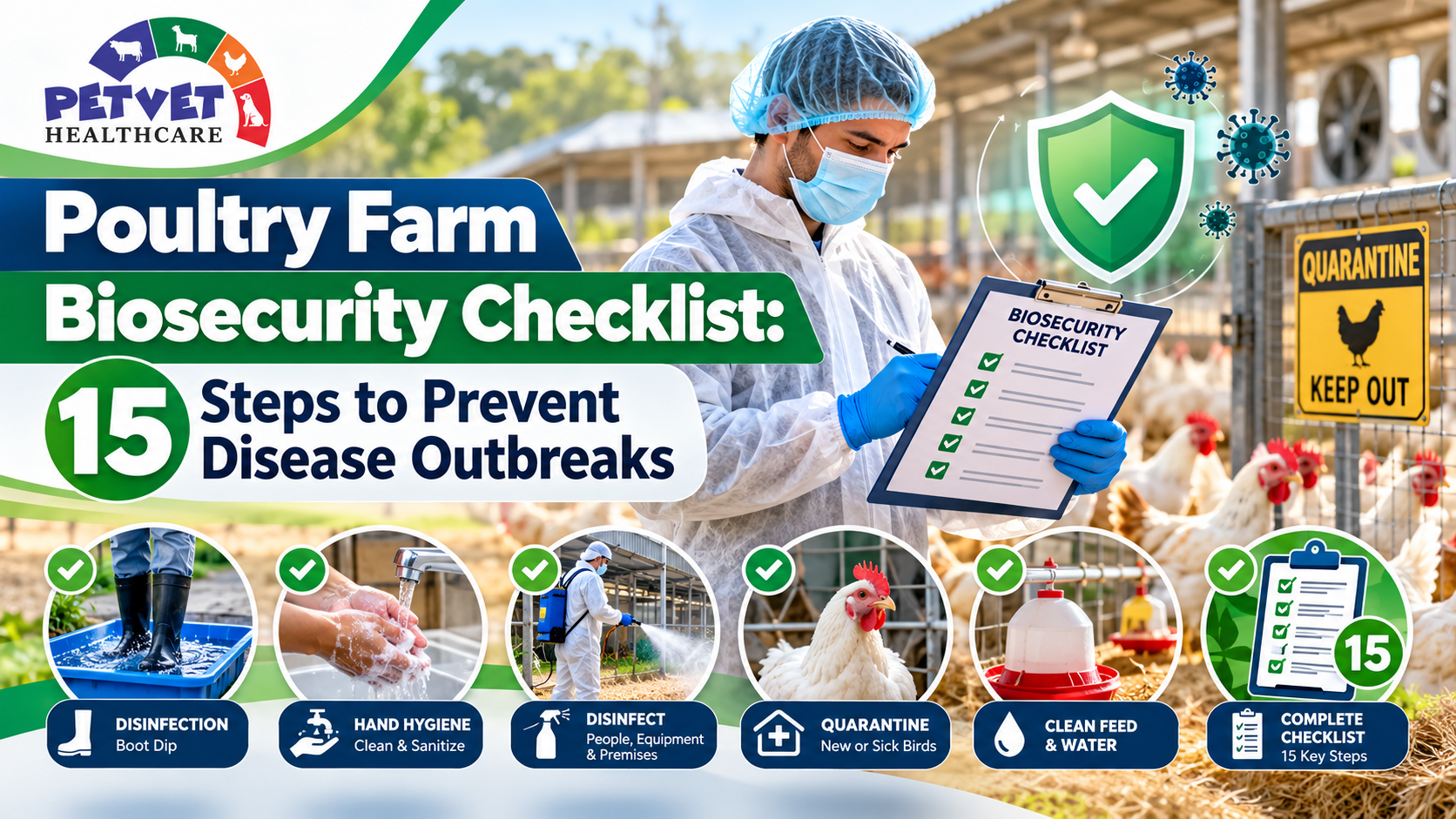
A poultry farm biosecurity checklist is a list of daily habits that keeps disease germs out of your farm and stops them from spreading inside it. The core steps are: control who and what enters, keep clean and dirty areas apart, clean and disinfect between flocks, keep out wild birds and rodents, give clean water and feed, quarantine new birds, dispose of dead birds safely, and keep records. Use the 15-step list below.
What Is Biosecurity in Poultry Farming?
Biosecurity means management steps that stop disease-causing germs from getting onto your farm, or moving from one shed to another.
The FAO explains it has two parts:
- Bio-exclusion: keep germs out of a clean farm
- Bio-containment: stop germs from leaving an infected farm
The Teagasc (Ireland) poultry guide adds a useful tip: judge biosecurity from the bird’s point of view and follow it every day, not only after an outbreak.
Why Is Biosecurity Important in Poultry Farming?
The importance of biosecurity in poultry farming is simple: prevention costs far less than a disease outbreak. Here is the Indian picture:
- India produced 142.77 billion eggs and 10.25 million tonnes of meat in 2023-24 (Basic Animal Husbandry Statistics 2024). A large, busy sector means more movement of birds, feed and people, and more chances for disease to spread.
- In a 2026 study of 39 broiler farms in Gujarat, all farms reported outbreaks. The most common were colibacillosis (92.3%), avian influenza (64.1%) and infectious bursal disease (48.7%) (Joshi et al., Frontiers in Veterinary Science). The sample is small and the data are self-reported, but the pattern is clear.
- The same study found that 79.49% of farmers were unaware of antimicrobial resistance (AMR) risks. Good biosecurity means fewer sick birds, and fewer sick birds means less medicine.
- Government guidance was written because of real losses. India’s Department of Animal Husbandry and Dairying (DAHD) issued biosecurity guidelines in 2015 after avian influenza hit two Central Poultry Development Organizations.
Types of Biosecurity in Poultry Farm
The Teagasc guide groups biosecurity into three levels. Some other guides use only two (structural and operational).
| Type | What it covers | Cost to change later |
|---|---|---|
| Conceptual | Where you build: distance from other farms, wind, water, wild bird routes, roads | Very high |
| Structural | Shed design, fencing, layout, easy-to-clean floors | High |
| Operational | Daily habits: entry rules, disinfection, water hygiene, records | Low |
What this means for you: If your farm is already built, operational biosecurity is where you can improve the fastest and cheapest.
What Are the 5 Major Components of Biosecurity?
Different sources give different numbers. The FAO names 3 core parts (isolation, traffic control, sanitation). A university extension guide adds pest control as a 4th. A practical way to remember it is a five-part grouping (our simple summary, not an official list):
| # | Component | Simple meaning |
|---|---|---|
| 1 | Isolation | Fence, buffer zone, quarantine for new birds |
| 2 | Traffic control | Control people, vehicles and equipment |
| 3 | Sanitation | Clean first, then disinfect |
| 4 | Pest and wild bird control | Keep out rodents, wild birds, pets |
| 5 | Health monitoring | Vaccination, daily checks, records, reporting |
The 15-Step Poultry Farm Biosecurity Checklist
These poultry farm biosecurity measures are grouped in five parts. Many figures below come from India’s DAHD biosecurity guidelines (2015). They were written for Central Poultry Development Organizations, but the principles apply to private farms too. Adjust for your farm size with your vet.
Part A: Location and Layout
☐ 1. Choose and secure the site Keep the farm away from water bodies and at least 1–2 km from other commercial facilities (DAHD). Build a boundary wall or fence. Remove tall trees and roosting spots that attract wild birds.
☐ 2. Plan the farm layout Place brooder sheds nearest the entry, then growers, then adult birds. Keep sheds of the same type about 30 ft apart and different types about 100 ft apart (DAHD). Use concrete floors and roads, and fix drains so water does not pool.
Part B: People, Vehicles and Equipment
☐ 3. Use one controlled entry and a visitor log Allow only essential people. Note name, date and where they came from. The Teagasc guide advises refusing entry if a visit could risk bird health.
☐ 4. Stop farm-to-farm spread Do not let anyone visit two farms within 24 hours. If unavoidable, they must shower and change first (DAHD).
☐ 5. Set up foot dips, handwash and dedicated footwear Keep sheds locked and give each shed its own boots. Renew foot dips and wheel dips daily. DAHD mentions a 50:50 mix of lime powder and bleaching powder for foot dips. Wash hands with soap before and after entering each shed.
☐ 6. Control vehicles Clean and disinfect vehicles before they enter. Keep drivers out of sheds. Feed trucks should serve younger flocks before older ones (DAHD). Warning: In the Gujarat study, 53.85% of farms had no vehicle sanitation at the gate, and only 31% restricted vehicle entry.
☐ 7. Keep clean and dirty zones apart Use red (dirty), amber (changing) and green (clean) zones, as the Teagasc guide describes. Do clean jobs first (feeding, egg collection). Do dirty jobs last (dead birds, manure). Change clothes and boots between them.
Part C: Keeping Pests and New Germs Out
☐ 8. Keep out wild birds, rodents and pets Use bird-proof nets, cover open drains, seal feed stores, clean up spilled feed fast, and keep dogs, cats and backyard birds away. Wild birds, especially migratory waterfowl, can carry avian influenza (Teagasc). In Gujarat, only 71.79% of farms had rodent-proof storerooms.
☐ 9. Quarantine new birds and supplies Isolate new birds for 21 days and test them before mixing. Keep new birds out of a previously infected house for at least 3 weeks after cleanout. DAHD also advises holding farm materials, drugs and vaccines in quarantine for 10 days.
☐ 10. Run all-in, all-out Fill and empty a shed together. Do not mix ages. FAO guidance says all-in, all-out lets you empty, clean and disinfect the whole shed between flocks.
Part D: Cleaning, Water and Feed
☐ 11. Clean first, then disinfect, then rest the shed Remove litter, manure and feed first, because disinfectant does not work through dirt (DAHD, Teagasc). Then wash, disinfect and dry. DAHD advises keeping the shed empty for at least 10 days. The Gujarat study used a 21-day benchmark, and only 41% of farms met it. Ask your vet for the right gap for your farm.
☐ 12. Give clean water Clean drinkers twice a day. Do not store water in tanks for more than a day, and test water regularly (DAHD). In Gujarat, 72% of farms used a water sanitizer.
☐ 13. Store feed safely Keep feed dry, covered and off the floor. Close the store to rodents and birds. DAHD also advises regular checks for mycotoxins and toxic feed parts. The Anitox checklist reminds us that feed itself can carry germs like Salmonella.
Part E: Waste, Health and Records
☐ 14. Handle dead birds and manure safely Remove dead birds at once. DAHD lists rendering, burial or incineration. Leave poultry manure undisturbed for at least 90 days before using it as fertilizer. In Gujarat, 97% of farms used burial alone. Researchers urge safer options like sealed storage or incineration.
☐ 15. Watch, vaccinate, record and report Count daily deaths and note feed and water intake. Follow your vaccine plan. Isolate sick birds, and report unusual deaths immediately. DAHD advises stopping the movement of birds, products and feed while a disease is suspected. Train every worker. In Gujarat, 61.54% of farmers had never had formal biosecurity training.
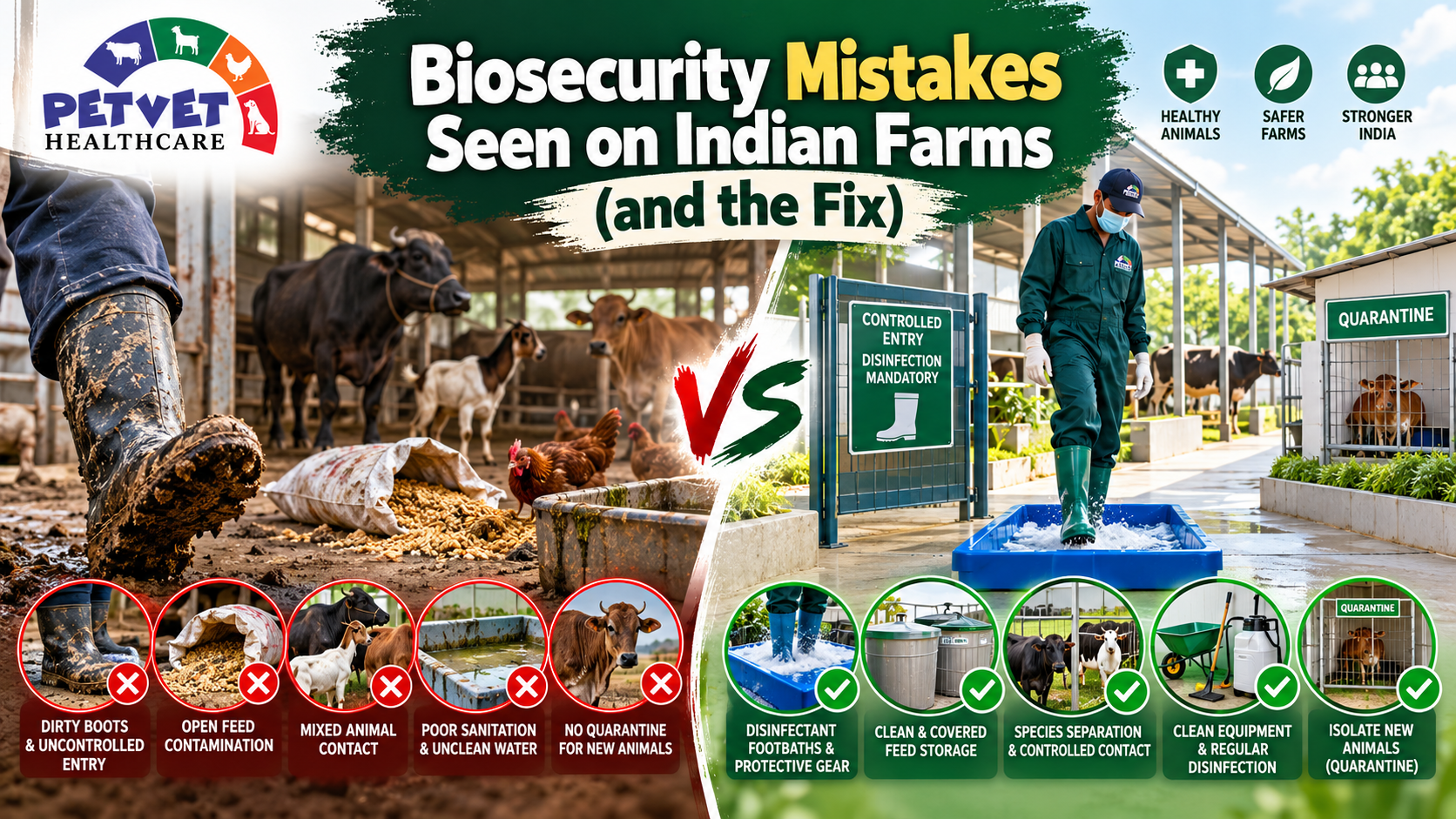
Biosecurity Mistakes Seen on Indian Farms (and the Fix)
| Common gap (Gujarat, n = 39) | Number | Simple fix |
|---|---|---|
| No vehicle sanitation at the gate | 53.85% of farms | Build a wheel dip or spray bay at the entry |
| Visitors not restricted | 56% restricted (so about 44% did not) | One gate, one log, one rule for all |
| Sheds not empty for the 21-day benchmark | 41% met it | Plan the next batch around downtime |
| Poor manure storage | 21% did it properly | Use covered storage |
| Carcass burial only | 97% | Add sealed pits or incineration |
| No formal training | 61.54% | Hold a short monthly worker briefing |
| Unaware of AMR | 79.49% | Use medicines only on vet advice |
Source: Joshi et al. (2026). Small sample, self-reported, one region. Use it as a guide, not a national average.
Biosecurity vs Vaccination vs Medicine
| Biosecurity | Vaccination | Medicine | |
|---|---|---|---|
| Goal | Keep germs out | Prepare the bird’s body | Treat sick birds |
| When | Every day | On a vet’s schedule | After illness starts |
| Cost | Low to moderate | Moderate | Often highest |
| Weak point | Needs discipline | Does not cover every germ | Cannot undo big damage |
Vaccines and medicines work best on top of good biosecurity, not instead of it.
Disinfection Quick Guide
- Always clean first. Disinfectants fail on dirt.
- DAHD lists chlorine dioxide and peracetic acid among approved disinfectants. Other agents it mentions include sodium hydroxide, sodium carbonate, citric acid, cresolic compounds and synthetic phenols.
- Follow the label for strength and contact time. Never mix disinfectants.
- Soak vehicles in cleaning product for 15–30 minutes before rinsing and disinfecting (DAHD).
- Wash hands with soap for about 10 minutes of contact time (DAHD).
Where Medicine and Supplements Fit In
Biosecurity comes first. But well-fed, low-stress birds cope better when germs do get in. DAHD guidelines mention vitamins, trace minerals and protein supplements to support immunity, and anti-stress support in hot weather and after procedures like de-beaking.
Also, as the Gujarat researchers note, farmers should use antibiotics only on a vet’s advice. The best way to use less medicine is to have fewer outbreaks.
How PetVet Healthcare Supports Your Poultry Farm
PetVet Healthcare (Granmed Pharma Pvt. Ltd.), a WHO-GMP certified veterinary medicine manufacturer in Ambala Cantt, Haryana, offers supportive products for poultry and livestock. From our product list:
| Need | PetVet product | What it is |
|---|---|---|
| B-vitamin support | PV PLEX | B-complex with L-lysine liquid |
| General vitamin support | GRATONE-H | Multivitamin tonic for livestock and poultry |
| Kidney and urinary support | GRIPSY VET | Urinary kidney tonic [CONFIRM poultry use and label claims] |
Please note: Biosecurity is a management system, not a bottle. No product replaces fences, foot dips, clean water, vaccines or a vet visit. PetVet’s range supports bird health alongside these steps. [CONFIRM: all product details against approved labels before publishing. PetVet’s current list does not show poultry disinfectants, water sanitizers or toxin binders.]
For vets, dealers and companies: See the full PetVet product list, the veterinary PCD pharma franchise and third-party veterinary medicine manufacturing if you want to build a poultry range under your own brand. To enquire, contact PetVet on +91 86074 15111 email: petvetindia@gmail.com and petvethealthcare@gmail.com].
Daily, Weekly and Per-Flock Routine
| When | Do this |
|---|---|
| Daily | Renew foot dips; clean drinkers; count and remove dead birds; check feed and water intake; log visitors |
| Weekly | Check fences, nets and rodent bait points; clean feed store; review records |
| Every flock | Quarantine new birds; clean, disinfect and rest the shed; fix repairs; brief workers |
| Every season | Review vaccine plan with your vet; prepare for the monsoon and migratory bird season |
When to Call a Poultry Vet Right Away
- A sudden jump in deaths
- Birds with swollen heads, blue combs or breathing trouble
- A big drop in feed intake or egg production
- Diarrhoea across many birds
- Any unusual signs after introducing new birds
Frequently Asked Questions
What is the importance of biosecurity?
Biosecurity protects your birds, your income and public health. It stops germs from entering or spreading on your farm, so you see fewer outbreaks, lower deaths and less medicine use. In a 2026 Gujarat study, every surveyed broiler farm had reported disease outbreaks, which shows how common the risk is.
What is biosecurity in poultry farming?
Biosecurity in poultry farming means daily management steps that keep disease germs out of the farm and stop their spread between sheds. It includes controlling visitors and vehicles, cleaning and disinfecting, keeping out wild birds and rodents, quarantining new birds, giving clean water and feed, and safely removing dead birds.
What are the 5 major components of biosecurity?
Sources vary, with the FAO naming three (isolation, traffic control, sanitation) and some adding pest control. A practical five-part view is: isolation, traffic control, sanitation, pest and wild bird control, and health monitoring with vaccination and records. Use whichever list your vet or state guideline follows.
What are the three types of biosecurity?
The three types are conceptual, structural and operational. Conceptual means where the farm is placed, structural means shed design and fencing, and operational means daily habits like disinfection, entry rules and water hygiene. Operational biosecurity is the easiest and cheapest to improve on an existing farm.
How long should a poultry shed stay empty between flocks?
India’s DAHD guidelines advise at least 10 days empty after cleaning, fumigation and disinfection. A Gujarat broiler study used a 21-day benchmark, and only 41% of farms met it. Longer gaps cut disease carry-over, so ask your vet what suits your birds, climate and past disease history.
Do small farms need a biosecurity plan too?
Yes. Small farms often have fewer barriers, such as shared tools and open sheds, so germs can enter easily. Start with the basics: a fence, a foot dip, a visitor rule, clean water, quarantine for new birds and safe disposal of dead birds. These steps are low-cost and protect your flock.
Key Takeaways
- Biosecurity keeps germs out and stops their spread. It works best when done every day.
- The three types are conceptual, structural and operational. Operational is the easiest to improve.
- Use the 15 steps: site, layout, entry, vehicles, zones, pests, quarantine, all-in all-out, cleaning, water, feed, waste and records.
- Indian data show gaps in vehicle control, downtime, waste handling and training.
- Clean first, then disinfect. Disinfectant does not work through dirt.
- Supportive products help bird health but never replace biosecurity, vaccines or a vet.
Related Reading
- PetVet product list and product gallery
- Withdrawal Period of Veterinary Drugs in Milk & Meat
- Haemorrhagic Septicaemia in Cattle & Buffalo
- About PetVet Healthcare
Sources
- Department of Animal Husbandry, Dairying & Fisheries, Government of India (2015). General Guidelines for Biosecurity at Central Poultry Development Organizations. PIB archive (PDF) and WATTPoultry summary
- Joshi B. et al. (2026). Evaluating biosecurity implementation in commercial broiler poultry production in Gujarat. Frontiers in Veterinary Science 12:1699509. Frontiers
- Teagasc. Biosecurity (poultry guide, PDF)
- FAO. Good Biosecurity Practices in Non Integrated Commercial and in Scavenging Production Systems in Tanzania
- eXtension Poultry. Biosecurity for small poultry flocks
- Anitox. Poultry Farm Biosecurity Checklist
- Department of Animal Husbandry & Dairying. Basic Animal Husbandry Statistics 2024, as summarised by Drishti IAS
- PetVet Healthcare. Product list