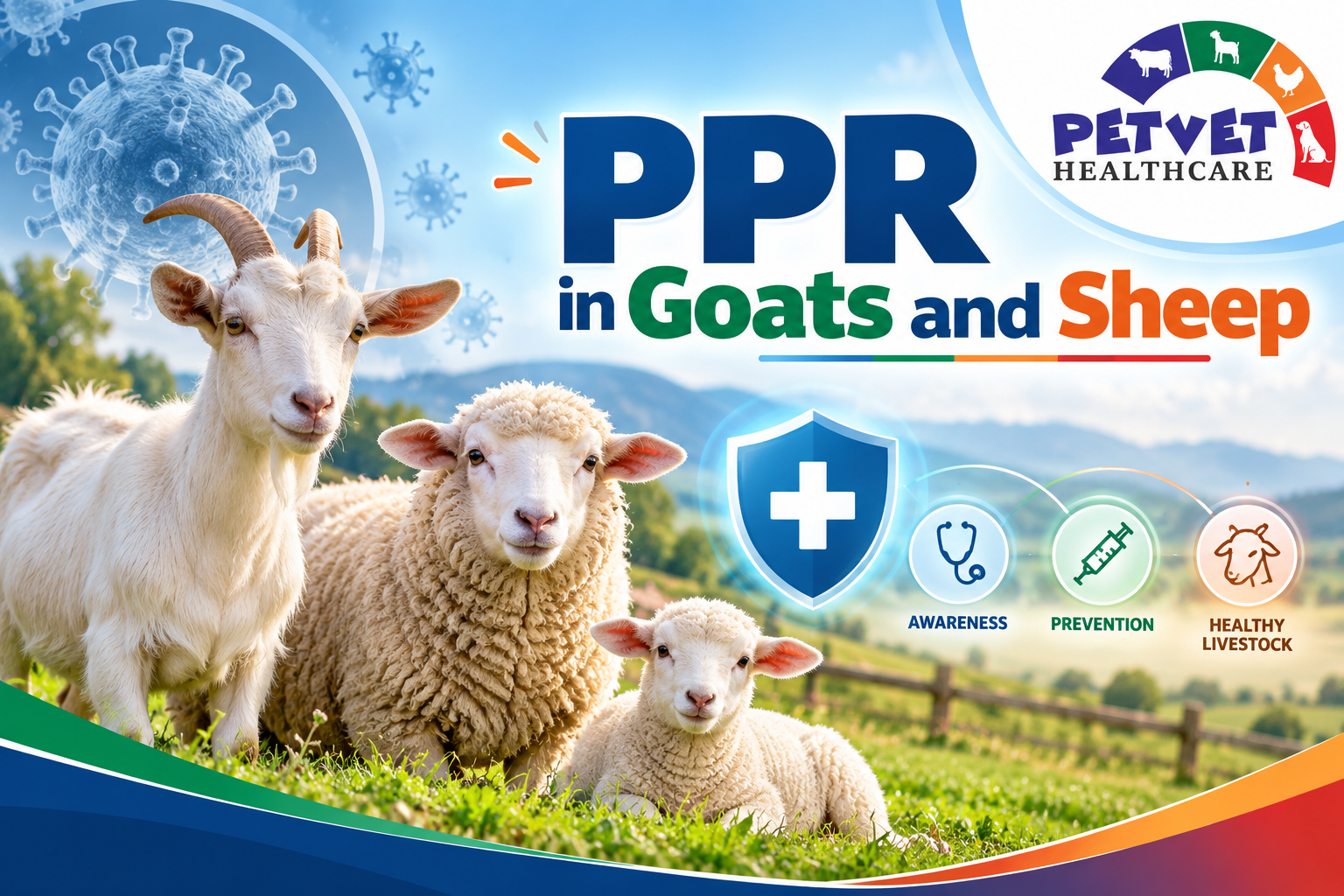
What is PPR in goats and sheep?
PPR (peste des petits ruminants), also called goat plague, is a fast-spreading viral disease of goats and sheep. It causes high fever, nasal discharge, mouth sores, diarrhoea and pneumonia. There is no medicine that kills the virus. A timely vaccine is the only reliable protection.
Goats usually get sicker than sheep. In a flock that has never been vaccinated, the disease can infect up to 90% of animals and kill up to 70% of those infected, according to the FAO.
For India, the stakes are high. The country has about 148.9 million goats and 74.3 million sheep (20th Livestock Census, 2019, via NDDB). Many belong to small and landless farmers, for whom a few goats are the family’s savings.
PPR at a glance
| Fact | Detail |
|---|---|
| Cause | Small ruminant morbillivirus (a virus related to rinderpest) |
| Animals affected | Goats and sheep; goats show more severe signs |
| Incubation period | Usually 4–5 days |
| Death rate | Up to 70% of infected animals (FAO) |
| Specific cure | None — only supportive treatment |
| Prevention | Live attenuated PPR vaccine (Sungri/96 strain in India) |
| Risk to humans | None known |
| Reporting | Notifiable disease — report suspected cases to your veterinary officer |
This guide explains the causes, how to spot symptoms early, what treatment actually helps, and how India plans to eliminate PPR by 2030.
Causes of PPR in goats: how the disease spreads
PPR is caused by the small ruminant morbillivirus, which passes from sick animals to healthy ones through close contact. The virus is present in discharge from the eyes, nose and mouth, and in dung.
The virus is fragile outside the body and does not survive long in sunlight or heat. That is why most outbreaks start when a new, infected animal joins a flock.
Common ways PPR enters a flock
- New animals from markets or fairs — the single biggest risk, especially before festivals when trading rises.
- Shared grazing and water points — nomadic and village flocks mixing together.
- Coughing and sneezing — fine droplets spread the virus between animals kept close together.
- Contaminated items — feed troughs, bedding, water buckets and vehicles used by sick animals.
- People — traders and helpers moving between flocks without washing hands or changing footwear.
Who is most at risk
- Kids and lambs aged 4 months to 1 year, after protection from the mother’s milk fades
- Unvaccinated flocks
- Animals weakened by worms, poor feed or stress from transport
Cattle, buffalo and pigs can be infected without showing signs, but they do not spread the disease (MSD Veterinary Manual). There is no long-term carrier animal, which is why vaccination can wipe the disease out (WOAH).
Symptoms of PPR in goats and sheep
The first sign of PPR is a sudden high fever of 40–41°C (104–106°F), followed within days by watery nose and eye discharge, mouth sores and diarrhoea. Death usually follows 5–10 days after signs begin if the animal is not supported (MSD Veterinary Manual).
How symptoms progress
| Stage | Typical timing | What you see |
|---|---|---|
| Incubation | Day 0–5 after exposure | No signs; the animal can already shed virus |
| Fever stage | Day 1–3 of illness | Fever 40–41°C, dullness, dry muzzle, stops eating |
| Discharge stage | Day 2–4 | Watery nasal and eye discharge that turns thick and pus-like; matted eyelids |
| Mouth sores | Day 3–5 | Grey dead patches and raw sores on gums, lips and tongue; bad smell from the mouth; drooling |
| Gut stage | Day 4–7 | Severe watery diarrhoea, dehydration, fast weight loss |
| Lung stage | Day 5–10 | Cough, laboured breathing, pneumonia; death or slow recovery |
Timings vary by animal age, body condition and how quickly care starts.
Other signs farmers report
- Abortion in pregnant does and ewes
- Crusty scabs around the lips, similar to orf
- Several kids falling sick within a week of each other
- Recovered animals stay weak for weeks and lose market value
When to call a vet: a fever plus nose discharge in more than one goat at the same time. Isolate those animals the same day.
PPR vs similar diseases in goats
PPR is often mistaken for pneumonia, orf or foot-and-mouth disease because the signs overlap. The combination of fever, mouth sores, diarrhoea and cough together points most strongly to PPR. Only a lab test confirms it.
| Disease | Cause | Key difference from PPR | Mouth sores | Diarrhoea |
|---|---|---|---|---|
| PPR | Virus | Fever + discharge + mouth sores + diarrhoea + pneumonia together | Yes, grey dead patches | Yes, severe |
| Contagious caprine pleuropneumonia (CCPP) | Bacteria (Mycoplasma) | Mainly lungs; no mouth sores or diarrhoea | No | No |
| Orf (contagious ecthyma) | Virus | Thick scabs on lips; animal stays alert; few deaths | Scabs on lips | No |
| Foot-and-mouth disease | Virus | Blisters on feet causing lameness | Blisters | Rare |
| Goat pox | Virus | Raised skin nodules all over the body | Sometimes | Rare |
| Haemorrhagic septicaemia / pasteurellosis | Bacteria | Sudden death, throat swelling; often follows PPR as a secondary infection | No | No |
| Coccidiosis / heavy worms | Parasites | Diarrhoea without high fever or mouth sores | No | Yes |
Differential list based on the MSD Veterinary Manual. Worm burden makes PPR worse, so follow a regular deworming schedule for goats and sheep.
How PPR is diagnosed
A vet can suspect PPR from the signs, but confirmation needs a lab test such as RT-PCR or antigen-capture ELISA. These are the preferred confirmatory tests listed by the MSD Veterinary Manual.
- Field check — the vet records fever, mouth lesions, discharge and how many animals are sick.
- Sample collection — eye and nose swabs, mouth scrapings, or blood from live animals; tissue from a dead animal.
- Lab testing — samples go to the state disease diagnostic lab. RT-PCR detects the virus; competitive ELISA detects antibodies and is used to check vaccination coverage.
- Reporting — PPR is a notifiable disease, so a confirmed case triggers ring vaccination by the state animal husbandry department.
Tip: keep a dead animal’s carcass covered and away from other animals until the vet arrives. Do not open it yourself.
PPR in goats treatment in India: what actually helps
There is no antiviral cure for PPR, so treatment means supportive care: controlling secondary infections, replacing lost fluids and keeping the animal eating. Treating these complications early lowers deaths in an affected flock (MSD Veterinary Manual).
All medicines below must be chosen and dosed by a registered veterinarian. Doses depend on the animal’s weight, age and the product.
Supportive treatment plan
| Problem | Why it kills | Supportive care your vet may use |
|---|---|---|
| Secondary bacterial pneumonia | Most PPR deaths come from lung infection | Broad-spectrum antibiotic injection for the full prescribed course |
| Dehydration from diarrhoea | Kids lose water and salts within hours | Oral electrolytes; IV fluids in severe cases |
| Mouth sores | Pain stops the animal from eating | Gentle mouth wash with a mild antiseptic; soft, moist feed |
| Fever and pain | Weakness, refusal of feed | Anti-inflammatory or fever-reducing injection |
| Weakness and slow recovery | Poor immunity, weight loss | Multivitamin, liver tonic and mineral supplements |
| Eye discharge | Crusting and secondary eye infection | Clean eyes with boiled, cooled water; eye ointment if advised |
Nursing care at home
- Isolate sick animals at least 20–30 metres away, in a dry, shaded, draught-free shed.
- Feed soft food such as green fodder, soaked grain gruel and fresh water several times a day.
- Use one person to care for sick animals; wash hands and change footwear after.
- Clean and disinfect the shed, troughs and buckets daily.
- Do not sell or move sick or in-contact animals — this is how PPR spreads village to village.
- Respect withdrawal periods before selling milk or meat from treated animals. See our guide on the withdrawal period of veterinary drugs.
Recovered animals develop strong immunity, but they should still be recorded and the rest of the flock vaccinated.
PPR vaccine for goats and sheep
India uses a live attenuated PPR vaccine based on the Sungri/96 strain, developed by ICAR-IVRI and given to goats and sheep above 4 months of age. The technology has been transferred to public and private makers, including Hester Biosciences and state institutes such as HVVI Hisar and IAH&VB Karnataka (Balamurugan et al., Viruses, 2026).
WOAH notes that efficient PPR vaccines can give long-lasting, even life-long, protection. In practice, follow your state programme or vet on booster timing for new kids and lambs each year.
Vaccine vs treatment: why prevention wins
| Factor | Vaccination | Treatment after infection |
|---|---|---|
| Stops the virus | Yes | No — only supports the animal |
| Protects the whole flock | Yes, when most animals are covered | No |
| Cost | Low; free under the government programme | Medicines, vet visits, plus lost animals |
| Effect on growth and sale | None after mild post-vaccine reaction | Weight loss, weeks of weakness |
| Risk of deaths | Very low | Up to 70% of infected animals (FAO) |
Vaccination checklist for farmers
- Vaccinate all healthy goats and sheep older than 4 months
- Vaccinate new kids and lambs once they cross 4 months
- Deworm 1–2 weeks before vaccination for a better response
- Do not vaccinate animals that are already sick or have fever
- Keep the vaccine cold (2–8°C) and use it soon after mixing
- Vaccinate and quarantine new animals for 2–3 weeks before they join the flock
- Keep a record card with date, batch number and ear tag
If you also keep cattle, see our cattle vaccination schedule in India.
India’s PPR eradication plan: targets and progress
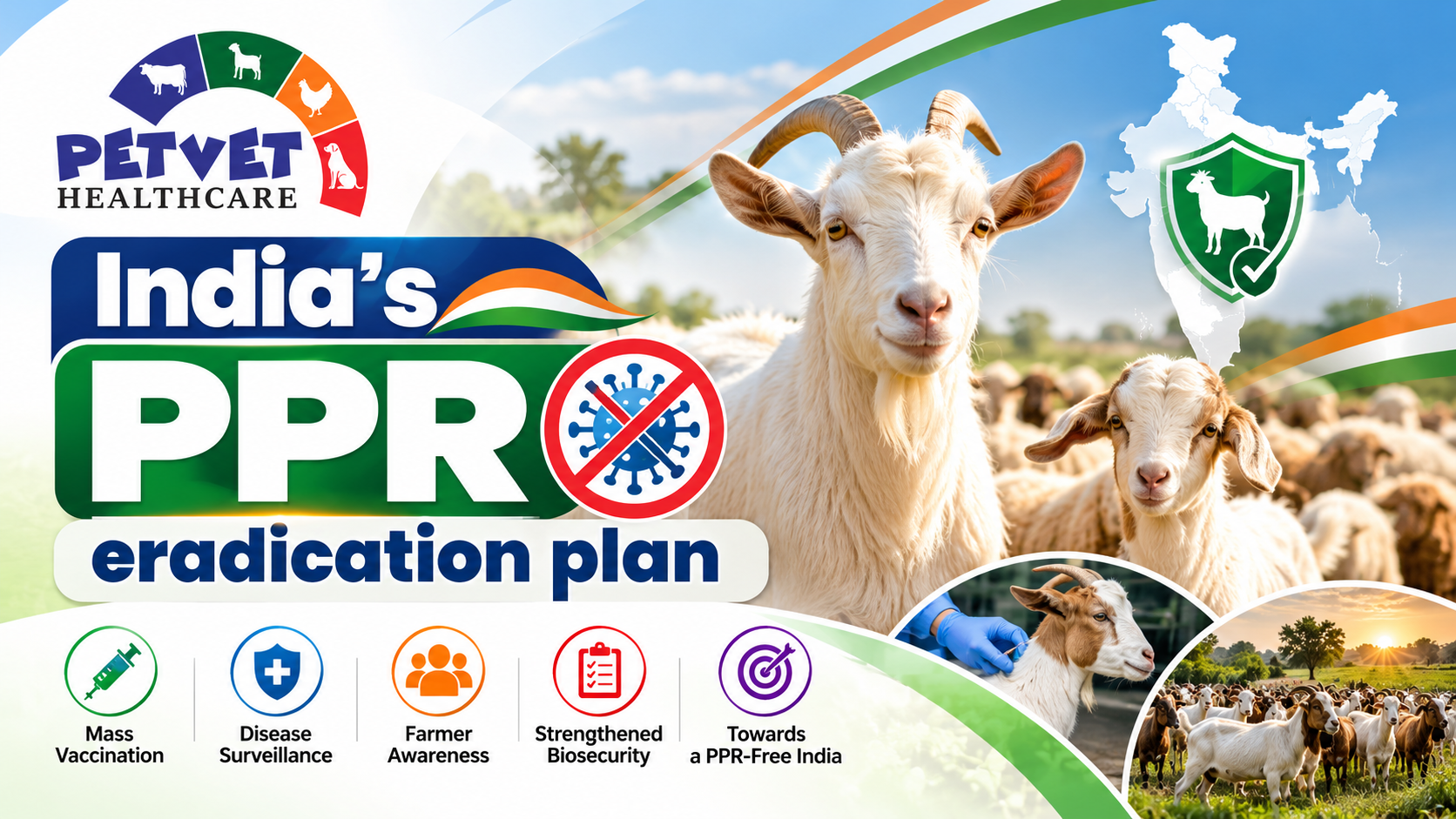
India runs a National PPR Eradication Programme under the Livestock Health and Disease Control scheme, aiming to stop virus transmission by 2028 and eliminate PPR by 2030. The programme, started in 2022–23, uses annual mass vaccination of goats and sheep above 4 months (Balamurugan et al., 2026).
This matches the global goal set by WOAH and FAO to eradicate PPR worldwide by 2030 — the second animal disease after rinderpest to be targeted for eradication.
Key milestones
- 2022–23 — National PPR Eradication Programme launched by the Department of Animal Husbandry and Dairying (DAHD).
- Each year — mass vaccination rounds, followed by blood sampling to check immunity.
- 2028 — target to interrupt PPR virus transmission across India.
- 2030 — target for countrywide elimination, in line with the global strategy.
PPR by the numbers
| Measure | Figure | Source |
|---|---|---|
| Countries affected or at high risk | More than 70 | FAO |
| Share of the world’s sheep and goats at risk | About 80% (~1.7 billion animals) | FAO |
| Global economic loss | Up to USD 2.1 billion a year | FAO |
| Families whose livelihoods are at risk | 300 million | FAO |
| Goats in India | 148.9 million (2019 census) | NDDB |
| Sheep in India | 74.3 million (2019 census) | NDDB |
| Overall seroconversion after Sungri/96 vaccination in India | 69.3% | Viruses, 2026 |
| Epi-units reaching the 70% protection target | 61% after vaccination (22% before) | Viruses, 2026 |
What the latest data tells farmers
The 2026 nationwide study tested 24,542 blood samples from 2,528 epi-units. Protection improved sharply, but about 4 in 10 units are still below the 70% herd-immunity mark.
The gap is mostly about coverage, not the vaccine. Missed kids, animals sold before the vaccinator arrives, and migratory flocks leave pockets of risk. Every farmer who gets the whole flock vaccinated closes that gap.
An earlier ICAR-NIVEDI review linked falling outbreaks in Andhra Pradesh, Telangana, Karnataka and Chhattisgarh to strategic mass vaccination (Balamurugan et al., IJVASR). Track your district’s disease alerts on ICAR-NIVEDI’s NADRES portal.
A practical outbreak response: the first 72 hours
The first three days decide how many animals you lose. Below is an illustrative example of a typical village outbreak and the right response. It is a teaching scenario, not a case record.
Scenario: A farmer with 40 goats buys 5 new goats at a weekly market. Six days later, 3 kids have fever and runny noses. By day 8, two have mouth sores and diarrhoea.
| Time | Action | Why it matters |
|---|---|---|
| Hour 0–6 | Move sick and new animals to a separate shed; stop sharing water and feed | Cuts contact spread to the other 37 animals |
| Hour 6–24 | Call the local veterinary officer; report suspected PPR | Starts sampling and ring vaccination in the village |
| Day 1–2 | Vet starts antibiotic, fluid and fever support for sick animals | Lowers deaths from pneumonia and dehydration |
| Day 1–3 | Healthy, fever-free animals vaccinated as advised by the vet | Builds protection before the virus reaches them |
| Day 1 onward | Daily cleaning; one caretaker for the sick shed; no sale of animals | Stops the outbreak leaving the farm |
| Week 3–4 | Record recovered and vaccinated animals; plan next year’s round | Keeps the flock protected as new kids are born |
The lesson: most outbreaks begin with an unvaccinated new animal. A 2–3 week quarantine for every purchase costs almost nothing. Learn more biosecurity habits in our farm biosecurity checklist — written for poultry, but the entry and hygiene rules apply to goat sheds too.
How PetVet Healthcare supports farmers and distributors
PetVet Healthcare is a WHO-GMP certified veterinary medicine manufacturer in Ambala Cantt, Haryana. We do not make the PPR vaccine; that comes through the government programme and licensed vaccine makers.
What we supply is the supportive-care range vets rely on during and after an outbreak:
- Veterinary injections — antibiotic and anti-inflammatory injections for secondary infections and fever
- Feed supplements — electrolytes, multivitamins, liver tonics and mineral mixtures for recovery
- Boluses — appetite and supportive boluses for weak animals
Browse the full product list. Distributors who want to serve goat and sheep farmers can explore our veterinary PCD pharma franchise. For bulk orders, call +91 86074 15111.
Frequently asked questions about PPR in goats and sheep
What is the treatment of PPR in goats?
There is no drug that kills the PPR virus. Treatment is supportive: a vet uses antibiotics to control secondary pneumonia, electrolytes or fluids for dehydration, fever-reducing injections, and multivitamins for recovery. Sick goats should be isolated and given soft feed. Early care reduces deaths, but vaccination is the only real protection.
What causes PPR disease in sheep and goats?
PPR is caused by the small ruminant morbillivirus, a virus closely related to rinderpest. It spreads through close contact with discharge from the eyes, nose and mouth, and through dung. Buying an infected animal at a market is the most common way the disease enters a healthy flock.
What are the symptoms of PPR in goats?
The main symptoms are sudden fever of 40–41°C, watery then thick nose and eye discharge, grey sores in the mouth, bad breath, severe diarrhoea and coughing. Pregnant goats may abort. Signs usually appear 4–5 days after exposure, and untreated animals often die within 5–10 days.
What is the PPR vaccine for goats?
India uses a live attenuated vaccine made from the Sungri/96 strain, developed by ICAR-IVRI. It is given under the skin to healthy goats and sheep above 4 months of age. It is supplied free under the National PPR Eradication Programme through state animal husbandry departments.
Can PPR in goats spread to humans?
No. PPR is not known to infect people, so it is not a public health risk. However, people can carry the virus on hands, clothes and footwear from one flock to another. Wash hands and change footwear after handling sick goats.
Can a goat recover from PPR?
Yes, many goats recover with good supportive care, especially adults in good body condition. Recovered animals gain strong immunity against PPR. Kids and weak animals have the highest risk of death, so early isolation and vet treatment matter most for them.
Is PPR in sheep less severe than in goats?
Usually, yes. Sheep and goats are equally likely to be infected, but sheep often show milder signs and fewer deaths. Mild cases in sheep can still spread the virus, so vaccinate both species in a mixed flock.
Disclaimer: This article is for awareness only. Always consult a registered veterinarian for diagnosis, medicine choice and dosage.
Related reading from PetVet Healthcare
- Deworming schedule for cattle, goats and sheep in India
- Haemorrhagic septicaemia in cattle and buffalo
- Withdrawal period of veterinary drugs in milk and meat
- Skin diseases in cattle: complete guide
- Veterinary injections vs oral medicine: which works better?
Sources
- WOAH — Peste des petits ruminants
- FAO — PPR background
- MSD Veterinary Manual — Peste des Petits Ruminants (Saliki, updated Feb 2026)
- Balamurugan et al. — Effectiveness of the PPR Sungri-96 Vaccine in India, Viruses 18(10):1102, Oct 2026
- Balamurugan et al. — PPR Control Programme and Strategies in India, IJVASR (ICAR)
- ICAR-NIVEDI NADRES — PPR under LHDCP
- NDDB — Livestock population in India by species