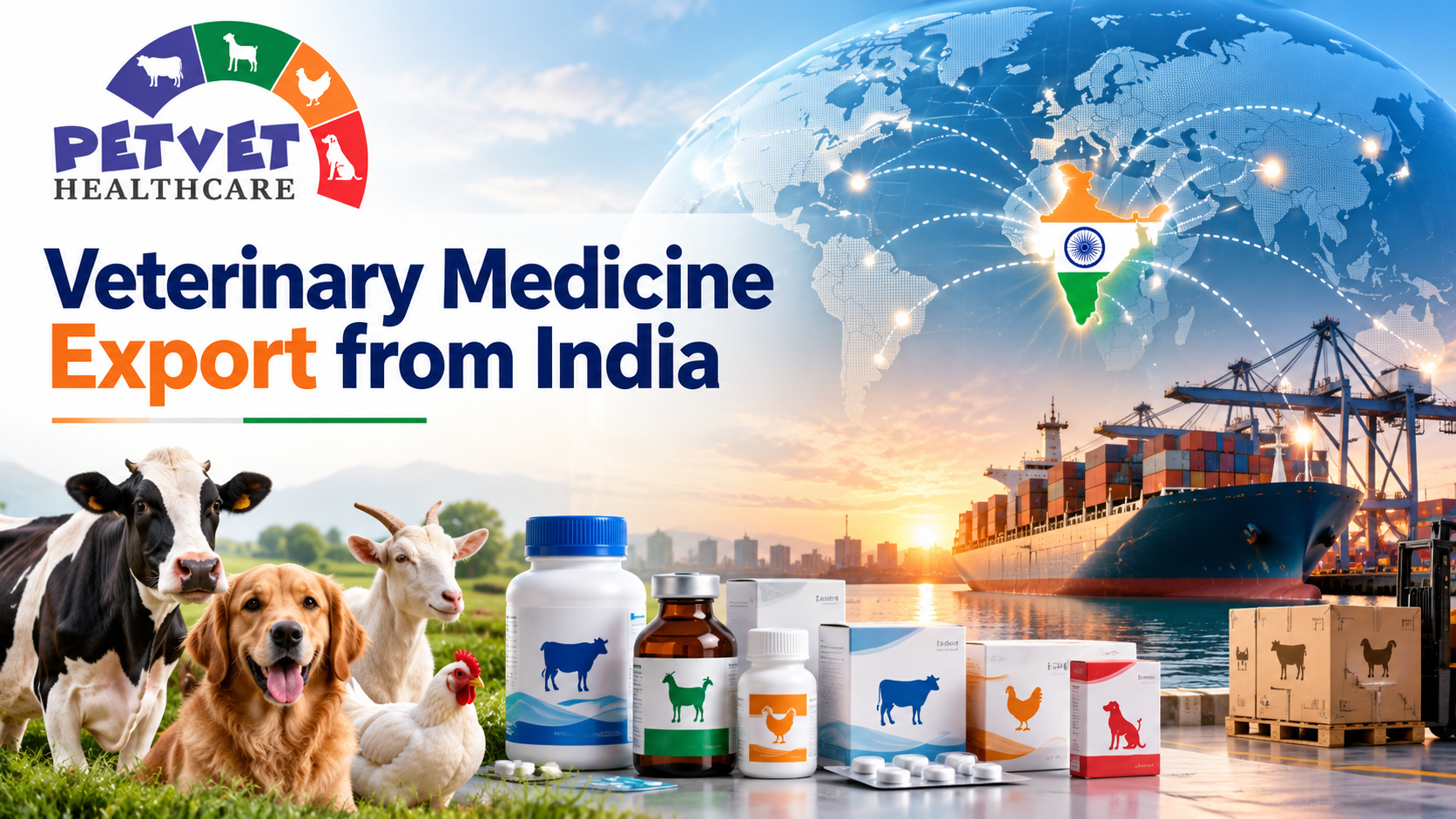
Yes, you can export veterinary medicines from India. You need an Import Export Code (IEC) from DGFT, a valid drug manufacturing or sale licence, and quality papers such as a WHO-GMP certificate. Some products also need a CDSCO Export NOC. Most important: register your product in the buyer’s country before you ship.
Why Veterinary Medicine Export from India Is Growing
India has a big home market and a strong drug-making base. Both help exporters.
- Home market is rising. IMARC values India’s veterinary medicine market at USD 918.47 million in 2025, and expects USD 1,580.43 million by 2034 (5.38% yearly growth).
- Animal health is wider still. A separate IMARC report puts India’s animal health market at INR 92.62 billion in 2025, growing about 7.11% a year. Livestock makes up 71% and pets 29%.
- India’s pharma export engine is strong. Pharmexcil reports that India exported USD 30.47 billion of pharma goods in FY2024-25 and sold in over 200 markets. In April–February FY2025-26, exports were USD 28.29 billion, up 5.6%.
- Vaccines are the fastest riser. In Q1 FY2026-27, pharma vaccine exports grew 35.68% year on year.
Note: Research firms use different scopes, so market numbers differ from report to report. Always check the source and year before you quote a number.
Why does this matter to you? Buyers in many countries want WHO-GMP quality at fair prices. India can deliver that. But the winners are exporters who get their papers right.
Can I Export Medicines from India?
Yes. Medicines can be exported if you:
- Hold the right Indian licences,
- Follow the Drugs and Cosmetics Act, 1940 and its Rules, and
- Meet the import rules of the destination country.
There are special cases. CDSCO’s guidance says an Export NOC is needed for unapproved or approved new drugs made for export. Narcotic and psychotropic drugs (NDPS) and banned drugs fall under separate permission rules. If your veterinary product is a standard, long-sold formulation, your state licensing authority will tell you whether an NOC applies.
Who Can Sell Veterinary Medicine in India?
Only people with the right licence. In simple terms:
- Manufacturers need a manufacturing licence (for example, Form 25/28 type licences under the Drugs Rules).
- Wholesalers, distributors and shops need a valid drug sale licence from the state drug authority.
- Vets, clinics and hospitals can dispense medicines to the animals they treat.
- Prescription drugs should be sold on a registered vet’s advice.
- Anyone selling without a licence risks legal action and seizure of stock.
In February 2026, the Ministry of Fisheries, Animal Husbandry & Dairying issued a note on a coordinated framework for veterinary medicines. Under it, CDSCO takes technical advice from the Empowered Committee on Animal Health–Regulatory (ECAH) on vet drugs and vaccines. Check the exact rule for your product type with your state drug controller.
Documents You Need to Export Veterinary Products from India
| Document | What it is for | Who issues it |
|---|---|---|
| IEC (Import Export Code) | Legal permission to import and export. Required before you can ship | DGFT |
| Manufacturing or sale licence | Proves you may make or deal in the drug | State drug authority / CDSCO |
| WHO-GMP / GMP certificate | Shows the factory follows quality rules. Many buyers ask for this | Licensing authority / certifying body |
| COPP / Free Sale Certificate | Often asked during product registration abroad | Issued under Indian regulatory system; check with your authority |
| Export NOC | Needed for some drugs (new or unapproved drugs, as per CDSCO guidance) | CDSCO zonal office |
| RCMC (if applicable) | Lets you claim export benefits. Pharmexcil is the council for pharma exports. Ask your adviser whether it covers your veterinary range | Export promotion council |
| Product dossier | Technical file for the buyer country’s regulator | You (the manufacturer) |
| Certificate of Analysis (COA) | Batch quality proof for each lot | Your QC lab |
| Commercial invoice, packing list, shipping bill | Customs clearance | You / your CHA |
| Bill of Lading or Airway Bill | Proof of shipment | Shipping line / airline |
Tip: Keep every document in one folder per product. It saves days when a buyer or regulator asks for papers.
How to Export Veterinary Medicines from India: Step by Step
- Pick your product and market. Start with 2–3 products you can make well. Check which country needs them.
- Get your IEC. Apply at DGFT. The government fee is ₹500.
- Check your licences. Make sure your manufacturing or sale licence is valid and covers the product you will export.
- Get your quality papers ready. WHO-GMP/GMP certificate, COA, stability data.
- Register the product in the buyer’s country. This is the longest step. Every country has its own dossier rules, forms and fees. Do not ship before this is done.
- Check if you need an Export NOC. If yes, apply to the CDSCO zonal office. CDSCO’s guidance gives a total of 7 days for NOC issue (5 working days for Step I and 2 working days for Step II).
- Pack and label for export. Use the buyer country’s language and label rules. Show name, strength, batch number, make and expiry dates, and storage needs.
- Book a freight forwarder or CHA. Share the invoice, packing list, COA and certificates. File the shipping bill.
- Handle payment safely. Use a Letter of Credit or advance payment for new buyers.
- Claim export benefits. Ask your CA about GST on exports (zero-rated supply with LUT or refund) and other schemes.
How to Export Veterinary Supplements from India
Veterinary supplements (minerals, vitamins, liver tonics, electrolytes) can be easier or harder than medicines, depending on how the product is classed. In India and abroad, a product may be seen as a drug, a feed supplement, or a feed additive. Each class has different rules. So:
- Ask your state drug authority how your product is classed.
- Ask the buyer’s regulator how they class it.
- Do not use health claims on the label that the regulator has not accepted.
Which Medicine Is Most Exported from India?
There is no public, vet-only ranking that names one “most exported” veterinary medicine. We will not guess. Here is what the data does show:
- For all Indian pharma, “drug formulations and biologicals” are the largest group: USD 5.98 billion, or 73.85% of exports in Q1 FY2026-27. Bulk drugs came next at USD 1.36 billion.
- In India’s home vet market, drugs hold 57.1% share and injectables (parenteral route) 46.2% (IMARC, 2025). Vaccines hold about 20% of animal health.
So the product groups that matter most are injectables, anti-infectives, dewormers, vitamin-mineral supplements and vaccines. Which one wins for you depends on the country, the animals (cattle, poultry, pets) and local disease load.
Which Countries Can You Target?
Indian veterinary suppliers often look at the regions below. Treat this as a starting list, not a guarantee of demand. Do your own market check first.
| Region | Example countries | What to check first |
|---|---|---|
| Africa | Nigeria, Kenya, Tanzania, Zambia, Ethiopia | Product registration rules, price pressure, local agents |
| South-East Asia | Vietnam, Indonesia, Philippines | Dossier format, label language, import permits |
| Middle East | Saudi Arabia, UAE | Registration time, Arabic labels, shelf-life rules |
| Latin America | Brazil | Strict registration, local representative |
| CIS & Central Asia | Armenia | Language, documents, payment terms |
| South Asia | Nepal, Bangladesh, Sri Lanka | Licence rules, border and customs steps |
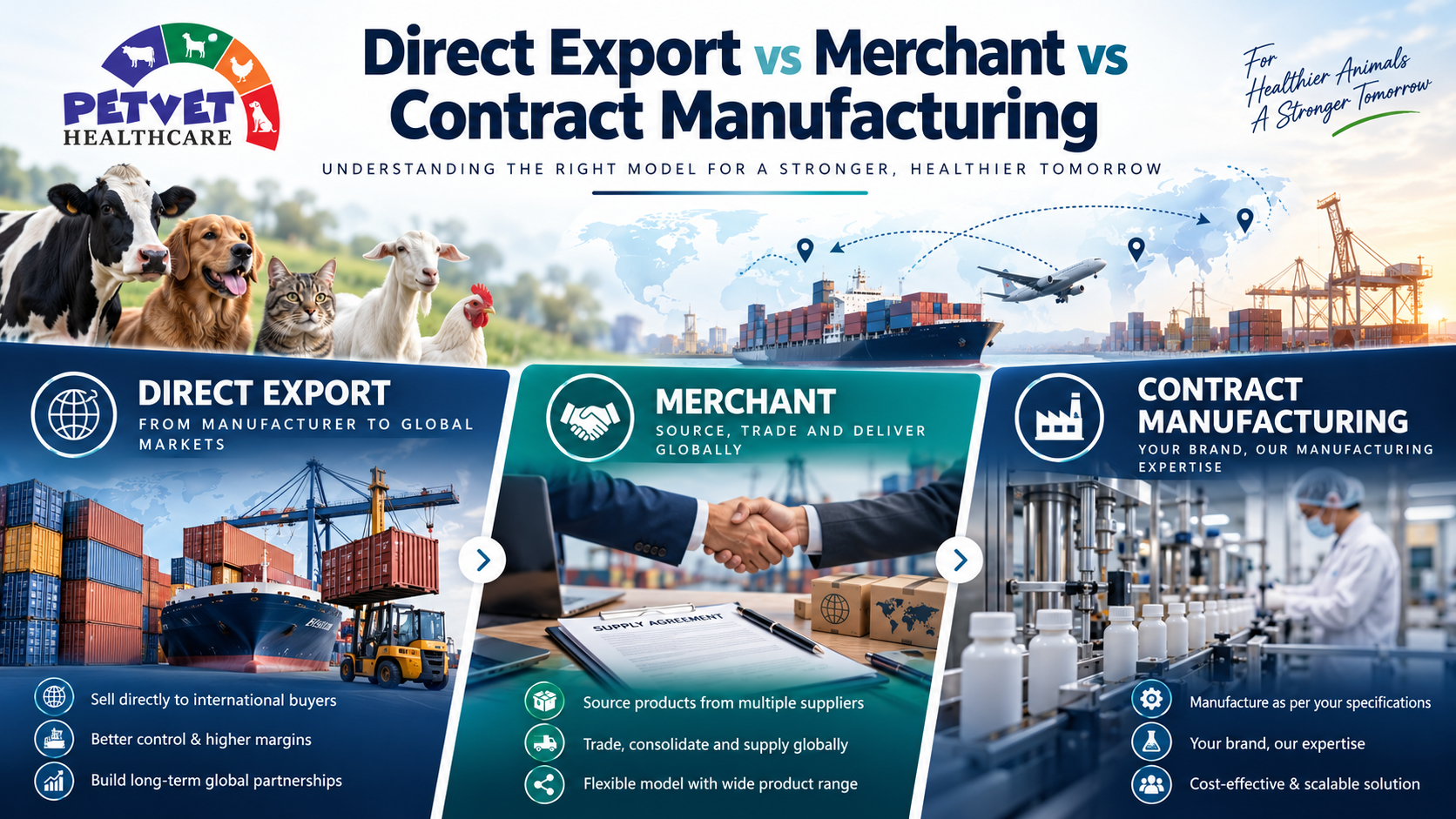
Direct Export vs Merchant vs Contract Manufacturing: Which Is Best?
| Route | Best for | Pros | Watch-outs |
|---|---|---|---|
| Make and export yourself | Companies with their own plant | Full control, best margin | High cost: licences, plant audits, dossiers |
| Merchant export | Traders with buyers | Low set-up cost | You depend on the maker’s quality and papers |
| Third-party (contract) manufacturing | Brands and exporters with no plant | No factory cost, your own brand name | Pick a WHO-GMP maker with a clean record |
| Domestic PCD partner first | New companies testing the market | Learn the trade at home | Not an export route by itself |
Common Export Mistakes (and How to Fix Them)
- Mistake: Shipping before the buyer country approves the product. Fix: Register first, ship later.
- Mistake: Wrong or short label. Fix: Use a checklist from the buyer’s regulator.
- Mistake: Short shelf life on arrival. Fix: Plan transit time and ask for at least the shelf life the buyer needs.
- Mistake: Vague agreements. Fix: Sign a written contract that lists price, payment terms, delivery and return rules.
- Mistake: Ignoring cold chain for vaccines and biologicals. Fix: Use a forwarder that handles temperature-controlled cargo.
- Mistake: Trusting a buyer without checks. Fix: Verify company, bank and past trade before you send stock.
What Are the Top Veterinary Medicine Companies in India?
No official “Top 20” ranking exists for Indian veterinary medicine companies. Any list that claims to be a clean Top 20 is usually based on paid or unclear data. So here is a list of well-known names, in alphabetical order. IMARC names these as key players in the Indian veterinary medicine market:
- Ani Healthcare Private Limited
- Ashish Life Science Pvt Limited
- Century Pharmaceuticals Ltd
- GMT Pharma International
- Hester Biosciences Limited (poultry and livestock vaccines)
- Indian Immunologicals Ltd. (vaccines)
- MarchVET (anthelmintics)
- SSS Pharmachem Pvt. Ltd
- Stanex Drugs & Chemicals Pvt. Ltd.
- Virbac
- Zenley Animal Health
- Zovix Pharmaceuticals
IMARC’s animal health report also names global players active in India, such as Boehringer Ingelheim, Elanco, Merck and Ceva Santé Animale. We have not padded this list to 20 just to match a search term. If you need a buyer-ready supplier shortlist, check each company’s licences and certificates yourself.
How PetVet Healthcare Can Help Exporters and Partners
(For importers, distributors, brand owners and vet pharma start-ups)
Getting the product right is half the job. PetVet Healthcare is a veterinary medicine manufacturer based in Ambala Cantt, Haryana. [CONFIRM before publishing: WHO-GMP certification, year of start, and export experience claims.] Our range covers veterinary injections, boluses and feed supplements such as electrolytes, liver tonics, minerals and multivitamins.
Here is how we can work with you:
- Private label / third-party manufacturing — your brand, our WHO-GMP plant. Third-party veterinary medicine manufacturing
- PCD franchise in India — start with a trusted range at home. Veterinary PCD pharma franchise
- Product details for your dossier — see our veterinary product list.
- Export enquiries — tell us the country, product and quantity. Contact PetVet Healthcare | +91 86074 15111 | petvetindia@gmail.com
Please note: product registration abroad stays the buyer’s and the manufacturer’s joint job, and we cannot promise approval in any country. We will share the technical papers we hold. [CONFIRM which export documents PetVet can supply: COA, GMP certificate, COPP, stability data.]
More guides are on our blog.
Frequently Asked Questions
Which medicine is most exported from India?
No public data names one top veterinary medicine. For all Indian pharma, drug formulations and biologicals lead, with 73.85% of exports in Q1 FY2026-27. In veterinary trade, injectables, dewormers, anti-infectives, supplements and vaccines are the main groups. The best choice depends on the buyer country, animal type and local disease needs.
Who can sell veterinary medicine?
Only licensed businesses can sell it. Manufacturers need a manufacturing licence, and wholesalers and shops need a drug sale licence from the state drug authority. Vets and clinics can dispense medicine to animals under their care. Prescription drugs should be sold on a registered vet’s advice. Selling without a licence can lead to legal action.
Can I export medicines from India?
Yes, if you hold an IEC, a valid drug licence, and meet the buyer country’s import rules. Some drugs also need a CDSCO Export NOC, such as new or unapproved drugs made for export. Narcotic and banned drugs follow separate permission rules. Register your product in the destination country before you ship.
What are the top 20 veterinary medicine companies in India?
There is no official Top 20 list. IMARC names 12 key players in India’s veterinary medicine market, including Hester Biosciences, Indian Immunologicals, Virbac, Stanex Drugs and Zovix Pharmaceuticals. Global firms such as Boehringer Ingelheim, Elanco and Ceva also operate here. Always check a supplier’s licences and certificates yourself.
Do I need a licence to export veterinary supplements from India?
Yes, you need an IEC at the very least, and your product must be made by a licensed unit. Whether it counts as a drug or a feed supplement changes the rules, in India and in the buyer’s country. Ask your state drug authority and the importer’s regulator how your product is classed before you ship.
How long does it take to start veterinary medicine export?
There is no fixed time. Getting an IEC is quick, and CDSCO’s Export NOC guidance sets a 7-day window. But product registration in the buyer’s country is the slow part and can take months in many markets. Plan your first shipment around that registration time, not around Indian paperwork.
Key Takeaways
- You can export veterinary medicines from India with an IEC, valid drug licences and quality papers.
- Register the product in the buyer’s country before shipping.
- Some products need a CDSCO Export NOC; ask your state authority.
- No official “most exported” or “Top 20” vet list exists, so check each source and supplier.
- Contract manufacturing with a WHO-GMP plant is a low-cost way to start.
Sources
- IMARC — India Veterinary Medicine Market (updated June 2026)
- IMARC — India Animal Health Market (July 2026)
- IMARC — Top Companies in the India Veterinary Medicine Industry
- Outlook Business — India’s pharma exports cross $28 bn till Feb (Pharmexcil data, April 2026)
- Indian Pharma Post — India’s pharma exports rise 6.8% to US$8.1 billion in Q1 FY27
- CDSCO guidance on Export NOC (via Medical Dialogues)
- TeamLease RegTech — MoFAH&D notification on coordinated regulatory framework for veterinary medicines (Feb 2026)
- Agile Regulatory — How to export medicine from India (Pharmexcil, IEC, documents)
- VetSet Lifecare — India Veterinary Medicine Export Opportunity (reference article)