A distributor in Karnal told us last year that he was running at a 22% margin. Turnover around ₹45 lakh. Good business, he thought.
Then we sat down with his books.
After credit losses, two expired batches he had to write off, transport, godown rent, and the extra 5% he had quietly been giving his top three retailers to keep them loyal — his actual take-home was closer to 9%. Not 22%. And he had no idea, because nobody had ever shown him where the gap was.
That gap is what this article is about.
PetVet Healthcare is a WHO-GMP and cGMP certified veterinary medicine manufacturer based in Ambala Cantt, Haryana, supplying injections, boluses and feed supplements to distributors, wholesalers and PCD franchise partners across India. Since 2019 we have onboarded distribution partners in most major states, which means we see margin structures from the inside — what gets quoted, what gets negotiated, and what actually survives to the bottom line. Veterinary medicine distributor margins in India are genuinely good compared with most trading businesses. But only if you know which numbers to protect.
What This Guide Covers
- What veterinary medicine distributor margins actually are in India
- Types of medicine wholesalers and what each layer earns
- Margin breakdown by product category, with real percentages
- Gross margin vs net margin — where the money disappears
- Why veterinary margins beat human pharma
- Investment needed to start a veterinary distribution business
- Six practical ways to improve your margins
- Frequently asked questions
What Are Veterinary Medicine Distributor Margins in India?
Veterinary medicine distributor margins in India typically range from 10% to 25% on trade price, depending on product category and distribution model. Feed supplements and nutraceuticals carry the highest margins at 25% to 35%. Antibiotic injections and critical-care drugs sit lower, around 10% to 18%. PCD franchise partners usually earn more than general stockists because they operate with monopoly rights in a defined territory.
That is the short answer. The longer answer is that “margin” means three different things to three different people in this supply chain, and confusing them is exactly how the Karnal distributor lost 13 points without noticing.
So let us break it down properly.
Types of Medicine Wholesalers in India (And What Each One Earns)
Most people entering this business assume there is one role called “distributor.” There isn’t. The Indian pharmaceutical distribution chain has at least five distinct layers, and each operates on completely different margin logic — high volume with thin margin at the top, low volume with fat margin at the bottom.
| Type of Wholesaler | Typical Margin | Volume Handled | Marketing Effort |
|---|---|---|---|
| C&F Agent (Carrying & Forwarding) | 2% – 5% | Very high | None — pure logistics |
| Super Stockist | 5% – 8% | High | Minimal |
| Distributor / Stockist | 10% – 15% | Medium to high | Low to moderate |
| PCD Franchise Partner | 20% – 40% | Low to medium | High — you own the territory |
| Retailer / Vet Pharmacy | 16% – 22% | Low | Direct customer handling |
Ranges are indicative of the veterinary segment and vary by company, region and product mix.
Notice something? The margin climbs as you move down the chain — and so does the work. A C&F agent earns 3% but handles ₹5 crore of stock a year. A PCD franchise partner might earn 30% on ₹40 lakh.
Both can be good businesses. They are just not the same business.
The most common mistake is a first-timer chasing the 30% number without understanding that PCD margin comes with an obligation — you have to actually go out and create demand in your territory. Nobody hands you the orders.
Profit Margins on Veterinary Products, by Category
This is where the real decisions get made. Two distributors with identical turnover can end the year ₹6 lakh apart purely because of what they chose to stock.
| Product Category | Distributor Margin | Movement Speed | Risk Level |
|---|---|---|---|
| Mineral mixture & feed supplements | 25% – 35% | Fast, seasonal | Low — long shelf life |
| Liver tonics & calcium gels | 22% – 30% | Fast | Low |
| Multivitamin & electrolyte powders | 20% – 30% | Fast | Low |
| Boluses (calcium, appetite, antibiotic) | 18% – 25% | Steady | Medium |
| Anti-inflammatory injections | 14% – 20% | Steady | Medium — breakage |
| Antibiotic injections | 10% – 18% | Fast | Medium to high |
| Critical care & scheduled drugs | 8% – 12% | Slow | High — expiry risk |
The pattern is hard to miss. Supplements and nutraceuticals sit at the top; prescription-heavy pharma sits at the bottom.
There’s a reason for that. Feed supplements aren’t price-controlled, they aren’t cross-checked against an MRP app by the farmer, and they carry shelf lives of 18 to 24 months. Antibiotics are the opposite — competitive, price-visible, shorter-dated, and every retailer in the district knows roughly what they should cost.
Which is why a lot of experienced distributors deliberately run a mixed basket. Antibiotics bring the retailer through the door every month. Supplements pay the rent.
Medicine Wholesale Business Profit Margin: Gross vs Net
Here is the part that catches almost everyone.
The margin your supplier quotes is a gross margin. It is what sits between your purchase price and your selling price. It is not profit. Profit is what remains after the business has finished taking its cuts — and in veterinary distribution those cuts are heavier than most people budget for.
Let us run actual numbers on a ₹10 lakh monthly turnover.
| Line Item | Amount (₹) | % of Turnover |
|---|---|---|
| Monthly sales (trade price) | 10,00,000 | 100% |
| Cost of goods (at 20% gross margin) | 8,00,000 | 80% |
| Gross margin | 2,00,000 | 20% |
| Less: retailer schemes & extra discount | 50,000 | 5.0% |
| Less: transport & freight | 18,000 | 1.8% |
| Less: godown rent & electricity | 22,000 | 2.2% |
| Less: salaries (1 field staff + 1 accounts) | 45,000 | 4.5% |
| Less: expiry / breakage write-off | 20,000 | 2.0% |
| Less: bad debt & credit loss | 15,000 | 1.5% |
| Net profit before tax | 30,000 | 3.0% |
Illustrative model based on typical single-district distributor operations. Actual figures vary by territory, staff structure and credit discipline.
Twenty percent gross became three percent net.
Now — before that number scares anyone off — this is a fairly punishing scenario, with a heavy discount leak and weak credit control. A well-run operation on the same turnover, with tighter schemes and a supplement-weighted mix, comfortably lands at 8% to 12% net. Some do better.
But that only happens on purpose. It never happens by accident.
Why Are Veterinary Margins Better Than Human Pharma?
Veterinary products generally carry higher distributor margins than human pharmaceuticals because most animal-health formulations fall outside price control, face less consumer price comparison, and move through a rural distribution network where relationships matter more than rate-shopping.
Four things drive this.
Price control is the big one. Human pharma products on the National List of Essential Medicines are capped under the Drugs (Prices Control) Order — margins there are legally fixed and thin. Most veterinary formulations sit outside that framework, so pricing is set by the market rather than a ceiling.
Then there’s price transparency, or the lack of it. A patient can check a tablet’s MRP on three apps before buying. A dairy farmer buying a calcium bolus almost never does. That isn’t exploitation — the product still has to work, or the farmer never buys it again — but it does mean pricing holds better.
Third, the demand cycle is biological. Lactation, breeding, monsoon disease pressure, seasonal deworming. Cattle don’t skip a calcium requirement because the farmer is having a tight month. Repeat purchase is built into the animal, not into the marketing.
And finally, rural distribution rewards presence. The distributor who shows up, extends fair credit and answers the phone at 9 PM keeps the retailer. Competitors can undercut on rate and still lose the account. That stickiness is worth real margin points.
Is the Veterinary Distribution Business Growing in India?
India’s veterinary medicine market is growing at a CAGR of 8.80% and is projected to reach USD 2.25 billion by 2034, according to Market Research Future. The growth is coming from three directions at once — commercial dairy expansion, organised poultry integration, and a fast-rising companion animal segment in tier-1 and tier-2 cities.
India is also the world’s largest milk producer, with output crossing 239 million tonnes in 2023-24 according to the Department of Animal Husbandry & Dairying. Every litre of that comes from an animal needing calcium, minerals and periodic veterinary intervention. That is the demand floor underneath this entire business.
So the market is expanding. Which is good news and a warning at the same time — growing markets attract new entrants, and new entrants compete on price long before they learn to compete on service.
Veterinary Supplement Distribution Business in India: The Higher-Margin Route
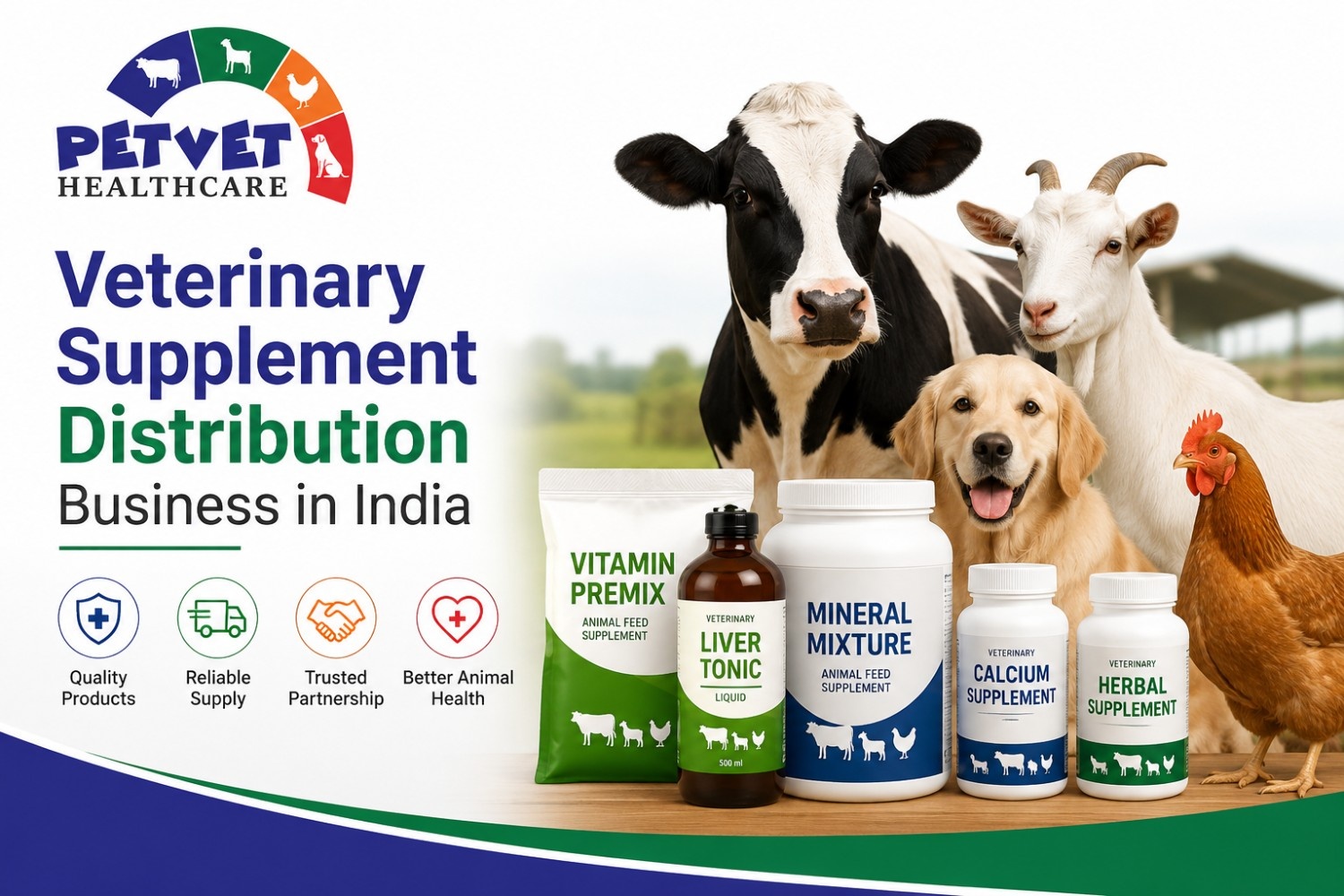
If you are starting fresh and want the cleanest entry, supplements are usually the smarter first move.
The reasoning is practical rather than clever. Feed supplements, mineral mixtures, liver tonics and electrolytes don’t carry the same regulatory weight as scheduled drugs. Shelf life runs 18 to 24 months instead of 12 to 18, so expiry write-offs drop sharply. There’s no cold chain to maintain. Glass breakage isn’t a line item. And the margin band sits 10 to 15 points above injectables.
The trade-off is that supplement sales are more seasonal and more education-dependent. You have to actually explain to a farmer why a mineral mixture improves conception rate. Nobody needs convincing about an antibiotic when the animal is already sick.
Most successful veterinary supplement distribution businesses in India end up running roughly 60% supplements and 40% pharma. The pharma keeps the retailer visiting; the supplements carry the profit.
How Much Investment Does a Veterinary Distribution Business Need?
Starting a veterinary distribution business in India typically requires ₹3 lakh to ₹12 lakh, depending on territory size and whether you operate as a PCD franchise partner or an independent stockist. The largest single component is working capital, not stock — because rural sales run on credit.
| Requirement | Approximate Cost (₹) | Notes |
|---|---|---|
| Drug licence (wholesale, Form 20B / 21B) | 5,000 – 15,000 | State drug authority; requires a qualified person |
| GST registration | Nil – 3,000 | Mandatory above threshold |
| Initial stock purchase | 1,50,000 – 5,00,000 | Varies by product basket |
| Godown / storage setup | 25,000 – 80,000 | Racking, refrigeration if required |
| Working capital (credit cycle) | 1,00,000 – 4,00,000 | Biggest hidden requirement |
| Field staff (first 6 months) | 60,000 – 1,50,000 | Optional at start |
| Marketing material & samples | 15,000 – 50,000 | Often supplied by manufacturer in PCD model |
Indicative ranges for a single-district operation. Costs differ by state and scale.
That working capital line is the one people underestimate. If your retailers pay in 60 days and your manufacturer wants payment in 30, you are financing the gap out of your own pocket — every month, on growing volume. Plenty of distributors have gone under while their sales chart was still pointing upward.
How to Improve Your Profit Margins on Veterinary Products
Six things that actually move the number. Not theory — these come from watching partner distributors fix their own P&L.
1. Fix the discount leak before anything else
Most distributors are giving away 4% to 7% in unrecorded schemes and “extra” they agreed to years ago and never revisited. Pull last quarter’s invoices, calculate the real average discount by retailer, and you will usually find two or three accounts absorbing far more than they deserve. That is the fastest margin recovery available to you, and it costs nothing.
2. Shift the product mix toward supplements
Moving 15% of turnover from injectables into feed supplements typically adds 2 to 3 points of blended margin. Same customers, same routes, same effort.
3. Buy direct from the manufacturer
Every layer between you and the plant takes a cut. Sourcing straight from a manufacturing unit instead of through a super stockist or trading house usually recovers 5% to 8% — and you get batch traceability into the bargain, which matters the moment a retailer questions quality.
4. Tighten the credit cycle by 15 days
Not by being aggressive. By being systematic — dated invoices, a reminder before the due date rather than after, and a small early-payment incentive that costs less than the interest you are currently losing. Fifteen days across a ₹10 lakh book frees up roughly ₹5 lakh of working capital.
5. Kill your slow movers honestly
Every distributor carries eight to ten SKUs that haven’t moved in six months, held onto because “someone might ask.” They won’t. That is dead capital heading straight for an expiry write-off. Liquidate at cost and redeploy.
6. Get monopoly rights in writing
If you are building demand in a territory, you should not be competing against another partner selling the same brand two towns over. A proper PCD agreement with defined monopoly rights protects the pricing you have worked to establish. Get it on paper before you start, not after there’s a problem.
Choosing a Manufacturing Partner That Protects Your Margin
Here is the uncomfortable truth about margin: you can do everything above correctly and still lose money if you have picked the wrong supplier.
Quality complaints eat margin faster than any discount ever will. One batch that doesn’t perform and the retailer stops stocking your brand entirely — and you have lost not a sale but a relationship you spent two years building. Irregular supply does the same damage more slowly. If the retailer can’t rely on you having stock in week one of the month, they will simply buy from someone who does.
So when you evaluate a veterinary medicine manufacturer, look past the margin percentage on the rate list and check four things: whether the facility is genuinely WHO-GMP and cGMP certified, whether they run in-house quality testing on raw materials and finished goods, whether the product range is wide enough that you can source your whole basket from one place, and whether monopoly rights are actually written into the agreement.
Why distributors work with PetVet Healthcare
PetVet Healthcare manufactures veterinary injections, boluses and feed supplements at a WHO-GMP and cGMP certified facility in Ambala Cantt, Haryana. Because we manufacture rather than trade, distribution partners buy directly from the plant — with no intermediate layer taking a margin slice along the way.
- WHO-GMP and cGMP certified manufacturing, operating since 2019
- In-house quality control testing every raw material and finished batch against pharmacopeial standards
- Complete range under one roof — antibiotic and anti-inflammatory injections, calcium and appetite boluses, mineral mixtures, liver tonics, electrolytes and multivitamins
- PCD pharma franchise with pan-India monopoly rights and promotional support
- Third-party and contract manufacturing for partners building their own brand
- Competitive margins across both pharma and the higher-margin supplement range
If you are evaluating a veterinary distribution business, our veterinary PCD pharma franchise programme covers territory allocation, margin structure and marketing support. If you already have a brand and want manufacturing capacity behind it, look at third-party veterinary medicine manufacturing. You can also browse the full veterinary product list to see what a complete basket looks like.
Frequently Asked Questions
What is the average profit margin for a veterinary medicine distributor in India?
Gross margins usually run 10% to 25% depending on product category, with supplements at the top and scheduled drugs at the bottom. Net profit after schemes, transport, staff, expiry and credit losses typically lands between 6% and 12% for a well-managed operation. Anyone quoting you a flat 25% net is talking about gross margin without saying so.
Which veterinary products give the highest profit margin?
Feed supplements and nutraceuticals — mineral mixtures, liver tonics, calcium gels, electrolyte and multivitamin powders — carry the highest margins at 25% to 35%. They also have longer shelf lives and lower breakage risk than injectables, so more of that gross margin actually survives to net.
What is the difference between a distributor, a stockist and a PCD franchise partner?
A distributor or stockist buys and resells across a territory on standard trade margins of 10% to 15%, usually without exclusive rights. A PCD franchise partner receives monopoly rights in a defined area plus marketing support, and earns 20% to 40% — but is responsible for creating demand in that territory rather than only fulfilling existing orders.
How much investment is needed to start a veterinary distribution business?
Between ₹3 lakh and ₹12 lakh for a single-district operation. Roughly ₹1.5 lakh to ₹5 lakh goes into opening stock, but the larger and more commonly underestimated requirement is working capital to fund the credit cycle, since rural retailers typically pay in 60 to 90 days.
Do I need a drug licence to distribute veterinary medicines in India?
Yes. Wholesale distribution of veterinary drugs requires a wholesale drug licence (Form 20B and 21B) issued by your State Drug Control Authority under the Drugs and Cosmetics Act, 1940. You will also need a qualified person, adequate storage premises and GST registration. Feed supplements not classified as drugs carry lighter requirements — worth confirming category-wise before you apply.
Are veterinary medicine margins better than human pharma margins?
Generally yes. Most veterinary formulations fall outside the Drugs (Prices Control) Order that caps margins on essential human medicines, and animal-health products face far less consumer price comparison. The trade-off is a smaller per-territory market and heavier reliance on credit sales.
What kills profit margins in a medicine wholesale business?
Five things, in roughly this order of damage: unrecorded discounts and schemes given to retailers, delayed payments turning into bad debt, expiry write-offs on slow-moving stock, transport costs across scattered rural routes, and breakage on glass vials. Discount leakage is usually the largest — and the easiest to fix.
Can I distribute veterinary supplements without distributing medicines?
Yes, and many people start exactly this way. A supplement-only veterinary distribution business has lighter licensing requirements, longer shelf life, better margins and lower risk. The limitation is that supplement demand is more seasonal and requires more farmer education, so most distributors eventually add a pharma range to keep monthly footfall steady.
Start a Veterinary Distribution Business With PetVet Healthcare
Veterinary medicine distributor margins in India reward the people who treat this as a business rather than a trade. Watch the discount leak, keep the credit cycle tight, weight the basket toward supplements, and buy as close to the manufacturer as you can get.
If you want to discuss territory availability, margin structure or product range, we are happy to have that conversation before you commit to anything.
PetVet Healthcare
GRANMED PHARMA PVT LTD, CR 1, Nanhera Road, Kuldeep Nagar, Nanhera, Ambala Cantt, Haryana 133004
Phone: +91 86074 15111
Email: petvetindia@gmail.com
Enquire about a PCD franchise Contact us About PetVet Healthcare