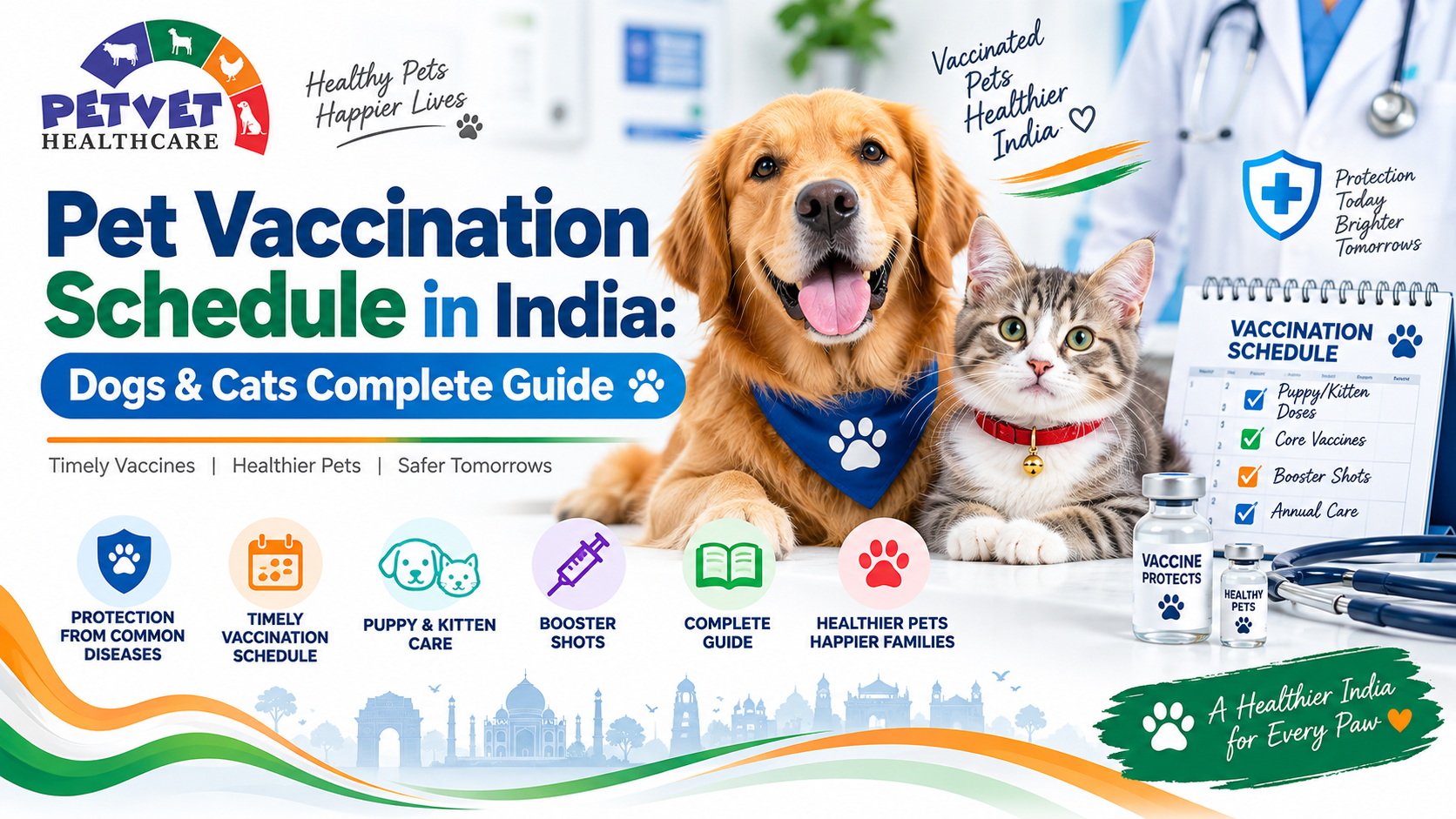
The pet vaccination schedule in India starts at 6–8 weeks of age. Puppies and kittens get core vaccines every 2–4 weeks until they are at least 16 weeks old. Dogs get DHPPiL (the “9-in-1”) and cats get FVRCP (the “3-in-1”). The first rabies shot is given from about 12 weeks. A booster follows at 6–12 months. After that, most Indian vets repeat boosters every year. Your vet may stretch some core vaccines to every 3 years if the vaccine label allows it.
Key facts at a glance:
- Start age: 6–8 weeks
- Last puppy/kitten dose: 16 weeks or older
- Rabies (first dose): from 12 weeks, then booster as per vaccine label and local rules
- Approximate cost: ₹3,500–₹8,000 for a full puppy series (estimate, varies by city)
- Street dogs: rabies and core vaccines at the first safe chance, then yearly boosters
Why Pet Vaccination Matters in India
India is a rabies-endemic country. The World Health Organization says dog bites and scratches cause 99% of human rabies cases worldwide. Rabies kills an estimated 44,000 people every year, and about 40% of victims are children under 15. (WHO Rabies Fact Sheet)
Rabies is not the only danger. Canine distemper, parvovirus and feline panleukopenia spread fast. They can kill a young pet within days. Treatment is costly and often fails. A vaccine is cheap by comparison.
India’s own national plan aims to eliminate dog-mediated rabies by 2030. It calls for at least 70% anti-rabies vaccination coverage among dogs in an area, every year, for three years in a row. (NCDC Rabies Operational Guidelines, 2024)
That is why this vaccination guide for dogs & cats in India covers both pet and street animals.
Core vs Non-Core Vaccines: What Your Pet Actually Needs
The World Small Animal Veterinary Association (WSAVA) splits vaccines into two groups. Its 2024 guidelines are the global reference most vets follow. (WSAVA 2024 Vaccination Guidelines)
| Group | Dogs | Cats |
|---|---|---|
| Core (every pet needs these) | Distemper (CDV), Adenovirus/Hepatitis (CAV), Parvovirus (CPV-2) | Panleukopenia (FPV), Calicivirus (FCV), Herpesvirus/Rhinotracheitis (FHV-1) |
| Core where the disease is common | Rabies; Leptospirosis | Rabies; FeLV for kittens and outdoor cats |
| Non-core (based on lifestyle and risk) | Kennel cough (Bordetella, Parainfluenza), Canine coronavirus | Chlamydia, Bordetella |
In India, rabies is treated as essential for every dog and cat. Leptospirosis is also common during the monsoon, so most Indian vets include it in the combination shot (DHPPiL).
Dog Vaccination Schedule in India (Puppy Chart)
This is a typical dog vaccination schedule used in Indian clinics. Your vet may adjust it based on your puppy’s health, breed and local disease risk. Brands also differ, so always follow the label.
| Puppy’s Age | Vaccine | What It Protects Against |
|---|---|---|
| 6–8 weeks | 1st dose DHPP/DHPPiL + deworming | Distemper, hepatitis, parvovirus, parainfluenza (± leptospirosis) |
| 10–12 weeks | 2nd dose DHPPiL | Same, to build stronger immunity |
| From 12 weeks | 1st Rabies dose | Rabies |
| 14–16 weeks | 3rd dose DHPPiL (final puppy dose) | Same. WSAVA says the last puppy dose must be at 16 weeks or older |
| 2–4 weeks after 1st rabies (as per vet/vaccine) | 2nd Rabies dose (many Indian vets follow this) | Rabies |
| 6 months | DHPPiL booster | WSAVA advises a booster at about 26 weeks |
| 12 months | DHPPiL + Rabies booster | Long-term protection |
| Optional | Kennel cough, Coronavirus | Dogs that board, groom or mix with many dogs |
Why so many doses? A puppy gets antibodies from its mother’s milk. These can block the vaccine and make it fail. Nobody knows the exact day they fade, so vets give several doses. The last one at 16 weeks or later makes sure the vaccine works. (WSAVA 2024)
Good to know: Virbac India advises that a dog should be healthy and dewormed about one week before vaccination. (Virbac India)
Adult Dog Vaccination Schedule
| Vaccine | How Often |
|---|---|
| DHPPiL (9-in-1) | Every year in most Indian clinics. WSAVA says core vaccines may last up to 3 years, so ask your vet |
| Rabies | Every year or every 3 years, depending on the vaccine and your city’s rules |
| Kennel cough | Every year for boarding, grooming or daycare dogs |
| Leptospirosis | Every year, especially in monsoon-prone areas |
Cat Vaccination Schedule in India (Kitten Chart)
Cats need protection too, even indoor cats. Viruses can enter your home on shoes and clothes.
| Kitten’s Age | Vaccine | What It Protects Against |
|---|---|---|
| 6–8 weeks | Health check + deworming; 1st FVRCP (3-in-1) or 4-in-1 dose | Panleukopenia, rhinotracheitis, calicivirus (± chlamydia) |
| 10–12 weeks | 2nd FVRCP dose | Builds immunity |
| From 12 weeks | 1st Rabies dose | Rabies |
| 14–16 weeks | 3rd FVRCP dose (final kitten dose) | WSAVA: final dose at 16 weeks or older |
| 12 months | FVRCP + Rabies booster | Long-term protection |
| Adult cats | FVRCP every 1–3 years; Rabies as per label and local rules | Ongoing cover |
| Outdoor or multi-cat homes | FeLV (after a negative test) | Feline leukaemia |
Some vaccines are licensed as a two-dose kitten course. For example, the Nobivac Tricat Trio label says the first dose can be given at 8–9 weeks, the second 3–4 weeks later, and not before 12 weeks of age. It also says the panleukopenia part can be repeated every 3 years, while the other two parts need yearly boosters. (MSD Animal Health product SPC)
Because labels differ, your vet will pick the number of doses that fits the vaccine used.
Street Dog Vaccination Schedule
Street dogs have a high risk of rabies, distemper and parvovirus. They are also the main reason mass dog vaccination matters. WHO calls mass dog vaccination “the most cost-effective strategy” to prevent rabies in people. (WHO)
Street dogs rarely have a known age or history. So the street dog vaccination schedule is simpler and more practical:
| Situation | What to Do |
|---|---|
| Unknown age, healthy adult dog | Rabies vaccine + one DHPPiL dose, then a booster after 2–4 weeks if your vet advises |
| Street puppy (under 16 weeks) | Follow the puppy chart above. Start with deworming and the first core dose at 6–8 weeks |
| Dog already sterilised under an ABC programme | Ask the NGO or municipal body for its vaccination certificate and the date for the next booster |
| Dog in a shelter | WSAVA says all dogs and cats entering a shelter should get core vaccines before or at entry |
| Every year after | Rabies and core booster, ideally in the same month |
How to help street animals safely:
- Take the dog to a licensed vet or your municipal rabies vaccination drive.
- Check your local municipal corporation, animal welfare NGO or government veterinary hospital for free or low-cost camps. Availability differs by city.
- Keep a written record of the date and vaccine used.
- Never handle a sick or aggressive animal without help.
India’s rabies guidelines also recommend compulsory registration and vaccination of pet dogs through municipal corporations. Check your city’s rules. (NCDC)

Rabies Vaccine for Pets: Latest Schedule in India
For pets, the rabies vaccine is not a “3 or 5 dose” course. Here is how it works:
- First dose: from 12 weeks of age (WSAVA and Virbac India).
- Second dose: many Indian vets give this 2–4 weeks later. WSAVA’s guideline for endemic areas mentions a second dose one year after the first.
- Booster: every year or every 3 years, based on the vaccine label and your local law. WSAVA notes that revaccination intervals are often set by law.
The “3 or 5 doses” question usually refers to humans bitten by an animal. That is a different schedule, covered in the FAQs below.
Important: A vaccinated pet is much safer. But a bite from any unknown animal still needs medical care. Wash the wound with soap and running water for at least 15 minutes and see a doctor right away. (WHO)
WSAVA Guidelines vs Common Indian Practice
| Point | WSAVA 2024 (Global) | Common Practice in India |
|---|---|---|
| Puppy/kitten start age | 6–8 weeks | 6–8 weeks |
| Final puppy/kitten dose | 16 weeks or older | 14–16 weeks (should be 16+) |
| First booster | About 26 weeks to 12 months | 6 and/or 12 months |
| Core booster after that | No more often than every 3 years | Mostly every year |
| Rabies | 12 weeks, then as per local law | 12 weeks, then yearly or 3-yearly |
| Leptospirosis | Core where common | Included in DHPPiL |
Neither approach is “wrong.” Indian vets often prefer yearly visits because they also give a full health check. Ask your vet which plan fits your pet.
Dog Vaccination Schedule in India with Price
Prices change by city, clinic and brand. The numbers below are approximate ranges taken from published clinic and pet-care pages in 2024–2026. Your vet’s consultation fee is extra. Treat them as a budget guide, not a fixed rate.
| Item | Approximate Price (₹) |
|---|---|
| DHPPiL (9-in-1) per dose | 800–1,800 |
| Rabies vaccine per dose | 300–700 |
| Kennel cough vaccine | 700–1,500 |
| Leptospirosis (if given separately) | From about 150 |
| Vet consultation | 300–1,000 |
| Full puppy series (3 core + rabies) | About 3,500–8,000 |
Sources for ranges: Supertails, VOSD, Heads Up For Tails.
Money-saving tips:
- Follow the full schedule. Missed doses can mean paying to restart.
- Use government veterinary hospitals and municipal camps for rabies shots where available.
- Avoid home vaccination by untrained sellers. A broken cold chain makes the vaccine useless.
Before and After the Vaccine: A Simple Checklist
Before:
- Book a health check. Never vaccinate a sick pet.
- Deworm about a week earlier.
- Carry the old vaccination card.
After:
- Get the card stamped with the vaccine name, batch number, date and vet’s signature.
- Mild tiredness, a sore spot or a small lump for a day is common.
- Call your vet if you see facial swelling, repeated vomiting, trouble breathing or collapse. These need emergency care.
- Most vets advise skipping a bath for about 2–3 days.
- Keep young puppies and kittens away from public parks until the course ends.
Beyond Vaccines: Everyday Care That Supports a Healthy Pet
A vaccine gives targeted protection. It does not replace good daily care. A healthy pet also needs:
- Regular deworming as advised by the vet.
- Tick and flea control. Ticks and fleas are common in India and cause skin disease and anaemia.
- Balanced nutrition. Growing puppies and kittens need enough protein, calcium and vitamins.
- Clean bedding and a clean bowl.
- Yearly check-ups.
A note on vaccines and PetVet Healthcare: We are a WHO-GMP certified veterinary medicine manufacturer based in Ambala Cantt, Haryana. We do not make or sell vaccines. Please buy vaccines only from your veterinarian, who stores them correctly.
What we do make are supportive veterinary products for companion animals, to be used on your vet’s advice. Our pet range includes:
- Gratone Pet Syrup – amino acids with multivitamins
- Bonmed Pet Syrup – calcium with multivitamins
- Granliv Liver Tonic – liver tonic with iron
- Scatik Shampoo and Soap – permethrin-based, for ticks and fleas
These are not a substitute for vaccines, and we do not claim that they improve vaccine response. Please ask your vet before giving any medicine, supplement or dewormer, since dose depends on species, age and weight.
Explore our full range on the Product List page.
For Vets, Clinics and Distributors
If you run a clinic, pet shop or veterinary distribution business, you can partner with us through our Veterinary PCD Pharma Franchise or third-party manufacturing services. Our team can share product details and quality documents on request via the Contact Us page.
Frequently Asked Questions
1. At what age should a puppy or kitten get its first vaccine?
Between 6 and 8 weeks. Vaccines are then repeated every 2–4 weeks until the pet is at least 16 weeks old. A booster follows at about 6 to 12 months. Do not start earlier than your vet advises, because the mother’s antibodies can block the vaccine in very young pets.
2. Is the rabies vaccine 3 or 5 doses?
It depends on who is vaccinated. Pets usually get one dose from 12 weeks, sometimes a second dose, then boosters. Humans bitten by an animal need a post-exposure course. The older IM schedule used 5 doses; India’s IAP lists 4 doses (days 0, 3, 7 and 14–28). Your doctor will decide the exact course.
3. What is the latest rabies vaccine schedule in India?
For pets: first dose from 12 weeks, then boosters yearly or every 3 years, per vaccine label and city rules. For humans, the pre-exposure schedule is 2 doses on days 0 and 7. After a bite, WHO’s updated intradermal plan is 3 visits (days 0, 3 and 7). Follow the hospital’s protocol and never delay.
4. What is the WHO 2026 immunization schedule for pets?
WHO publishes immunization schedules for people, not for pet dogs and cats. For pets, vets follow WSAVA guidelines and local law. WHO’s role for animals is to push mass dog vaccination, with at least 70% of dogs covered each year. We could not find a pet-specific WHO schedule for 2026.
5. How many times is the 4-in-1 vaccine given to cats?
A 4-in-1 cat vaccine usually covers panleukopenia, rhinotracheitis, calicivirus and chlamydia. Kittens get 2–3 doses, 3–4 weeks apart, starting at 6–9 weeks. WSAVA says the final dose should be at 16 weeks or older. A booster follows at 12 months, then every 1–3 years as your vet advises.
6. How much does dog vaccination cost in India?
A single dose costs roughly ₹300–₹700 for rabies and ₹800–₹1,800 for the 9-in-1 vaccine. A full puppy series is often ₹3,500–₹8,000 in private clinics. These are estimates and differ by city and brand. Government camps may offer rabies shots at low or no cost.
7. What is the vaccination schedule for street dogs?
Give rabies and a core vaccine (DHPPiL) as soon as the dog can be safely handled by a vet, with a booster after 2–4 weeks if advised. Street puppies follow the normal puppy chart. All street dogs need yearly rabies and core boosters. Ask your municipal body about free drives.
8. Do indoor pets need vaccines?
Yes. Viruses like parvovirus and panleukopenia can enter on shoes, clothes or hands. Indoor pets can also escape or meet visitors’ pets. Rabies vaccination is often needed for pet registration in Indian cities, even for pets that rarely go out. Your vet can adjust non-core vaccines to lifestyle.
9. What if I miss a booster date?
Do not panic and do not guess. Call your vet. For a short delay, one booster is often enough. For a long gap, or if a puppy missed a dose in the primary series, your vet may repeat the series. Bring the old vaccination card to help the vet decide.
10. Can I vaccinate my pet at home?
This is not advised. Vaccines must stay cold from factory to injection. If this chain breaks, the vaccine can fail without warning. Reactions such as allergy also need quick treatment. A vet visit also gives a health check and a valid, stamped certificate you may need for travel, boarding or pet licence.
Key Takeaways
- Start at 6–8 weeks. The last puppy or kitten dose should be at 16 weeks or older.
- Core vaccines: DHPPiL for dogs, FVRCP for cats, plus rabies for both.
- Boosters at 6–12 months, then every year or every 3 years as your vet advises.
- Street dogs need rabies and core vaccines too. Mass vaccination protects people.
- Prices are approximate. Always confirm with your vet.
- PetVet Healthcare does not make vaccines. Buy them only through a licensed vet.
This guide is for general information. It is not a substitute for veterinary advice. Schedules vary by vaccine brand, pet health and local rules. Always follow your veterinarian’s plan.
Sources
- WSAVA – 2024 Guidelines for the Vaccination of Dogs and Cats
- WSAVA 2024 Guidelines – Journal of Small Animal Practice (Squires et al.)
- WHO – Rabies Fact Sheet
- WHO – Rabies PEP Recommendations
- National Centre for Disease Control (India) – Rabies Operational Guidelines, 2024
- Indian Academy of Pediatrics – Rabies Vaccine Information
- Virbac India – Dog Vaccination Guide
- MSD Animal Health – Nobivac Tricat Trio SPC
- Supertails – Dog Vaccination Schedule in India and Cat Vaccination Schedule in India (price ranges)
- VOSD – Dog/Puppy Vaccination Schedule (price ranges)
- Heads Up For Tails – Dog Vaccination Cost in India (price ranges)
Related Reading
- Poultry Vaccination Schedule in India: Complete Chart
- Deworming Schedule for Cattle, Goats & Sheep in India
- Common Diseases in Dairy Cattle and Their Treatment
- How Veterinary Clinics Can Buy Medicines Directly from Manufacturers
- About PetVet Healthcare (Granmed Pharma Pvt Ltd)
Call to action: Questions about our pet products, or want to stock them at your clinic? Call +91 86074 15111 or +91 82228 98961, email petvetindia@gmail.com, or visit the Contact Us page.
PetVet Healthcare is a brand of Granmed Pharma Pvt Ltd, CR 1, Nanhera Rd, Kuldeep Nagar, Nanhera, Ambala Cantt, Haryana 133004.