Walk into almost any veterinary medicine godown in Hisar, Meerut or Anand around March, and you will find the same thing sitting in a back corner. Three or four cartons of something that looked very promising eighteen months ago. Still sealed. Still gathering dust.
Ask the stockist about it and the answer barely changes from town to town. The company representative pushed it hard. The margin looked excellent on paper. Nobody stopped to check whether the veterinary doctors in that belt actually prescribe it.
That is the real problem in veterinary distribution. Not finding products — there is no shortage of those. The problem is knowing which ones will move off your shelf within 30 to 45 days, and which ones will quietly eat your working capital for two years.
This guide is built around that question.
What are the fastest-selling veterinary products in India?
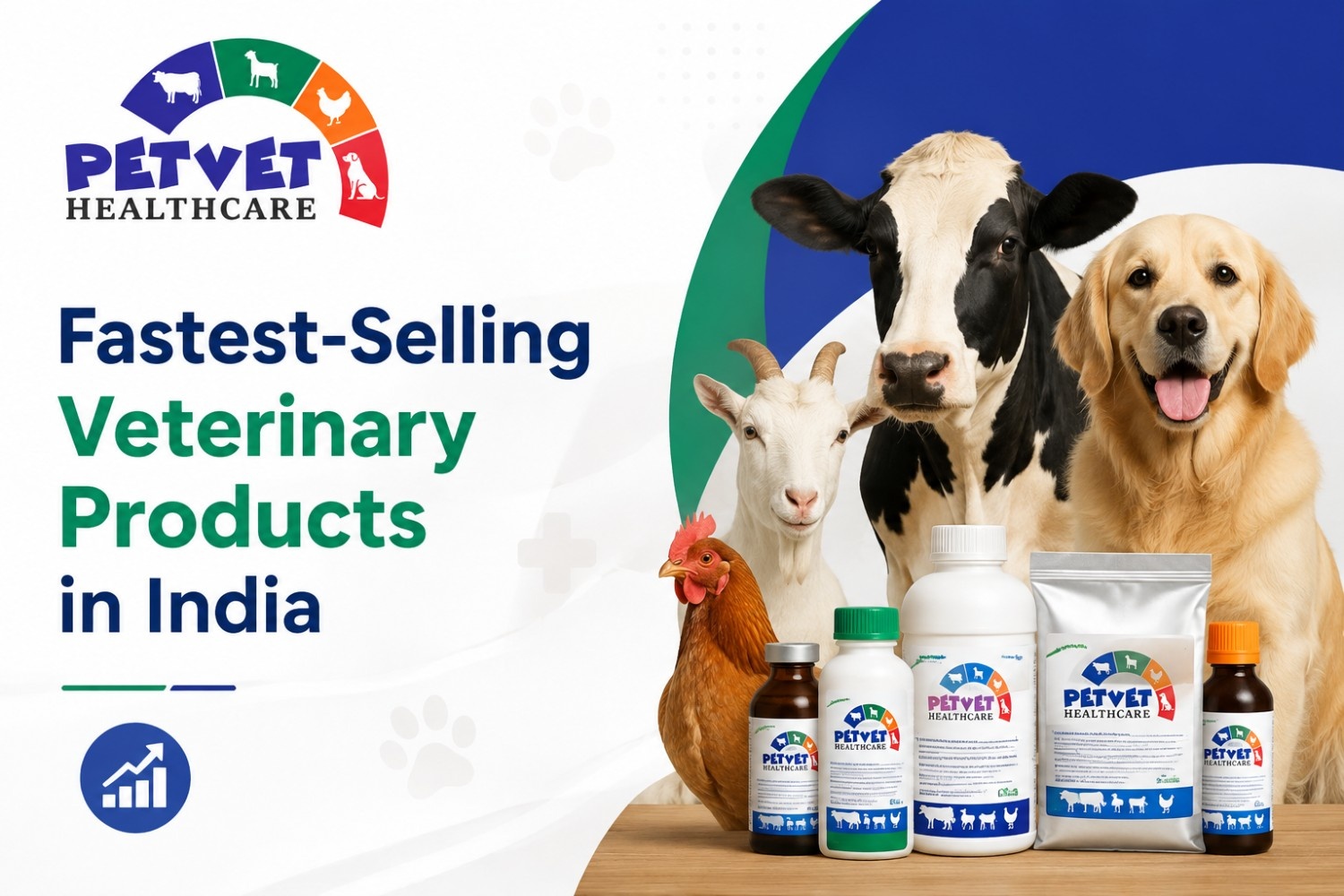
The fastest-selling veterinary products in India are calcium boluses and gels, broad-spectrum antibiotic injections, liver tonics, mineral mixtures, and anti-inflammatory injections. These five categories move fastest because livestock consume them continuously through the year, creating predictable repeat orders rather than one-time seasonal spikes.
PetVet Healthcare is a WHO-GMP and cGMP certified veterinary medicine manufacturer based in Ambala Cantt, Haryana, supplying injections, boluses and feed supplements to distributors, dealers and stockists across India. This guide draws on what actually moves through our distribution network — not on category lists copied out of a market report. For the full catalogue, see our veterinary product list.
Why some stock sells and other stock just sits
There is one distinction that explains most of it, and once you see it you cannot unsee it.
Some veterinary products are consumption-driven. The animal needs them regularly, whether or not it is sick. Mineral mixtures, calcium supplements, liver tonics — a dairy farmer with 20 buffaloes buys these month after month, because stopping means milk yield drops. The reorder is automatic.
Other products are event-driven. They sell only when something goes wrong. A specific antibiotic for a specific infection. A specialised hormone. Real demand exists, but it is lumpy and unpredictable, and if the veterinary doctors in your territory prefer a different molecule, you are stuck holding it.
Consumption beats events. Every time.
So when a company representative shows you a high-margin specialty product, the first question is not about margin. It is whether the animal needs it every month, or only when a problem appears.
The five fastest-moving categories, ranked by reorder frequency
Below is how these categories behave in a typical distribution territory. Reorder cycles are averages across our partner network — a dense dairy belt runs faster, a mixed-farming district slower.
| Category | Primary use | Main buyer | Reorder cycle | Demand stability |
|---|---|---|---|---|
| Calcium boluses & gels | Milk fever, post-calving recovery, lactation support | Dairy farms, vet clinics | 20–30 days | Very high, year round |
| Antibiotic injections | Mastitis, respiratory infection, wound infection | Vet clinics, large farms | 25–40 days | High |
| Liver tonics | Appetite loss, recovery, post-treatment support | Dairy & poultry farms | 30–45 days | Very high |
| Mineral mixtures | Daily feed supplementation, fertility, yield | Dairy farms, feed dealers | 30 days | Very high, year round |
| Anti-inflammatory injections | Pain, fever, inflammation, post-surgical | Vet clinics | 30–45 days | High |
| Electrolytes & poultry supplements | Heat stress, dehydration, gut health | Poultry integrators | 15–25 days in summer | Seasonal spike |
| Dewormers | Internal parasite control | All livestock owners | Quarterly cycles | Predictable, cyclic |
1. Calcium boluses and gels — the safest first order
If you are opening a new territory and can only stock one thing properly, stock calcium.
Milk fever hits dairy animals around calving, and it hits hard. A high-yielding buffalo that goes down with hypocalcaemia costs the farmer far more than the treatment ever would. So farmers buy calcium not just to treat but to prevent — before calving, after calving, and through peak lactation.
That is three purchase occasions per animal, per cycle. Multiply it across a dairy belt and you have the single most reliable reorder in veterinary distribution. Our calcium bolus and feed supplement range is the highest-volume category moving through our distributor network, and has been for years.
2. Broad-spectrum antibiotic injections
Mastitis alone keeps this category alive. Add respiratory infections, wound management and post-surgical cover, and antibiotic injections become the backbone of clinic-side sales.
One caution here, and it matters more every year. Antimicrobial resistance regulation is tightening. Stick to suppliers who follow current labelling and withdrawal-period norms properly. A cheap antibiotic from an unverified source is not a bargain — it is a liability sitting in your godown.
3. Liver tonics
Underrated by new distributors. Loved by experienced ones.
Liver tonics sell because they are the default supportive therapy. Animal off feed? Liver tonic. Finished an antibiotic course? Liver tonic. Poultry batch underperforming? Liver tonic. Veterinary doctors prescribe them alongside almost everything else, which means the category rides on the back of every other sale you make.
4. Mineral mixtures
This is the closest thing to grocery in veterinary distribution. Bought by weight, consumed daily, reordered on schedule. Margins per kilo are thinner than injectables, but volume compensates — and volume is what keeps a distribution business’s cash cycle healthy.
5. Anti-inflammatory injections
Fever, pain, inflammation, lameness. Steady clinic demand across cattle, buffalo, small ruminants and companion animals. Pairs naturally with antibiotics, so bundled prescribing is common and the two categories pull each other along.
When do veterinary products sell fastest during the year?
Veterinary product demand in India follows a fairly consistent annual pattern. Calcium and mineral supplements peak during the main calving months of October to January, poultry electrolytes and heat-stress products peak from April to June, and antibiotic demand rises sharply through the monsoon from July to September when infection load increases.
Here is the working calendar our distributors plan purchases against.
| Period | What moves fastest | Why it happens |
|---|---|---|
| Jan – Mar | Mineral mixtures, liver tonics, dewormers | Post-calving lactation support; pre-summer conditioning |
| Apr – Jun | Electrolytes, heat-stress supplements, poultry range | Peak summer; heat stress in poultry and cattle; dehydration |
| Jul – Sep | Antibiotic injections, anti-inflammatories, hoof care | Monsoon — infection load, foot rot, mastitis, wound cases |
| Oct – Dec | Calcium boluses & gels, uterine cleansers, fertility support | Main calving season across most Indian dairy belts |
Two practical notes on this calendar.
First, order roughly six weeks ahead of each window, not during it. Manufacturers face the same demand spike you do, and July is a bad month to discover everyone’s antibiotic stock is already committed.
Second, this shifts by region. Kerala’s monsoon is not Punjab’s monsoon. Adjust it to your own territory rather than following it blindly.
Regional demand — India is not one market
A distributor in Ludhiana and a distributor in Coimbatore are technically in the same business, selling almost completely different baskets.
In the northern dairy belt — Punjab, Haryana, western Uttar Pradesh, Rajasthan — high-yield buffalo and crossbred cattle dominate. Calcium, mineral mixtures and fertility products lead, with strong injectable demand from a dense network of private veterinary practitioners.
Across the western belt, Gujarat and Maharashtra’s cooperative dairy structure means bulk buying through unions and larger farms. Volume-driven products do well, and pricing pressure is real.
The southern states shift the mix again. Tamil Nadu, Andhra Pradesh, Telangana and Karnataka carry heavy poultry concentration alongside dairy, which pushes electrolytes, gut-health products and poultry-specific supplements much higher up the list.
Uttar Pradesh remains the largest single state market, accounting for roughly 14% of India’s animal health market in 2025 according to IMARC Group’s India animal health analysis, driven by its livestock population and established dairy and poultry infrastructure. Pharmacies and drug stores account for around 45% of all animal health distribution in the country — which is to say, distributors and stockists still control the largest share of how these products reach the end user.
What margins should distributors realistically expect?
Margin talk in this industry gets exaggerated on both sides. Company representatives quote the best case. Distributors quote the worst. The honest picture sits in the middle and varies sharply by category.
| Product type | Typical distributor margin | Volume behaviour | Cash cycle |
|---|---|---|---|
| Feed supplements & mineral mixtures | 15–25% | Very high volume | Fast — 20–30 days |
| Calcium boluses & gels | 20–30% | High volume | Fast — 20–30 days |
| Liver tonics & general supplements | 25–35% | Steady volume | Moderate — 30–45 days |
| Antibiotic & anti-inflammatory injections | 20–30% | Moderate volume | Moderate — 30–45 days |
| Specialty / niche molecules | 35–50% | Low, unpredictable | Slow — 90+ days |
Margin bands are indicative ranges observed across PCD and wholesale arrangements in India as of 2026. Actual terms vary by manufacturer, order volume, territory exclusivity and payment cycle.
Look at that last row carefully. A 50% margin on a product that sells four units a quarter earns you less than an 18% margin on something that moves 400 kilos a month — and it ties up money you could have rotated three times over in the same period.
Fast-moving beats high-margin. Not always. But usually.
How to choose a B2B veterinary medicine supplier in India
This is where most distributors get hurt, and usually not because they picked a dishonest supplier. They picked one they never checked properly.
Check the manufacturing certification before the price list
WHO-GMP certification means the facility has been audited against Good Manufacturing Practice standards for consistency, contamination control, documentation and batch traceability. It is not decorative. When a batch fails in the field — wrong potency, sedimentation, a broken seal — GMP documentation is what lets you trace it and get it resolved. The WHO’s own GMP guidance sets out exactly what the audit covers if you want to understand it properly.
Ask for the certificate. Ask for the number. Ask when it expires. A genuine WHO-GMP certified supplier sends it without hesitation.
Confirm the drug licence and product approvals
Veterinary medicines in India are regulated under the Drugs and Cosmetics Act, 1940 and its rules. Manufacturing and marketing require valid licences from the State Drug Controller, with oversight from the Central Drugs Standard Control Organisation (CDSCO). Verify that product labels carry manufacturing licence numbers, batch numbers, manufacturing and expiry dates, and withdrawal periods where applicable.
Judge the supplier on the boring things
Certification gets a supplier onto your shortlist. What keeps them there is far less glamorous.
Do they hold consistent stock of their fast movers, or does the calcium go out of stock every October exactly when you need it? Is there one person who answers your call, or a different number every time? How do they handle a damaged consignment or a near-expiry batch — replacement, credit note, or silence? Do they respect territory boundaries, or will you find your own products selling two districts away at a lower rate?
Ask for two existing distributor references. Call them. Twenty minutes of phone calls saves years of regret.
Five stocking mistakes that cost distributors money
These come up again and again in conversations with our partners.
Ordering by margin instead of by movement is the first and biggest. A high-margin product that sits for a year delivers a negative return once you account for capital tied up and expiry risk.
Second, ignoring what local veterinary doctors actually prescribe. Your real customer is often the vet, not the farmer. If practitioners in your belt trust a particular molecule or brand, stocking against that preference is an expensive argument to win.
Third, over-ordering on the first purchase. New suppliers offer better terms on larger opening orders, which is precisely why so many distributors end up holding eighteen months of stock against four months of demand.
Fourth, not tracking expiry by batch. Veterinary products carry real shelf-life limits, and near-expiry stock is close to impossible to move at full price.
Fifth — and this one is quieter — stocking too many brands in the same category. Three calcium boluses from three companies means triple inventory, volume split three ways, and none of the leverage that comes with concentrated buying.
Working with PetVet Healthcare as your veterinary product supplier
PetVet Healthcare manufactures veterinary injections, boluses and feed supplements from a WHO-GMP and cGMP certified facility in Ambala Cantt, Haryana. We supply directly to distributors, dealers, stockists and PCD franchise partners across India.
Our range is built deliberately around the categories described above — the ones that move, rather than the ones that look impressive in a catalogue.
The feed supplement range covers calcium, liver tonics, multivitamins, mineral mixtures, gels and electrolytes. Injections cover antibiotics and anti-inflammatories manufactured under aseptic conditions. Boluses span calcium, appetite and antibiotic formulations. Every raw material and finished batch is tested in-house against pharmacopeial standards before release.
What distributor partners get
- WHO-GMP and cGMP certified manufacturing, with documentation available on request
- Monopoly rights by territory under our PCD franchise arrangement
- Promotional support — visual aids, sample packs and order-boosting materials
- Consistent stock availability on the fast-moving categories
- Competitive bulk pricing for wholesale and stockist partners
- Third-party and contract manufacturing if you want to build your own brand
If you are evaluating a distribution partnership, the veterinary PCD pharma franchise page covers territory rights and margin structure in detail. If you already have a brand and need a manufacturing partner instead, our third-party veterinary medicine manufacturing service handles formulation, packaging and regulatory documentation.
You can also browse the full product gallery or read more about our manufacturing standards on the about us page.
Frequently Asked Questions
Which veterinary products have the highest demand in India?
Calcium boluses and gels, mineral mixtures, liver tonics, broad-spectrum antibiotic injections and anti-inflammatory injections carry the highest and most consistent demand. These are consumption-driven products, meaning livestock need them regularly rather than only during illness, which produces reliable monthly reorders for distributors.
How much investment is needed to start veterinary medicine distribution in India?
A district-level setup typically starts between ₹1.5 lakh and ₹5 lakh depending on territory size and how deep you go on stock. That covers opening inventory, a drug licence, GST registration and basic storage. PCD franchise arrangements usually start lower because the opening order requirement is smaller. Discuss your specific territory with the manufacturer before fixing a number.
What licence do I need to distribute veterinary medicines in India?
You need a wholesale drug licence from your State Drug Controller under the Drugs and Cosmetics Act, 1940, along with GST registration. If you stock Schedule H products, a registered pharmacist may be required depending on your state’s rules. Premises must meet minimum area and storage conditions, including cold storage where the product demands it.
Why does WHO-GMP certification matter when choosing a supplier?
WHO-GMP certification confirms the facility has been audited for quality control, contamination prevention, batch documentation and traceability. For a distributor this matters practically, not just on paper — if a batch has a problem in the field, GMP documentation is what lets you trace it, replace it, and protect your own standing with veterinarians and farmers.
What margin do veterinary product distributors make in India?
Margins generally run 15–25% on feed supplements and mineral mixtures, 20–30% on calcium products and injectables, and 35–50% on specialty molecules. Higher margin does not mean higher earnings. A fast-moving 20% product usually returns more annually than a slow 45% one, because your capital rotates several times over the same period.
How do I know which products will sell in my territory?
Talk to five or six veterinary practitioners in your area before placing a first order and ask what they prescribe most often. Check what existing distributors stock. Look at the dominant livestock type — a buffalo dairy belt needs a very different basket from a poultry-heavy district. Then start small across your top five categories and expand from what actually moves.
Is there a difference between PCD franchise and wholesale distribution?
Yes. A PCD franchise usually gives you monopoly rights in a defined territory, promotional support and the company’s brand backing, in exchange for buying only from that manufacturer. Wholesale distribution gives you freedom to stock multiple companies but no territory protection. PCD suits distributors building a long-term territory; wholesale suits established stockists with an existing customer base.
How far in advance should distributors place seasonal orders?
Roughly six weeks ahead of the demand window. Order calcium and uterine products by mid-September for the October to December calving season, poultry electrolytes by late February for summer, and antibiotics by late May for the monsoon. Manufacturers face the same seasonal spike, so ordering during peak demand often means waiting.
Ready to stock the products that actually move?
PetVet Healthcare works with distributors, dealers and stockists across India as a WHO-GMP certified B2B veterinary medicine supplier. Whether you are opening a new territory or replacing an unreliable current supplier, we can talk through what makes sense for your region and livestock mix. Call +91 86074 15111 or +91 82228 98961, email petvetindia@gmail.com, or use the contact form to get started.
PetVet Healthcare · GRANMED PHARMA PVT LTD, CR 1, Nanhera Road, Kuldeep Nagar, Nanhera, Ambala Cantt, Haryana 133004 · WHO-GMP & cGMP certified veterinary medicine manufacturer.