What Is Tick Fever in Dogs?
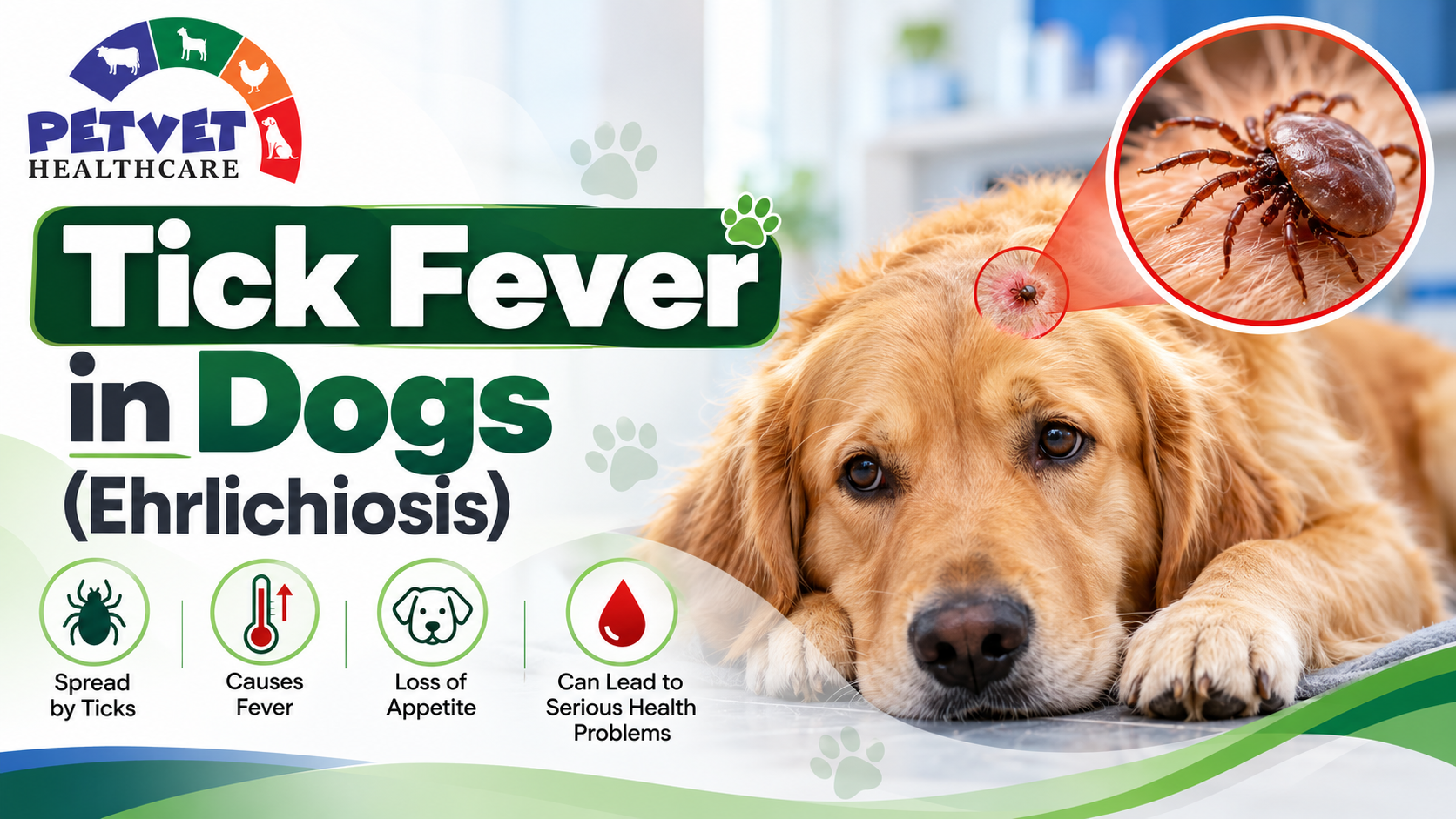
Tick fever in dogs is a blood infection spread by the bite of an infected tick. In India it is most often ehrlichiosis, caused by the bacterium Ehrlichia canis and carried by the brown dog tick. It lowers platelets, causes fever and bleeding, and is curable with early antibiotic treatment from a vet.
In simple words: the tick bites, germs enter the blood, and they attack the white blood cells. The body then struggles to make platelets, the cells that stop bleeding. That is why a nosebleed or dark stool is a warning sign.
Indian vets see this disease all year. In one Punjab study, 86.9% of dogs with suspected tick fever tested positive for E. canis antibodies (Veterinary World, 2017). So if your dog has ticks and stops eating, think of tick fever first.
Tick fever in dogs is curable when treated early. Most dogs feel better within 24–48 hours of starting the right antibiotic, but the full course usually runs 28 days (Merck Veterinary Manual).
About this guide
- Written by: Team PetVet Healthcare, Ambala Cantt — WHO-GMP certified veterinary medicine manufacturer since 2019
- Medically reviewed by: [Add vet name, BVSc & AH / MVSc, registration no.]
- Last updated: 31 October 2026
- How we made it: We reviewed the Merck Veterinary Manual, CDC guidance, and peer-reviewed Indian field studies from Punjab, Odisha, Haryana, Chennai and Nagpur. We compared their findings in one table below so owners can see how common the disease is in India. All numbers link to their source.
This article is for awareness. It does not replace a vet visit. Never start antibiotics without a vet’s advice.
Types of Tick Fever in Dogs: Ehrlichiosis vs Babesiosis vs Anaplasmosis
“Tick fever” is a common name, not one disease. In India, the brown dog tick (Rhipicephalus sanguineus) can carry several germs, and many dogs carry more than one at a time. Your vet’s blood test tells which one it is.
| Type | Germ | What it attacks | Key sign | Usual treatment (vet only) |
|---|---|---|---|---|
| Ehrlichiosis (most common) | Ehrlichia canis (bacteria) | White blood cells, bone marrow | Low platelets, nosebleed, fever | Doxycycline, 28 days |
| Babesiosis | Babesia gibsoni, B. vogeli (protozoa) | Red blood cells | Severe anaemia, dark or red urine, jaundice | Antiprotozoal drugs (e.g. imidocarb, atovaquone + azithromycin) |
| Anaplasmosis | Anaplasma platys (bacteria) | Platelets | Bruising, mild bleeding | Doxycycline |
| Hepatozoonosis | Hepatozoon canis (protozoa) | White blood cells, muscles | Weight loss, muscle pain | Vet-guided combination therapy |
Why this matters: babesiosis does not respond to doxycycline alone. Guessing the type at home can waste days your dog may not have. This is why a blood smear or PCR test comes first.
The rest of this guide focuses on ehrlichiosis, the form most Indian owners mean when they say tick fever.
Tick Fever in Dogs Symptoms
The first signs of tick fever in dogs show up 1 to 3 weeks after a tick bite: tiredness, fever and loss of appetite (CDC). Bleeding signs such as a nosebleed come later and mean the platelets are already low.
What Indian vets actually see
We compared two Indian clinical studies to show how often each sign appears in confirmed cases:
| Symptom | Odisha study (56 dogs, 2019–2022) | Punjab study (73 dogs) |
|---|---|---|
| Lethargy / weakness | 100% | 47.9% |
| Fever | 75% | 38.4% |
| Poor appetite | 69.6% | 42.5% |
| Nosebleed (epistaxis) | 46.4% | — |
| Black, tarry stool (melena) | — | 42.5% |
| Pale gums | — | 32.9% |
| Swollen belly (fluid) | 26.8% | — |
| Swollen hind legs | 16.1% | — |
| Ticks seen on the dog | 79% | 60.3% |
Sources: Pathogens, 2024 (Odisha); Veterinary World, 2017 (Punjab). A dash means that study did not report the sign.
Our takeaway: lethargy and poor appetite are the most common early clues. Fever is missed in many dogs because owners do not check temperature. A normal dog’s temperature is about 101–102.5°F; above 103°F needs a vet.
The three stages of ehrlichiosis
- Acute stage (weeks 1–4): fever, tiredness, swollen lymph nodes, low platelets. Most dogs respond well to treatment here.
- Subclinical stage (months to years): the dog looks normal, but the germ hides in the body. Only a blood test shows low platelets.
- Chronic stage: the bone marrow fails. Signs include severe anaemia, repeated bleeding, eye inflammation, weight loss and kidney damage. German Shepherds are more at risk of this severe form (Merck Veterinary Manual).
Red-flag signs: go to the vet today
- Nosebleed, even a small one
- Black stool or blood in urine
- Red or purple spots on the gums, belly or ears
- Very pale or white gums
- Refusing food for more than 24 hours
- Wobbly walking, seizures, or swollen legs
How Vets Diagnose Tick Fever
A vet confirms tick fever with blood tests, not by symptoms alone. The most useful clue is a low platelet count: in the Punjab study, every seropositive dog had low platelets, with an average of 56,000/µL against about 3,23,000/µL in healthy dogs (Veterinary World, 2017).
| Test | What it shows | Good to know |
|---|---|---|
| CBC (complete blood count) | Low platelets, anaemia | First and cheapest step |
| Blood smear | Germ seen under microscope | Often misses it: only 3.9–14.3% positive in Indian studies |
| Rapid kit (SNAP 4Dx, dot-ELISA) | Antibodies to E. canis | Result in 10 minutes at the clinic |
| PCR test | Germ’s DNA, exact species | Most accurate; also tells Ehrlichia from Babesia |
| Liver and kidney tests | Organ damage | Needed in long or severe cases |
Example: In the Odisha study, a plain blood smear found the germ in only 3.93% of dogs, while PCR confirmed it in most positive dogs (Pathogens, 2024). A “negative smear” does not rule out tick fever.
Treatment for Tick Fever in Dogs
The standard treatment for tick fever in dogs is the antibiotic doxycycline, given for 28 days. Vets often start it before test results come back, because waiting can let the disease get worse (Merck Veterinary Manual).
What a typical vet treatment plan includes:
- Antibiotic: doxycycline (or minocycline) for 28 days. The dose depends on body weight, so only your vet should set it.
- Supportive care: IV fluids for dehydration, liver tonic, and iron or vitamin B12 for anaemia.
- Platelet support: blood or platelet transfusion if bleeding is severe.
- Tick removal: killing ticks on the dog and in the house, so re-infection does not happen.
- Follow-up tests: a repeat CBC after 2–4 weeks. In chronic cases, blood values can take 3–6 months to return to normal.
Injectable or oral? Very weak dogs that vomit often start on injections at the clinic, then switch to tablets at home. Read our guide on injectable vs oral veterinary medicine.
Most common mistake: stopping tablets once the dog starts eating again. The fever goes in 1–2 days, but the germ is still in the body. Stopping early is a main reason dogs relapse.
Tick Fever in Dogs Treatment at Home: What Is Safe
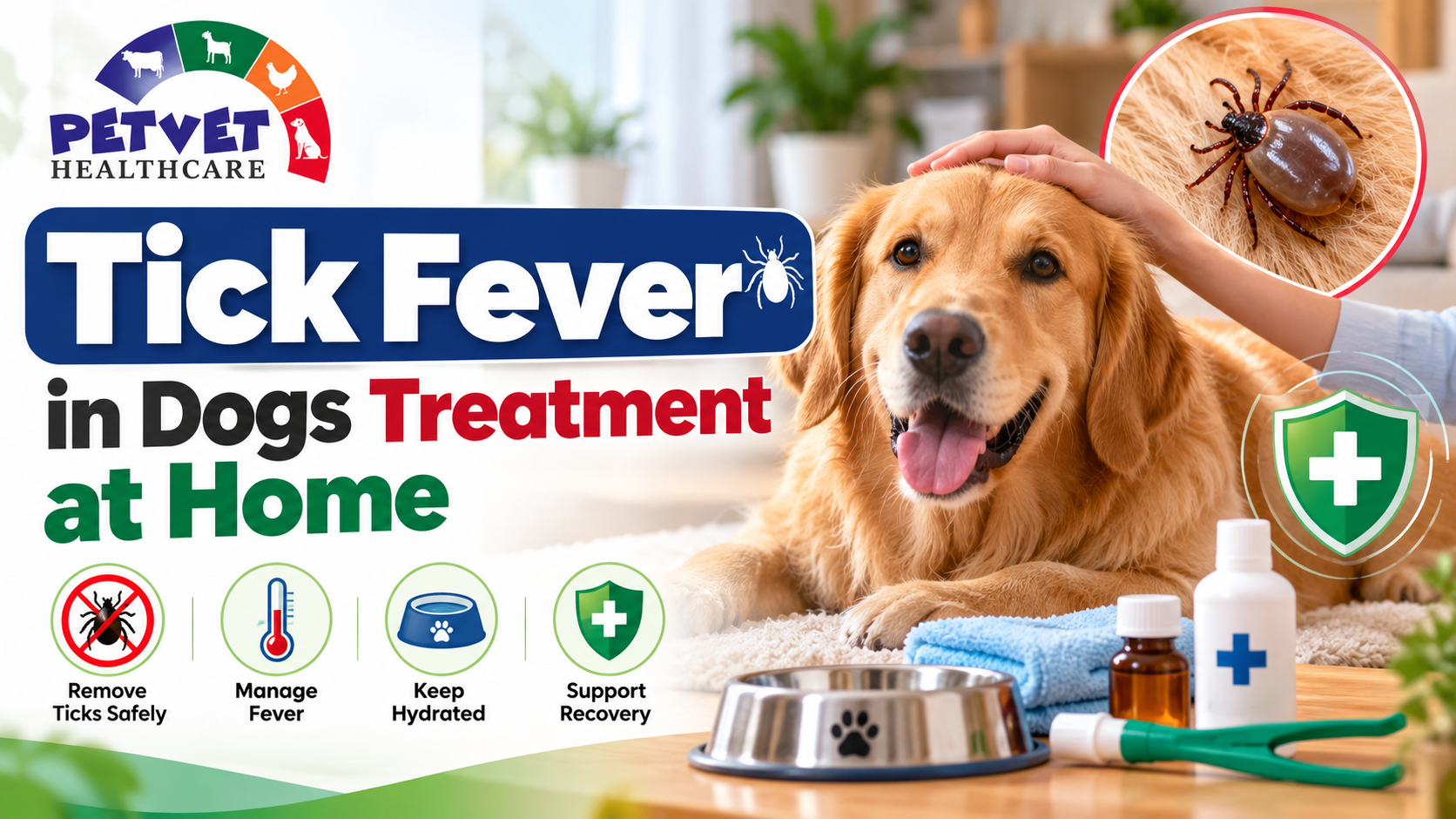
You cannot cure tick fever at home, but good home care helps recovery a lot. Use these steps alongside your vet’s medicine, never instead of it:
- Give every dose on time and finish all 28 days.
- Give doxycycline with food to reduce vomiting. Do not give it with milk, curd or calcium tablets; they block absorption.
- Offer soft, easy food: boiled chicken and rice, eggs, or soaked kibble in small meals.
- Keep water fresh and add ORS if your vet allows it.
- Rest: no running or rough play. Low platelets mean even a small injury can bleed.
- Check gums daily: pink is good; pale or white means call your vet.
- Remove ticks safely with fine tweezers, close to the skin, pulling straight out (CDC).
Avoid these home remedies: human painkillers like paracetamol or ibuprofen (they are toxic to dogs or worsen bleeding), kerosene or petrol on ticks, and papaya-leaf juice as a replacement for treatment. There is no proof it cures ehrlichiosis in dogs.
Is Tick Fever in Dogs Curable?
Yes, tick fever in dogs is curable, especially in the acute stage. Most dogs clear the infection within 2–4 weeks of correct treatment, and fever usually falls within 24–48 hours (Merck Veterinary Manual). In the chronic stage, a cure is harder and some dogs need long-term care.
Tick Fever in Dogs Survival Rate
There is no single survival rate, because it depends on the stage at diagnosis. Early cases treated quickly usually recover well. Severe, late cases are a different story:
| Study | Dogs | Result |
|---|---|---|
| Israel, 100 confirmed cases (Harrus et al.) | 49 followed for one year | 34.7% died |
| Israel, hospitalised dogs (Shipov et al.) | 40 | 52.5% survived, 47.5% died |
These numbers come from referral hospitals, where the sickest dogs go. They show what happens when the disease reaches the bone marrow. In the second study, dogs with very low white cells, severe anaemia (PCV below 11.5%) and low potassium did not survive.
Bottom line: the earlier the test, the better the odds.
Is Tick Fever in Dogs Dangerous or Not?
Yes, tick fever is dangerous if ignored. Untreated, it can cause internal bleeding, bone marrow failure, kidney damage and death. With early diagnosis and a full antibiotic course, though, most dogs live a normal life. The danger is not the disease alone; it is the delay.
How Common Is Tick Fever in Indian Dogs?
Tick fever is common across India, from Punjab to Odisha. We pulled together the Indian studies we reviewed into one table. Note that each study used a different test, so the numbers are not directly comparable. Antibody tests find more cases than a blood smear.
| Region | Dogs tested | Test used | Positive |
|---|---|---|---|
| Ludhiana, Punjab | 84 suspected cases | Dot-ELISA (antibodies) | 86.9% |
| Nagpur, Maharashtra | — | Blood smear | 42.85% |
| Bhubaneswar, Odisha (2019–2022) | 178 | Smear + PCR | 31.46% |
| Haryana and Delhi | — | Blood smear | 11.35% |
| Ludhiana, Punjab | 951 | Blood smear | 7.9% |
| Chennai, Tamil Nadu | 485 | Blood smear | 6% |
Sources: Veterinary World, 2017 (Punjab study and the earlier Indian studies it cites); Pathogens, 2024 (Odisha).
What the data tells owners:
- Among dogs that already look sick with ticks, most test positive. Do not wait for the “classic” nosebleed.
- In Odisha, 55% of cases came in summer, and 25% of positive dogs were German Shepherds.
- Dogs that go outdoors and dogs over 20 kg made up most cases there, though these links were not statistically strong.
Tick Fever in Dogs and Cats: Can Cats Get It Too?
Yes, cats can get tick-borne infections, including ehrlichiosis, but it is rare compared with dogs (Cornell Feline Health Center). Cats groom off many ticks, which may be one reason.
| Point | Dogs | Cats |
|---|---|---|
| How common | Common in India | Rare |
| Main signs | Fever, low platelets, nosebleed | Fever, anaemia, tiredness, weight loss |
| Treatment | Doxycycline, 28 days | Doxycycline-type antibiotics, vet-guided |
| Big risk | Dog tick products on cats | Many dog tick products (permethrin) are toxic to cats |
Important: never use a dog’s tick spray, collar or spot-on on a cat. Ask your vet for a cat-safe product.
Can Humans Get Tick Fever from Dogs?
No, you cannot catch tick fever directly from your dog. It spreads only through tick bites, not by touch, licking or sharing a home (CDC). But a dog with ticks means ticks are around you too. Wear gloves when removing ticks, and never crush one with bare fingers.
How to Prevent Tick Fever in Dogs
Tick control is the only real prevention. There is no vaccine for canine ehrlichiosis. Follow this plan:
- Use a vet-approved tick preventive year-round: spot-on, collar, or oral tablet. Common actives include fipronil, isoxazolines (fluralaner, afoxolaner), pyrethroids and amitraz (Merck Veterinary Manual).
- Check your dog daily after walks: ears, between toes, under the collar, armpits and tail base.
- Treat the house too. The brown dog tick lives indoors in wall cracks, kennels and bedding. Wash bedding in hot water weekly.
- Keep grass short around the house and avoid stray-dog gathering spots on walks.
- Never use human mosquito repellents on dogs (CDC).
- Get a CBC done if your dog had ticks in the past month and seems dull. Early testing saves lives.
- Keep routine care on track: vaccines and deworming keep immunity strong. See our pet vaccination schedule in India.
Practical example: (illustrative) say a Labrador in Ambala gets ticks after monsoon walks. The owner applies a monthly spot-on, checks paws every evening, and sprays the kennel corners every two weeks. Ticks stop returning within a month, and the risk of tick fever drops with them.
Prevention vs treatment cost: a simple comparison
| Prevention | Treating tick fever | |
|---|---|---|
| Time | A few minutes a month | 28 days of medicine + follow-up tests |
| Vet visits | 1–2 a year | Several, plus possible hospital stay |
| Risk to dog | Very low | Bleeding, organ damage in late cases |
| Effort | Low | High: daily tablets, diet care, rest |
Frequently Asked Questions About Tick Fever in Dogs
Can a dog recover from tick fever?
Yes. Most dogs recover fully when treated in the acute stage. Fever usually drops within 24–48 hours of starting doxycycline, and the infection clears in 2–4 weeks. Dogs diagnosed in the chronic stage, with bone marrow damage, recover more slowly and some need lifelong monitoring.
What are the first signs of tick fever in dogs?
The first signs are tiredness, loss of appetite and fever, usually 1–3 weeks after a tick bite. Many owners first notice their dog “is just not himself.” In Indian studies, lethargy appeared in up to 100% of confirmed cases. Bleeding signs like a nosebleed come later.
How long does tick fever last in dogs?
The acute stage lasts about 2–4 weeks. Treatment runs for 28 days even if the dog looks well sooner. If untreated, the germ can hide for months or years and then cause chronic disease. In chronic cases, blood values may take 3–6 months to return to normal after treatment.
Can humans get tick fever from dogs?
No. Tick fever does not pass directly from dogs to people. Both get it only from infected tick bites, according to the CDC. However, ticks on your dog can also bite you. Remove ticks with tweezers and gloves, and wash your hands afterwards.
Is tick fever in dogs curable?
Yes, tick fever in dogs is curable with a full 28-day course of doxycycline prescribed by a vet. The cure rate is highest in the acute stage. Stopping tablets early is the most common reason for relapse, so finish the full course.
Is tick fever in dogs dangerous or not?
It is dangerous if ignored. Untreated tick fever can cause internal bleeding, severe anaemia, kidney damage and death. In one hospital study of severe cases, 47.5% of dogs died. With early testing and treatment, most dogs return to normal life.
What is the survival rate of tick fever in dogs?
Survival is high when the disease is caught early, but no single figure applies to all dogs. In studies of severe hospital cases, survival ranged from about 52% to 65%. Very low white cells, severe anaemia and low potassium were linked to death.
Can tick fever in dogs be treated at home?
No, not on its own. Tick fever needs a vet-prescribed antibiotic. At home, you can support recovery: give every dose with food, offer soft meals, keep the dog rested, and check gum colour daily. Avoid human painkillers and do not rely on papaya-leaf juice as a cure.
Can a dog get tick fever twice?
Yes. Recovering from ehrlichiosis does not give lasting protection, and dogs in tick-heavy areas can be re-infected. That is why year-round tick control matters even after a full recovery.
Related Reading on PetVet Healthcare
- Canine Parvovirus in Puppies: Symptoms, Treatment & Prevention
- Pet Vaccination Schedule in India: Dogs & Cats Complete Guide
- Winter Health Issues in Pets and How to Manage Them
- How to Spot and Deal With Pet Allergies
- Injectable vs Oral Veterinary Medicine: Which Works Better?
Quality Veterinary Medicines from PetVet Healthcare
PetVet Healthcare makes injections, boluses and feed supplements, including liver tonics and multivitamins, in a WHO-GMP certified facility in Ambala Cantt, Haryana. Vets and distributors across India use our range for supportive care.
- Browse our product list
- Become a distributor through our veterinary PCD pharma franchise
- Call +91 86074 15111 or contact us
Always use antibiotics only on a registered vet’s prescription.
Sources
- Merck Veterinary Manual — Ehrlichiosis in Dogs
- CDC — Ehrlichiosis in Dogs: Fast Facts for Dog Owners
- Clinical and haematobiochemical response in CME seropositive dogs of Punjab — Veterinary World, 2017
- Molecular Confirmation and Epidemiology of Ehrlichia canis in Eastern India — Pathogens, 2024
- Prognostic Indicators for Canine Monocytic Ehrlichiosis — Shipov et al.
- Canine Monocytic Ehrlichiosis: A Retrospective Study of 100 Cases — Harrus et al.
- Cornell Feline Health Center — Tick-borne diseases in cats