Haemorrhagic septicaemia (HS) is a sudden, deadly bacterial disease of cattle and buffalo, caused by Pasteurella multocida. Early signs are high fever, drooling, nasal discharge and fast breathing. Then the throat, neck and brisket swell. In the worst cases, death comes within 8–24 hours. Antibiotics work only if given very early, so yearly vaccination before the monsoon is the best protection.
What Is Haemorrhagic Septicaemia Disease?
HS is a blood-poisoning disease. Germs spread through the blood and attack the lungs and throat. It is also called “HS” or galghotu in many Indian regions [CONFIRM local names with reviewing vet].
- Cause: Pasteurella multocida, mainly types B:2 and E:2 (MSD Veterinary Manual)
- Who gets it: Mainly buffalo and cattle. Sheep, goats and pigs are rarely affected
- How it spreads: Through the spit and nose fluid of sick animals or carriers, and through contaminated feed and water
- Time to signs: 1–3 days after infection
- Human risk: HS is not considered a zoonotic disease (MSD)
Carrier animals look healthy but can still pass on the germ. This is why outbreaks can start suddenly in a herd that seemed fine.
How Big Is the HS Problem in India?
HS is one of India’s costliest cattle diseases. Here is what research shows:
| Fact | Number | Source |
|---|---|---|
| Outbreaks reported, Jan 1987 – Mar 2016 | 26,305 | Chanda et al., Scientific Reports, 2024 |
| Share of outbreaks in South India | 70.2% (Andhra Pradesh 10,285; Karnataka 7,399) | Chanda et al., 2024 |
| Share of outbreaks in North India | 5.6% | Chanda et al., 2024 |
| Peak month of outbreaks | August (monsoon) | Chanda et al., 2024 |
| Case fatality in buffalo | 63% | Bardhan et al., Indian Journal of Animal Sciences, 2020 |
| Case fatality in crossbred / indigenous cattle | 44% / 42% | Bardhan et al., 2020 |
| Share of HS deaths that are buffalo | 52% | Bardhan et al., 2020 |
| Loss per sick buffalo | ₹20,296 | Bardhan et al., 2020 |
| Yearly loss in bovines (most likely range) | ₹126–128 billion | Bardhan et al., 2020 |
Please note: Studies use different methods, so loss figures differ a lot. Chanda et al. report another estimate of about ₹5,255 crore (around US$800 million) per year, based on 2007–2011 outbreak data. Both show a very large loss.
What this means for you: Buffalo are hit hardest. This is why haemorrhagic septicaemia in buffalo needs extra care, especially in the rainy season.
Haemorrhagic Septicaemia in Cattle vs Buffalo
| Point | Buffalo | Cattle |
|---|---|---|
| Severity | Usually more severe | Often less severe |
| Case fatality (Bardhan 2020) | 63% | 42–44% |
| Share of deaths in the study | 52% | 48% (indigenous 31%, crossbred 17%) |
| Highest rate of sickness | Lower than crossbred cattle | Crossbred cattle (4.18% morbidity vs 3.27% in buffalo) |
| Also called | Water buffalo, carabao (Philippines) | Cow, bull, calf |
MSD notes that water buffalo generally show higher illness rates and more severe disease than cattle. Young calves and young adults are often the worst hit in endemic areas.
Hemorrhagic Septicemia Symptoms in Cattle and Buffalo
HS moves fast. Vets describe two forms.
Peracute form (the sudden form)
- Fever, drooling, nasal discharge and hard breathing
- Signs are easy to miss because the course is so short
- Death can occur within 8–24 hours of the first signs (MSD)
Acute form (the common form)
- High fever: 40–41.1°C (104–106°F)
- Dullness and loss of appetite
- Heavy drooling, watery eyes, and nasal discharge that turns thick and sticky
- Swelling of the throat, jaw, neck and brisket (the “chest front”)
- Noisy, difficult breathing, bluish gums or tongue
- Belly pain and loose motions in some animals
- Collapse, then death. The acute form usually lasts up to 3 days, sometimes 5 (MSD)
Quick timeline
| Time after signs begin | What you may see |
|---|---|
| Hour 0–6 | Fever, dullness, drooling, no cud chewing |
| Hour 6–24 | Throat and neck swelling, breathing trouble |
| Day 1–3 | Collapse, bluish colour, death if untreated |
What the vet may find after death
Swelling under the jaw and neck, small blood spots in organs, fluid in the chest and belly, and swollen lymph nodes. Pneumonia and lung congestion are common (MSD).
Look-alikes: Anthrax, blackleg, other Pasteurella infections, salmonellosis and poisoning can look similar (MSD). Do not cut open an animal that died suddenly. Call a vet first, because anthrax must be ruled out.
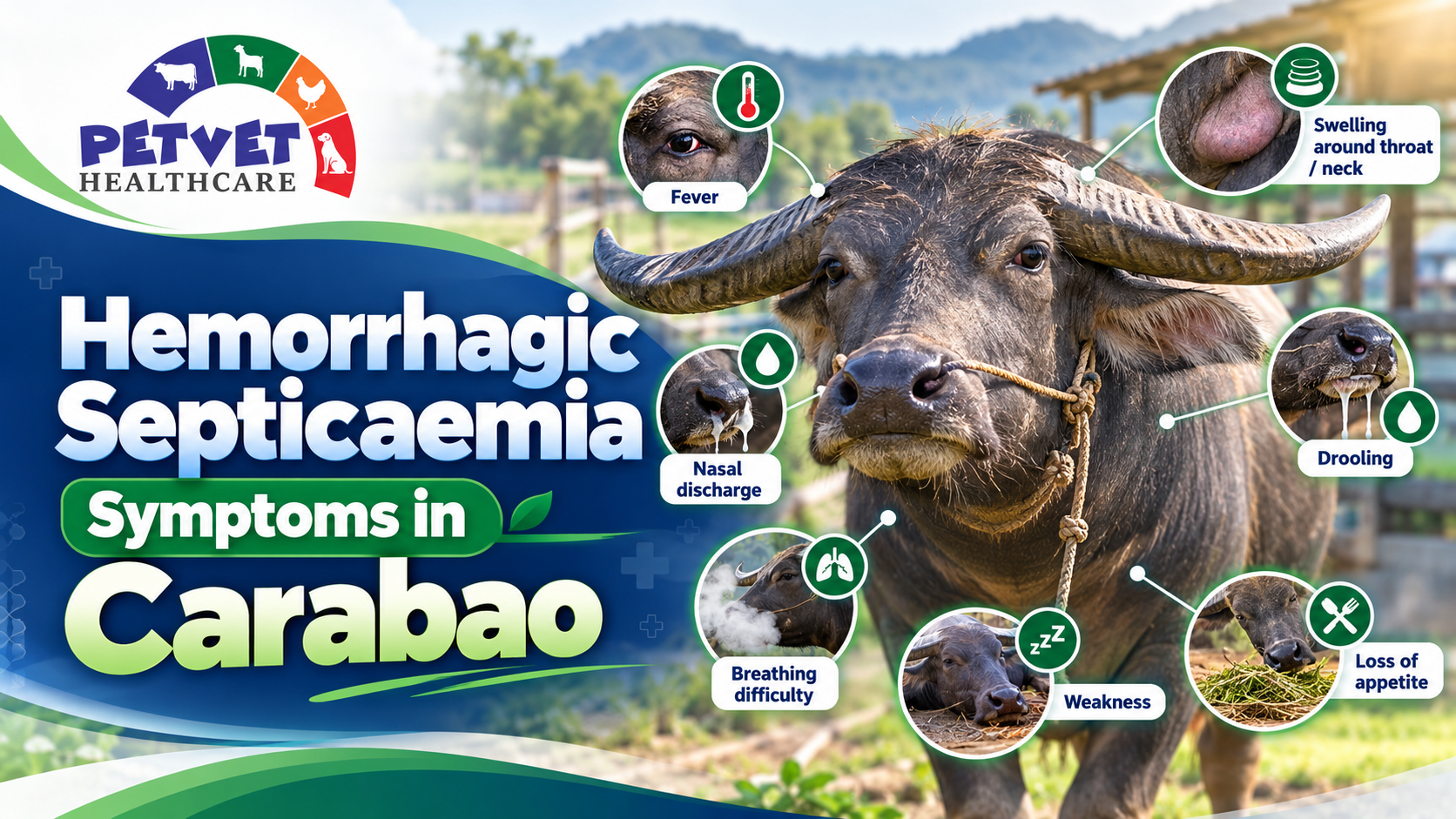
Hemorrhagic Septicaemia Symptoms in Carabao (Water Buffalo)
In the Philippines and some other countries, water buffalo are called carabao. The disease is the same. Expect fever, drooling, swelling of the throat and neck, and fast breathing. As in India, buffalo usually get a more severe illness than cattle.
How Is HS Diagnosed?
- History and signs: season, missed vaccination, sudden deaths in the herd
- Lab test (the proof): growing and identifying Pasteurella multocida B:2 or E:2 from blood or organs, or a PCR test (MSD)
Because HS moves so fast, vets often start treatment based on signs and send samples at the same time.
Hemorrhagic Septicemia Treatment: What Works?
What is the preferred drug for HS in cattle?
There is no single “best” drug. MSD lists these antibiotic groups as consistently effective:
- Fluoroquinolones (enrofloxacin, ciprofloxacin)
- Cephalosporins (ceftiofur)
- Florfenicol
- Tetracyclines (such as oxytetracycline)
Sulfonamides, penicillin and a few others worked in some outbreaks. But multidrug resistance is rising in some strains (MSD).
The most important rule: speed
Hemorrhagic septicemia in buffalo treatment follows the same rules as in cattle, but buffalo often get sicker faster, so they need even quicker action.
Antibiotics work best before or at the start of fever. Treatment often fails once the throat swells, because the disease moves too fast (MSD). Treat it as an emergency.
Supportive care a vet may add
- Medicine to bring down fever and pain
- Fluids and energy support
- Care for breathing trouble
- Vitamin and liver support during recovery
The vet decides the drug, dose and number of days. Do not use leftover medicine or random injections.
Milk and meat after treatment
Antibiotics leave residues. Follow the withdrawal period your vet gives before selling milk or meat. See our guide: Withdrawal Period of Veterinary Drugs.
Prevention: Vaccination Is Your Best Defence
Because treatment often comes too late, vaccination is the main tool.
| Vaccine type | Protection time | Notes (MSD) |
|---|---|---|
| Oil-adjuvant vaccine | About 9–12 months | Given once a year. Thick and harder to inject |
| Alum / gel vaccine | About 4–5 months | Booster needed twice a year |
Indian researchers (Chanda et al., 2024) report protection of about 6–9 months from commonly used vaccines, and suggest vaccinating in May–June, at least 3 months before the outbreak season. Vaccines are given free of cost in endemic areas through government services.
Calves need extra care. In a 2023 study of 60 Murrah buffaloes given a combined FMD + HS oil vaccine, protected calves fell from 60% at 3 months to 35% at 5–6 months, while adults stayed at about 80% at 6 months (Rustagi et al., 2023). The authors advise booster doses for calves.
Farm steps that lower risk
- Vaccinate before the monsoon and keep a written record. Ask your local vet or animal husbandry office for the right schedule.
- Avoid overcrowding in the rainy season.
- Give clean water and clean feed. Germs spread through contaminated feed and water.
- Separate sick animals at the first sign of fever or drooling.
- Report suspected cases to your vet or the local animal husbandry department fast.
- Check new animals before they join the herd.
- Disinfect sheds and troughs after a case, and ask your vet how to handle the carcass safely.
When to Call a Vet Right Now
- Fever with drooling and nasal discharge
- Swollen throat, neck or brisket
- Hard or noisy breathing
- Sudden death of any animal in the herd
- Unvaccinated animals in a monsoon outbreak area
How PetVet Healthcare Supports HS Care
PetVet Healthcare (Granmed Pharma Pvt. Ltd.), a WHO-GMP certified veterinary medicine manufacturer in Ambala Cantt, Haryana, supplies medicines that vets use in treatment and recovery. From our product list:
| Need | PetVet product | What it is |
|---|---|---|
| Antibiotic (vet-prescribed) | GROFLOX | Enrofloxacin 10% injection |
| Antibiotic (vet-prescribed) | CEFBOLD-CF | Ceftiofur sodium 1 g injection |
| Antibiotic (vet-prescribed) | GRANOXY | Oxytetracycline dihydrate 200 mg injection |
| Fever and pain relief (vet-prescribed) | GRANCET-P, GRANIM-P | Piroxicam + paracetamol; nimesulide + paracetamol injections |
| Liver and vitamin support | GRANLIV-XP, GRANLIV | Thiamine, multivitamin and liver extract injection; liver tonic with iron |
| Energy support | GRANBOOST | Propylene, nicotinamide and glucose |
| Vitamin C support | GRANVIT-C | Ascorbic acid injection |
Please note: PetVet does not sell an HS vaccine [CONFIRM]. Vaccines come from approved makers and government services. Our medicines support your vet’s plan. They are not a cure, and none of these products can undo late-stage HS. Use them only on a vet’s advice. [CONFIRM: all product details against approved labels before publishing.]
For vets, dealers and distributors: See the full PetVet product list, the veterinary PCD pharma franchise and third-party veterinary medicine manufacturing. To enquire, contact PetVet on +91 86074 15111 [email: petvetindia@gmail.com and petvethealthcare@gmail.com].
Frequently Asked Questions
What are the symptoms of haemorrhagic septicaemia (HS) in buffaloes?
Buffaloes show sudden high fever (40–41°C), dullness, heavy drooling and nasal discharge. Then the throat, neck and brisket swell, and breathing becomes noisy and hard. Gums may turn bluish. Buffaloes often get a more severe illness than cattle, and death can come within 8–24 hours in the fastest cases. Call a vet immediately.
What are the signs and symptoms of hemorrhagic septicemia?
The main signs are high fever, drooling, tearing eyes, nasal discharge, and swelling of the throat, neck and chest front. Animals breathe with effort and may turn bluish before collapsing. Some also have belly pain and loose motions. The disease moves fast, so any animal with fever and drooling during the monsoon needs urgent veterinary care.
What is the preferred drug for treating hemorrhagic septicemia (HS) in cattle?
No single drug is “preferred” for every case. Fluoroquinolones such as enrofloxacin, cephalosporins such as ceftiofur, florfenicol and tetracyclines are the groups most often effective. They work only if given very early. Resistance is rising, so a vet should choose the drug and dose, ideally after a lab test.
What are the symptoms of hemorrhagic septicemia in carabao?
Carabao is the Philippine name for water buffalo. The signs match those in Indian buffalo: fever, drooling, nasal discharge, swelling of the throat and neck, and fast, noisy breathing. Water buffalo usually suffer more severe disease than cattle. Early veterinary treatment and yearly vaccination before the rainy season give the best chance of saving them.
When should I vaccinate my cattle and buffalo against HS?
Vaccinate before the rainy season. Indian researchers suggest May–June, at least 3 months before the August peak. Oil-adjuvant vaccines protect for about 9–12 months, and alum vaccines about 4–5 months, so schedules differ. Calves may need a booster. Ask your local vet for the plan that suits your area.
Can humans catch haemorrhagic septicaemia from animals?
HS is not considered a zoonotic disease, according to the MSD Veterinary Manual, so it does not normally pass from cattle or buffalo to people. Still, wear gloves when handling sick animals, wash your hands, and do not open an animal that died suddenly, because other diseases like anthrax can look similar.
Key Takeaways
- HS is a sudden bacterial disease. It spreads through spit, nose fluid, feed and water.
- Fever, drooling and a swollen throat are the red flags. Death can come in 8–24 hours.
- Buffalo are hit harder than cattle: 63% case fatality versus 42–44% in one national study.
- Antibiotics work only when given very early, so call the vet at the first sign.
- Vaccinate every year before the monsoon, and give calves a booster.
- Supportive medicines help recovery but do not replace vaccination or veterinary care.
Related Reading
- PetVet product list and product gallery
- Canine Parvovirus in Puppies: Symptoms, Treatment & Prevention
- Withdrawal Period of Veterinary Drugs in Milk & Meat
- About PetVet Healthcare
Sources
- MSD Veterinary Manual. Hemorrhagic Septicemia in Water Buffalo and Cattle
- Chanda M.M. et al. (2024). Spatial and temporal analysis of haemorrhagic septicaemia outbreaks in India over three decades (1987–2016). Scientific Reports 14:6773. NORA repository (PDF)
- Bardhan D. et al. (2020). Economic losses due to hemorrhagic septicaemia in India. Indian Journal of Animal Sciences 90(3):341–346. ICAR e-Pubs
- Rustagi N. et al. (2023). Kinetics of humoral response to Pasteurella multocida in buffaloes against combined foot-and-mouth + haemorrhagic septicaemia vaccine. Indian Journal of Animal Sciences 93(9):853–857. ICAR e-Pubs (PDF)
- PetVet Healthcare. Product list