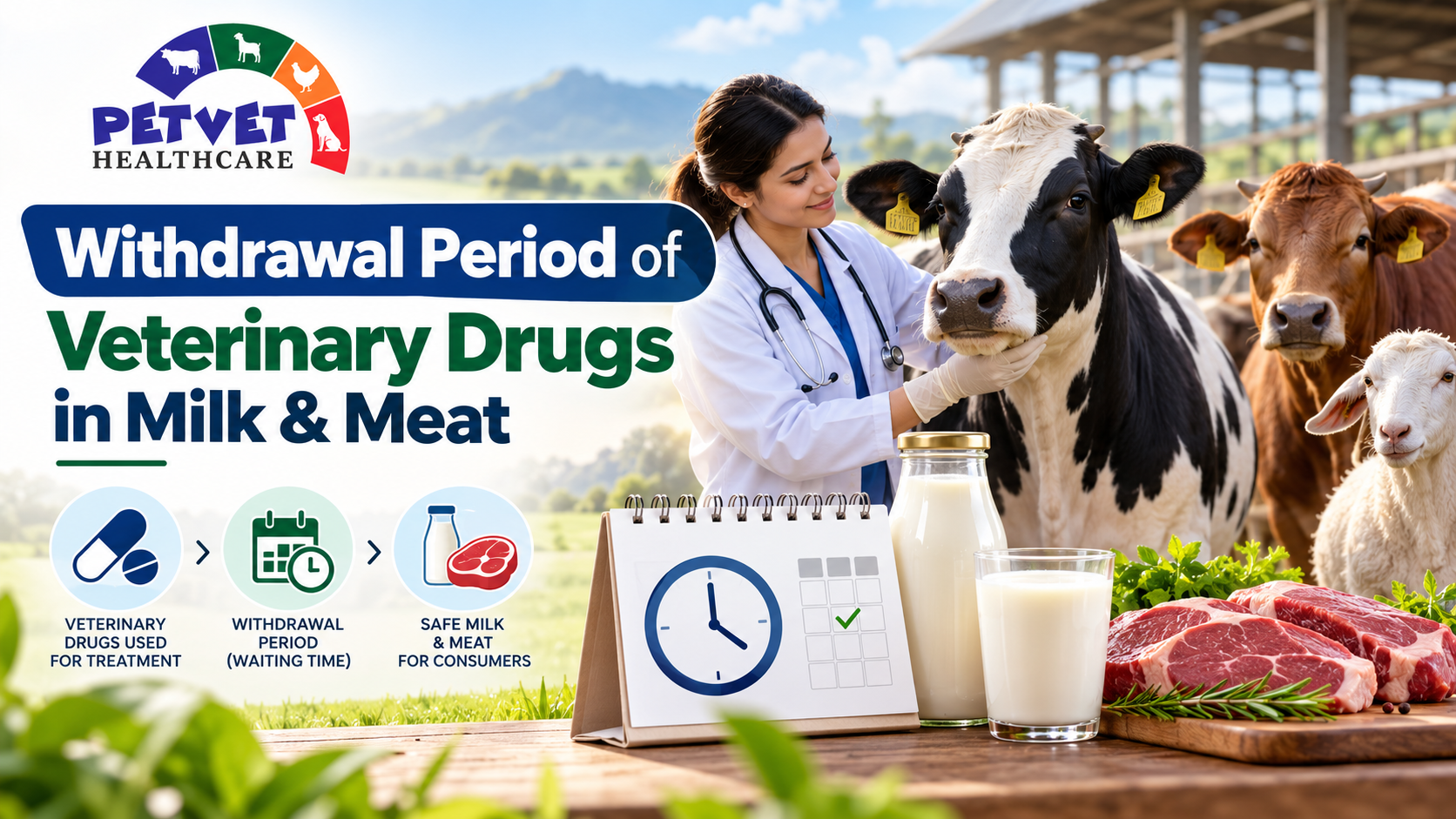
The withdrawal period of veterinary drugs is the minimum wait between the last dose of a medicine and the time you can safely use the animal’s milk, meat or eggs as food. During this time the drug leaves the body, so residues fall below the legal limit. The number of days is different for each drug, animal and food. Always read the label.
Withdrawal Period Meaning in Veterinary Medicine
Let’s keep it simple. When you treat a dairy cow, goat, buffalo, broiler or layer hen with a medicine, the drug stays in the body for some time. Small traces can pass into milk, meat and eggs.
The withdrawal period meaning in veterinary medicine is the time you must wait after the last dose before the food from that animal is safe to sell or eat. Finland’s medicines agency, Fimea, defines it as the minimum time between the last dose and the production of meat or other animal-derived food.
It is also called withdrawal time or withholding period.
A quick example (from Fimea): If a cow is treated for mastitis and the milk withdrawal period is 6 days, the farm can send milk to the dairy from day 7 after the last dose.
(This is only an example. Your product may have a different number. Check the label.)
What Is the Withdrawal Period for Drugs in General?
In human medicine, “withdrawal” often means the side effects a person feels after stopping a drug. That is not what we mean here. In veterinary medicine, withdrawal period is about food safety: how long to wait before using milk, meat or eggs from a treated animal.
Why Withdrawal Periods Matter
Skipping the wait may look harmless. But it puts people, your income and your animals at risk.
- Human health. Drug residues in food can add to antibiotic resistance (AMR). Resistant germs are harder to treat in people too.
- Legal risk. India’s food regulator, FSSAI, sets limits for antibiotic and veterinary drug residues in milk, meat, poultry and fish. Milk or meat above the limit can be rejected.
- Business loss. Dairies and buyers can reject a full milk tanker if one farmer’s milk has residues.
- Trade. Exporters must meet strict residue rules in other countries.
- Trust. Safe food builds a strong brand for your farm.
What the data shows:
- Failure to follow the correct withdrawal time is the most common cause of illegal drug residues in food, per the Merck Veterinary Manual.
- In FSSAI’s 2018 national milk survey, 77 milk samples from 13 states and 2 Union Territories crossed safe limits for antibiotic residues. Of these, 40 were processed milk and 37 were raw milk. (Down To Earth noted that the survey did not publish which drugs were found, and it did not test every antibiotic farmers use.)
- In July 2019, India’s Health Ministry banned colistin for food-producing animals, poultry, aqua farming and animal feed supplements, because of antibiotic resistance fears.
Key Factors Determining the Duration
Why can’t one number work for every withdrawal period veterinary medicine uses? Because the time a drug takes to leave the body depends on many things. Here are the key factors determining the duration of a withdrawal period:
| Factor | How it changes the wait |
|---|---|
| The drug itself | Some drugs leave the body fast. Others stay for days or weeks |
| Dosage form | Injection, bolus, powder in water, and feed mix can all behave differently |
| Dose | A higher dose takes longer to clear. Merck notes that doubling the dose adds one half-life to the time |
| Route | Muscle, vein, under-the-skin or by mouth give different residue patterns. Injection sites can hold residues longer |
| Length of treatment | Longer courses can mean longer waits |
| Animal species | Cow, buffalo, goat and chicken process drugs differently |
| Food type | Milk, meat, eggs and honey each have their own withdrawal time |
| Animal’s health | A sick animal with weak liver or kidney clears drugs slowly, so the wait may be longer |
| Off-label use | If you change the dose, route or species from the label, the label’s withdrawal time is no longer valid. Ask your vet |
How are the numbers set? Regulators run residue studies. Animals get the highest intended dose, and tissue samples (muscle, liver, kidney, fat) are tested over time. The withdrawal period is set so that residues drop below the Maximum Residue Limit (MRL), often with an added safety margin.
Withdrawal Period vs MRL vs Treatment Course vs Expiry Date
Many farmers mix up these four terms. This table clears it up.
| Term | Simple meaning | Who sets it |
|---|---|---|
| Withdrawal period | Days to wait after the last dose before using milk, meat or eggs | Drug regulator, printed on the label |
| MRL (Maximum Residue Limit) | The highest drug residue allowed in a food | Food regulator (in India, FSSAI), guided by global bodies like Codex/JECFA |
| Treatment course | How many days you give the medicine | The label and your vet |
| Expiry date | Last date the medicine itself is good to use | The manufacturer |
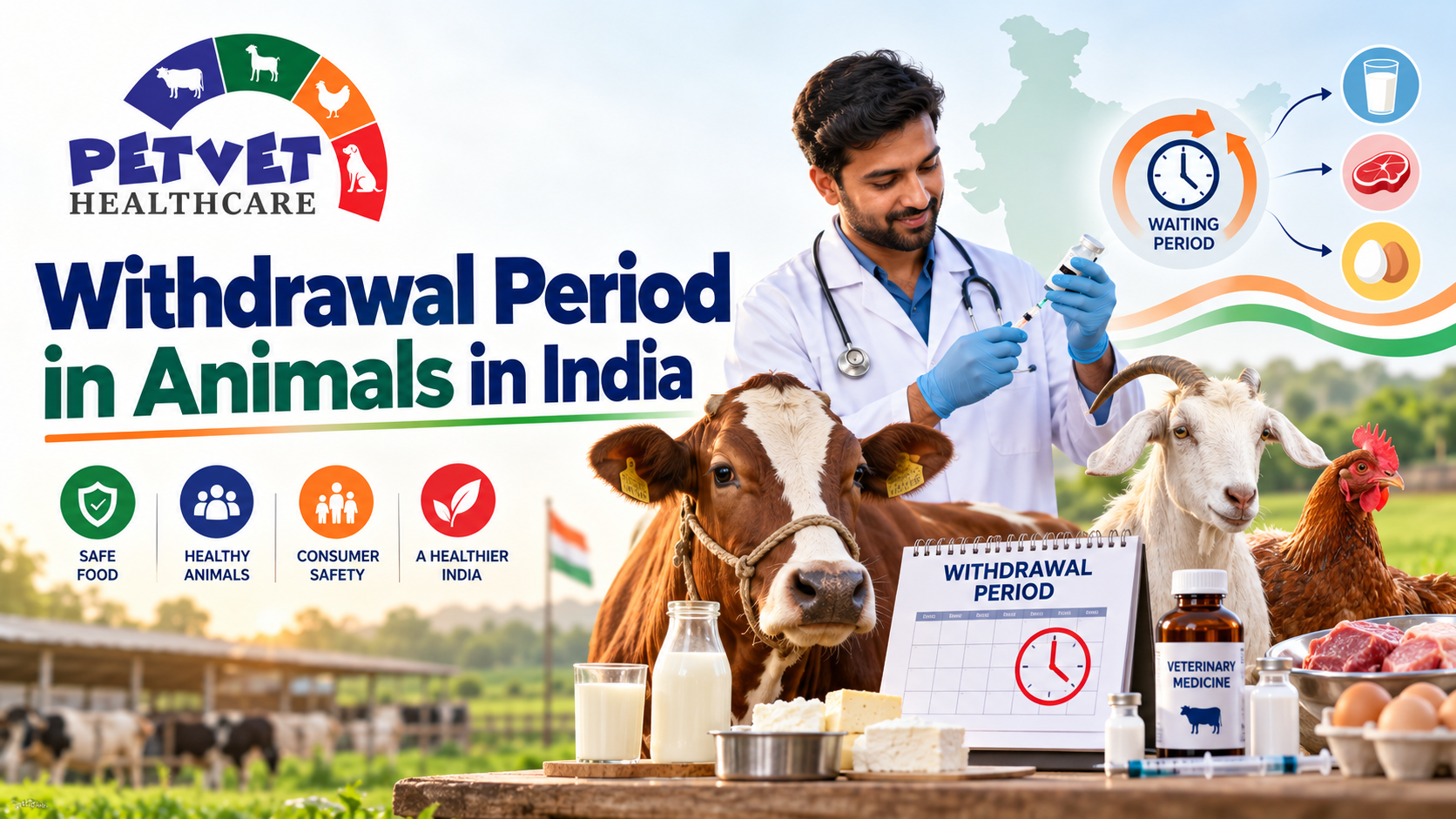
Withdrawal Period in Animals in India: What to Know
For withdrawal period in animals in India, remember these points:
- There is no single number. Each product label lists its own withdrawal time. Follow the label for your exact product, species and food type.
- FSSAI controls residues in food. Under the Food Safety and Standards (Contaminants, Toxins and Residues) Regulations, tolerance limits cover antibiotics and veterinary drugs in meat, poultry, fish and milk products. A 2018 amendment was reported to cover 103 substances and set a low limit of 0.01 mg/kg for 76 antibiotics not meant for food animals. Check FSSAI’s latest notification for the current text.
- Enforcement is by testing. FSSAI said it would do surprise inspections and random sampling of food on the market.
- Banned drugs. Colistin cannot be used in food animals and poultry in India.
- Both milk and meat matter. Cattle sold for slaughter after treatment need meat withdrawal. Cows in milk need milk discard time.
Rules get updated. Ask your vet or local animal husbandry office for the latest guidance.
Withdrawal Period in Poultry
Poultry farms have two things to watch: meat (broilers) and eggs (layers).
For broilers:
- Know the last date of treatment, then count the days on the label before sale.
- Birds sold early for a good price can carry residues. A short delay is cheaper than a rejected batch.
For layers:
- Some medicines are not approved for layer hens at all. Read “not for use in laying birds” warnings.
- Eggs laid during treatment and the withdrawal time should not go to market, unless the label says otherwise.
- Mark treated sheds and keep treated-batch eggs separate.
What Is the Withdrawal Period for Antibiotics in Poultry?
There is no one number. It depends on the specific antibiotic, the product, the bird type and whether you mean meat or eggs. Your label and vet give the exact days. Never use banned antibiotics such as colistin. Do not give antibiotics as “growth boosters.”
Withdrawal Period of Antibiotics: Common Mistakes
| Mistake | Why it is risky | What to do instead |
|---|---|---|
| Selling milk or birds “just a day early” | Residues may still be above the limit | Count from the last dose and wait the full label time |
| Using a human medicine or off-label dose | The label withdrawal time no longer applies | Ask your vet to set a new withdrawal time |
| Not writing treatments down | You forget the last dose date | Keep a simple treatment log |
| Mixing treated and untreated milk | One cow can spoil the whole can | Milk treated animals separately and discard that milk |
| Skipping the label on a “known” product | Formulas and doses change | Read the label every time |
| Giving antibiotics in feed for growth | Fuels resistance and may be illegal | Use medicine only for treatment, on vet advice |
Farmer’s 7-Step Withdrawal Checklist
- Call your vet before using any antibiotic. Do not guess.
- Read the label for the withdrawal time for milk, meat and eggs.
- Write it down: animal ID, drug, dose, last-dose date, safe date.
- Mark the animal (tag, leg band, or shed sign) so no one mixes up its milk or meat.
- Keep treated milk and eggs out of the market until the safe date.
- Ask your vet about a longer wait if the animal was very sick or has liver or kidney problems. Merck notes that slower clearance can mean a longer withdrawal time.
- Keep records safe. They protect you if a buyer or officer asks.
How PetVet Healthcare Supports Safe, Responsible Animal Care
(For farmers, vets, distributors and clinics)
At PetVet Healthcare, we are a veterinary medicine manufacturer in Ambala Cantt, Haryana. [CONFIRM before publishing: WHO-GMP certification and year of start.] Our range includes injections, boluses and feed supplements such as electrolytes, liver tonics, minerals and multivitamins.
Safe use starts with clear information. Here is what we stand for:
- Clear labels. Withdrawal and use instructions should be easy to find. [CONFIRM: add the withdrawal period to each product label and product page, wherever it applies.]
- Vet-guided use. Medicines, and especially antibiotics, should be used only on a registered vet’s advice.
- Supportive care, not shortcuts. Electrolytes, liver tonics and minerals support recovery. They do not replace proper treatment, and they do not shorten the withdrawal time of any drug.
Explore more:
- Veterinary product list
- Veterinary PCD pharma franchise
- Third-party veterinary medicine manufacturing
- Contact PetVet Healthcare — +91 86074 15111 | petvetindia@gmail.com
- More guides on our blog
Frequently Asked Questions
What is the withdrawal period for veterinary drugs?
It is the minimum number of days you must wait after the last dose of a veterinary drug before using the animal’s milk, meat or eggs as food. The wait lets the drug leave the body so residues drop below the legal limit. Each drug has its own number on the label.
What is the withdrawal period for animals?
It is the waiting time after treating a food animal, such as a cow, buffalo, goat or chicken, before its milk, meat or eggs can enter the food chain. The length depends on the drug, species and food type. Treated animals should be marked, and their products kept out of sale until the safe date.
What is the withdrawal period for drugs?
In veterinary medicine, it means the time to wait before using food from a treated animal. It is not the same as drug withdrawal symptoms in people, which are the effects felt after stopping a medicine. For farm animals, the exact days are printed on the drug label or leaflet.
What is the withdrawal period for antibiotics in poultry?
There is no single number. It depends on the antibiotic, the product, the bird (broiler or layer) and whether it is meat or eggs. Read the label and ask your vet. Some antibiotics are not allowed in laying birds, and colistin is banned for poultry in India.
What happens if I sell milk or meat before the withdrawal period ends?
The food may carry drug residues above the legal limit. It can be rejected by the dairy or buyer, and it may breach FSSAI rules. Residues can also add to antibiotic resistance in people. If it happens by mistake, stop supply of that batch and call your vet.
Can I use milk from a treated cow for my own family?
It is not safe. The same residues that are unfit for sale are unfit for home use too. Discard milk from a treated cow until the withdrawal period is over. Keep it away from family members and pets, and ask your vet how to dispose of it safely.
Key Takeaways
- The withdrawal period is the safe wait between the last dose and using milk, meat or eggs.
- The right number is on the label. It changes with the drug, species, dose, route and food.
- Skipping it is the leading cause of illegal residues and fuels antibiotic resistance.
- Keep simple records: animal, drug, dose, last-dose date and safe date.
- Use antibiotics only on vet advice. Never use banned drugs such as colistin.
Sources
- Fimea (Finnish Medicines Agency) — What is a withdrawal period?
- Merck Veterinary Manual — Chemical Residues in Animal-Source Foods
- BVL (German Federal Office of Consumer Protection) — Determination of Withdrawal Periods
- FDA — CPG Sec. 615.300 Responsibility for illegal drug residues in meat, milk and eggs
- FAO — JECFA Toolbox for Veterinary Drug Residues Risk Assessment
- FSSAI news clipping — Tolerance limits for antibiotics in food (Aug 2018)
- Food Safety Helpline — How veterinary drug residues pose a food safety risk
- Down To Earth — Milk in India is certainly not as safe as the food regulator claims
- The Poultry Site — India bans colistin in poultry farms (July 2019)