A dairy farm owner in Karnal once told us he had been buying calcium boluses from the same supplier for four years. Good rates. Prompt delivery. No complaints.
Then a batch failed during milk fever season. He called the supplier for the Certificate of Analysis. It took eleven days to arrive — and when it did, the manufacturer’s name on it belonged to a company he had never heard of, sitting 600 kilometres away.
His “supplier” had never made a single bolus. They were a trading company.
That is not a scandal, by the way. Trading companies are legal, licensed, and often genuinely useful. But that farm owner had assumed he was buying factory direct for four years, and the difference only became visible the moment something went wrong.
PetVet Healthcare is a WHO-GMP and cGMP certified veterinary medicine manufacturer based in Ambala Cantt, Haryana, producing injections, boluses and feed supplements for cattle, poultry and companion animals since 2019. We supply farms, veterinarians, wholesalers and distributors across India — and because we get asked this question constantly by bulk buyers, this guide lays out the honest comparison between buying from a direct manufacturer and buying from a veterinary trading company.
What This Guide Covers
- What a direct veterinary medicine manufacturer actually is
- What a veterinary trading company does differently
- Side-by-side comparison across nine factors
- How much margin stacking really costs you
- Wholesale distributors vs retail outlets — where each fits
- Bulk API vs contract manufacturing (a different question entirely)
- Six ways to verify whether your supplier actually manufactures
- When a trading company is genuinely the better choice
- Frequently asked questions
What Is a Direct Veterinary Medicine Manufacturer?
A direct veterinary medicine manufacturer is a company that owns the licensed production facility where the medicine is physically made. It holds a manufacturing licence under the Drugs and Cosmetics Act 1940, runs its own quality control laboratory, releases its own batches, and its name appears as the manufacturer on the product label and Certificate of Analysis.
That last part matters more than most buyers realise. Under the Drugs and Cosmetics Rules 1945, a manufacturing licence for veterinary formulations is issued in Form 25 or Form 28 depending on the drug category. A trading or wholesale licence — Form 20B and 21B — is a completely different document. One allows you to make medicine. The other allows you to sell it.
So when a supplier says “we are a veterinary pharmaceutical manufacturer,” the licence number on their invoice tells you whether that is literally true or loosely true.
What Is a Veterinary Trading Company?
A veterinary trading company buys finished medicines from one or more manufacturers and resells them, usually under the manufacturer’s brand or occasionally under its own. It does not own a production facility, does not hold a manufacturing licence, and is not the entity legally accountable for how the batch was made.
Trading companies exist because they solve a real problem. No single manufacturer makes everything. A trader can put boluses from one factory, injections from another and feed supplements from a third into one invoice and one delivery. For a small clinic ordering forty items a month, that convenience has genuine value.
The trouble starts when a buyer needs something the trader structurally cannot provide — a batch investigation, a formulation change, a stability report, or a price that reflects the actual cost of manufacturing.
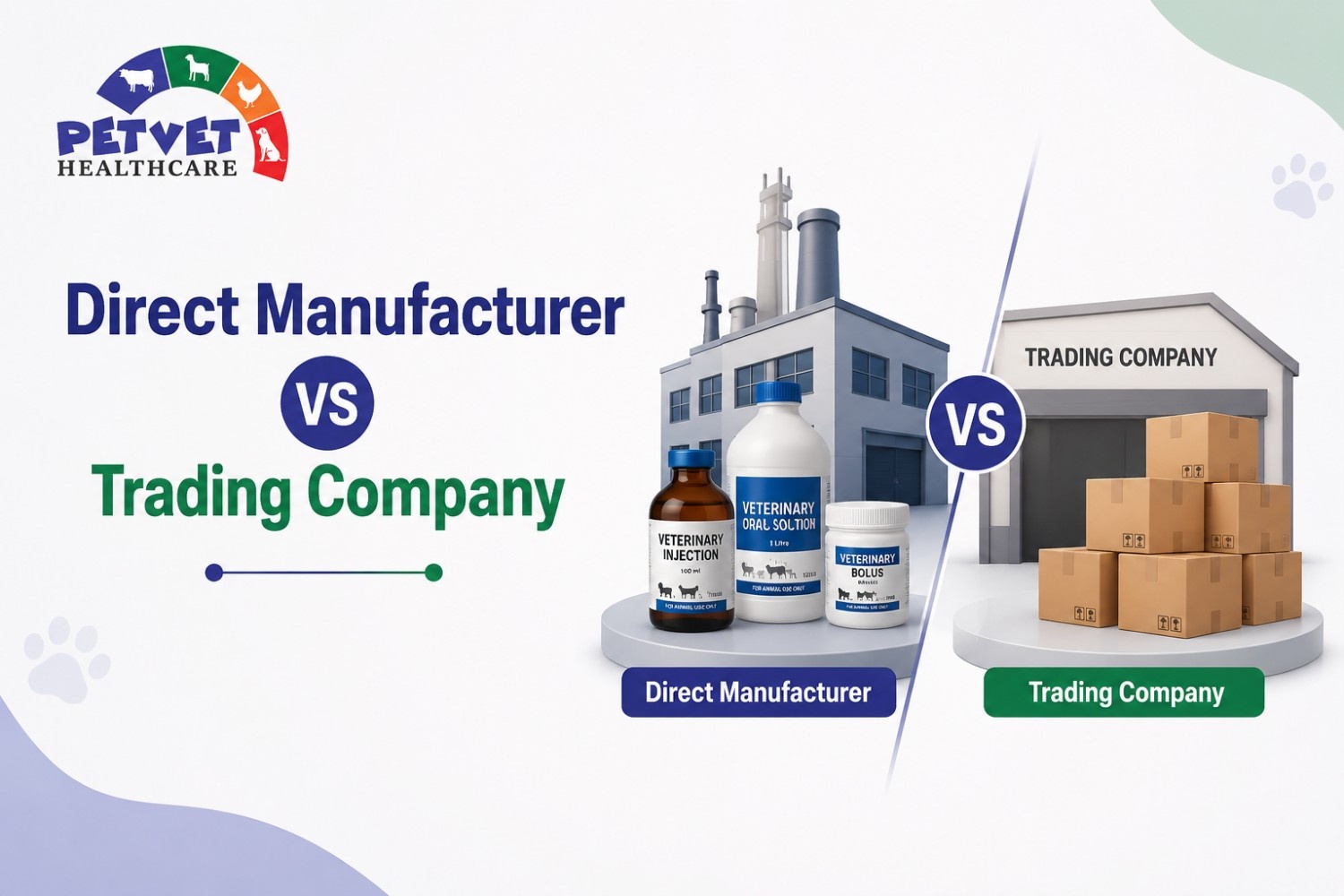
Direct Manufacturer vs Trading Company: Full Comparison
Here is how the two models compare across the factors that matter most to bulk veterinary medicine buyers.
| Factor | Direct Manufacturer | Trading Company |
|---|---|---|
| Owns production facility | Yes | No |
| Licence type | Form 25 / 28 (manufacturing) | Form 20B / 21B (wholesale) |
| Typical bulk price | Factory cost + single margin | Factory cost + 2 to 4 stacked margins |
| Batch traceability | Direct — own batch records | Depends on upstream cooperation |
| Certificate of Analysis | Issued in-house, same day | Requested from manufacturer, 3–15 days |
| Custom formulation | Possible | Not possible |
| Private labelling | Available via third-party manufacturing | Rarely available |
| Product range | Limited to own portfolio | Wide — multiple manufacturers |
| Quality accountability | Legally the manufacturer | Passes liability upstream |
| Minimum order quantity | Higher (batch-size driven) | Lower (stock-driven) |
| Supply consistency | Controlled by own production plan | Subject to supplier availability |
| Best suited for | Bulk, recurring, large-volume buyers | Small, mixed, low-volume orders |
How Much Does Margin Stacking Actually Cost You?
This is the part buyers underestimate.
Every layer between the factory and your farm adds a margin. In Indian veterinary pharma, industry-typical markups run roughly 12–20% at the trading level, another 10–18% at the wholesale level, and 20–35% at retail. None of those numbers are fixed — they move by product category, order size and region — but the compounding effect is consistent.
Work through a simple example. Say a calcium bolus leaves the factory at a landed cost of ₹100 per unit.
| Route | Layers | Approximate Landed Price | Extra Cost |
|---|---|---|---|
| Factory direct (bulk) | Manufacturer → You | ₹100 – ₹115 | Baseline |
| Via trading company | Manufacturer → Trader → You | ₹118 – ₹135 | +18% to 35% |
| Via trader + wholesaler | Manufacturer → Trader → Wholesaler → You | ₹135 – ₹158 | +35% to 58% |
| Full retail chain | Manufacturer → Trader → Wholesaler → Retailer → You | ₹165 – ₹210 | +65% to 110% |
Illustrative ranges based on typical Indian veterinary pharma trade practice. Actual figures vary by product, volume and negotiation.
For a farm buying 500 boluses a month, that middle scenario is roughly ₹17,500 to ₹29,000 a year in avoidable cost. For a distributor moving 10,000 units, the gap runs into lakhs.
And here is the thing nobody mentions — the trader is not overcharging you. They are charging what their own cost structure requires. The money is real, it is just being spent on a layer you may not need.
Quality Control: Who Is Actually Accountable?
Price is the visible difference. Accountability is the expensive one.
When you buy from a WHO-GMP certified veterinary pharmaceutical manufacturer, quality responsibility sits in one place. The manufacturer tests incoming raw materials, runs in-process checks, releases the finished batch against pharmacopeial standards, and retains control samples and batch manufacturing records for the legally required retention period.
If a problem surfaces, that manufacturer can pull the batch record and tell you what happened. Usually within a day.
With a trading company, the chain is longer. They have to go back to their source, who may have to go back to theirs. Every handoff adds delay, and in a milk fever emergency or a poultry disease outbreak, delay is the whole problem.
There is also a storage question that rarely gets asked. Many veterinary injections and biologicals require controlled temperature conditions. A direct manufacturer controls the cold chain from production to dispatch. A trading company may add one or two extra storage points along the way — and each one is a place where temperature excursions can happen without anyone recording them.
Wholesale Distributors vs Retail Outlets: Where Does Each Fit?
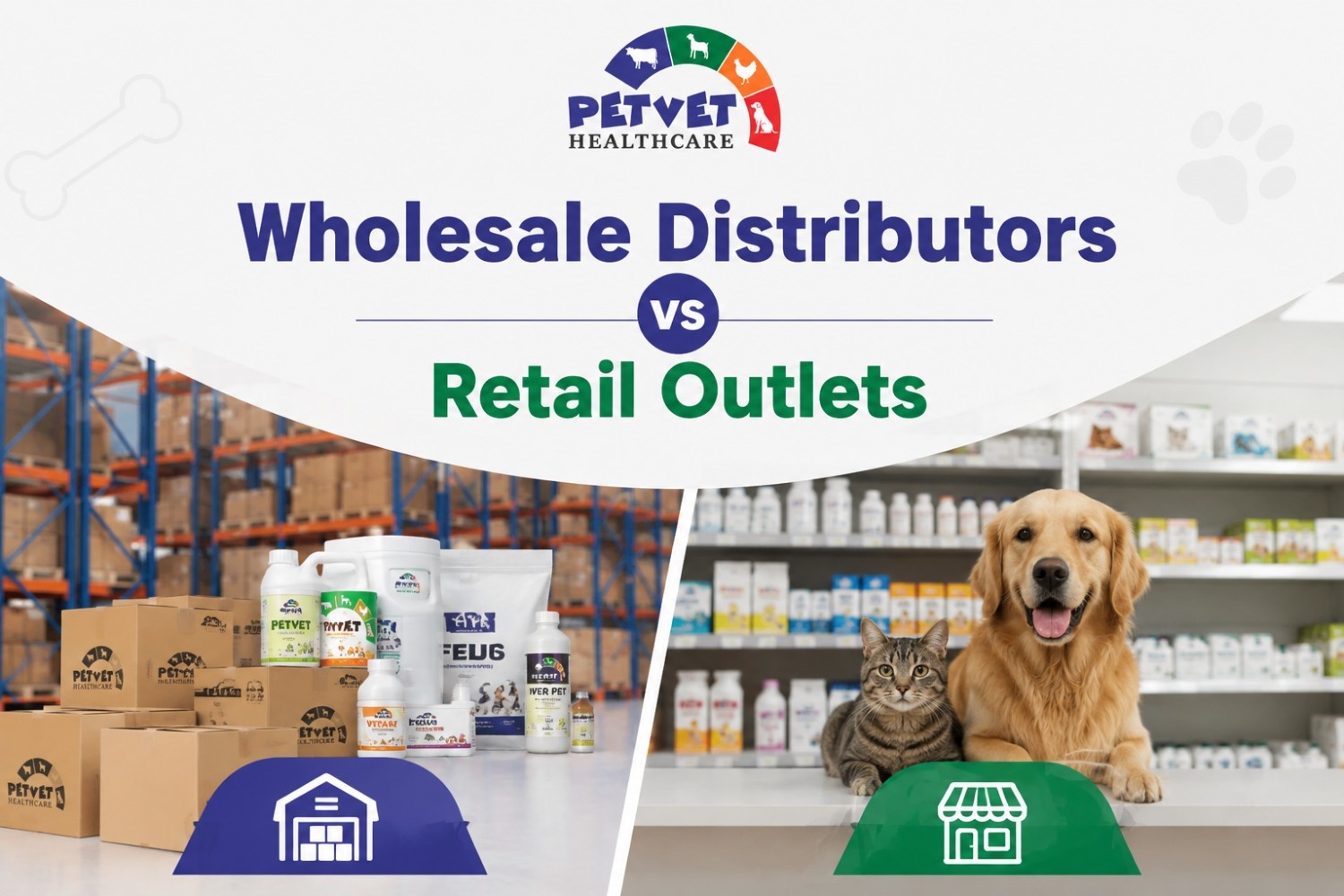
Buyers often collapse two separate questions into one. Manufacturer versus trader is about who made the product. Veterinary wholesale versus retail is about the size and structure of the purchase.
A wholesale distributor sells in bulk quantities to businesses — farms, clinics, other distributors — usually with a wholesale drug licence, tiered volume pricing and credit terms. A retail outlet sells single units to end users, holds a retail licence, and prices for convenience rather than volume.
So the practical decision tree looks like this. If you are ordering fewer than 50 units a month across mixed products, a retail outlet or trading company is genuinely simpler. If you are ordering in hundreds or thousands of the same items every month, going factory direct as a veterinary B2B medicine supplier partner will almost always cost less and give you better control.
Somewhere in between, most buyers run a hybrid. Core high-volume products direct from the manufacturer, long-tail occasional items through a trader. That is not indecision. That is just sensible procurement.
Bulk API vs Contract Manufacturing: A Different Question Entirely
This one gets confused with the manufacturer-versus-trader question, and it shouldn’t be.
Bulk API means buying the Active Pharmaceutical Ingredient — the raw drug substance itself, before it becomes a bolus or an injection. Buying bulk API only makes sense if you own a licensed formulation facility and can convert that API into a finished dosage form yourself. For a farm, a clinic or a distributor, bulk API is not usable. It is not a cheaper way to buy medicine; it is a raw material for someone else’s factory.
Contract manufacturing — also called third-party manufacturing — is when you own a brand and pay a licensed manufacturer to produce finished products under your label. You supply the brand, the artwork and the order volume. The manufacturer supplies the facility, the formulation, the quality systems and the regulatory documentation.
For most bulk buyers wanting their own brand, contract manufacturing is the route. Bulk API is not.
| Bulk API | Contract Manufacturing | |
|---|---|---|
| What you receive | Raw drug substance | Finished, packed product |
| Own facility needed | Yes — mandatory | No |
| Own manufacturing licence | Required | Not required |
| Suitable for | Formulation companies | Brand owners, distributors, marketing companies |
| Typical minimum order | Kilogram-scale | Batch-scale (varies by product) |
| Regulatory burden | Fully on you | Shared with manufacturer |
How Do You Verify Whether a Supplier Actually Manufactures?
Six checks. None of them take more than a phone call, and any genuine veterinary medicine manufacturer will answer all six without hesitation.
1. Ask for the manufacturing licence number
Not the GST number, not the drug licence generally — specifically the Form 25 or Form 28 manufacturing licence, with the issuing State Drug Controller’s name. A trading company will give you Form 20B or 21B instead, which is the giveaway.
2. Read the label carefully
Indian labelling rules require the manufacturer’s name and address on the pack. If the company you are paying is not the company printed as manufacturer, you are buying through a trader. That is not automatically bad — but now you know.
3. Ask for a Certificate of Analysis for a specific batch
A manufacturer pulls it from their own QC records, usually same day. A trader has to request it upstream. Time the response. It tells you everything.
4. Request a factory visit or a virtual walkthrough
Real manufacturers are generally happy to show the plant to serious bulk buyers. Vague answers here are informative.
5. Ask about custom formulation
Ask whether they can adjust a strength, change a flavour, or produce a variant under your own label. A manufacturer will discuss feasibility and batch size. A trader cannot engage with the question at all.
6. Check the WHO-GMP or cGMP certificate
Ask for a copy showing the certified facility address. Then check that the address matches the manufacturer name on the product label. Mismatches are common and worth asking about.
When Is a Trading Company Actually the Better Choice?
It would be dishonest to write this article and pretend the answer is always “go direct.” It isn’t.
A trading company makes better sense when your order is small and spread across many products, when you need forty different SKUs from a dozen manufacturers on one invoice, or when you want something today from local stock rather than waiting on a production schedule. Traders also carry inventory risk that manufacturers often won’t, and for irregular or seasonal buyers that flexibility genuinely matters.
Direct manufacturing wins when volume is high, orders repeat, product range is focused, quality documentation is required for audits or exports, or you want your own brand.
Most established buyers eventually settle into both. The mistake is not using a trader. The mistake is not knowing which one you’re using.
Buying Bulk Veterinary Medicine Direct from PetVet Healthcare
PetVet Healthcare manufactures at a WHO-GMP and cGMP certified facility in Ambala Cantt, Haryana. Not a trading arrangement, not an outsourced arrangement — our own plant, our own quality control laboratory, our own batch release.
What that means practically for bulk veterinary medicine buyers:
- Factory-direct pricing with no stacked trading margins
- Certificate of Analysis issued in-house for any batch you order
- Full range under one roof — injections, boluses, feed supplements, nutritional solutions
- Third-party and contract manufacturing for buyers who want their own brand
- PCD pharma franchise with monopoly rights across Indian states
- Custom formulation and private labelling with regulatory documentation
Our portfolio covers antibiotic and anti-inflammatory injections, calcium boluses for milk fever, appetite and antibiotic boluses, liver tonics, electrolytes, multivitamins, mineral mixtures and calcium gels — formulated for cattle, buffaloes, goats, sheep, poultry and companion animals.
India’s veterinary medicine manufacturing market is growing at a CAGR of 8.80% and is projected to reach USD 2.25 billion by 2034 according to Market Research Future’s 2025 analysis. Buyers who lock in direct manufacturer relationships now tend to hold better pricing as demand tightens.
If you are currently buying through a trader and want to see what the same products cost factory direct, send us your current product list and monthly volumes. We will send back a straight comparison. No obligation.
Call +91 86074 15111 or email petvetindia@gmail.com.
Facility address: Nanhera Road, Kuldeep Nagar, Ambala Cantt, Haryana 133004.
Frequently Asked Questions
Is buying from a veterinary medicine manufacturer always cheaper than a trading company?
For bulk and repeat orders, almost always — you remove one to three margin layers, which typically saves 18% to 55% depending on how long the chain was. For very small mixed orders, a trading company can work out similar or even cheaper, because manufacturers price around batch quantities and small orders don’t benefit from that structure.
What is the minimum order quantity when buying direct from a manufacturer?
It varies by product because it is tied to batch size rather than a fixed policy. Boluses and feed supplements generally have lower thresholds than injections, which require sterile batch runs. The practical answer is to share your monthly volume and ask — most manufacturers will tell you honestly whether your quantity fits their production economics.
How do I know if my current supplier is a manufacturer or a trading company?
Check the product label. Indian labelling rules require the manufacturer’s name and address on the pack. If that name is different from the company invoicing you, you are buying through a trader. You can also ask for the manufacturing licence number — Form 25 or Form 28 indicates a manufacturer, Form 20B or 21B indicates a wholesaler or trader.
Can a trading company provide a Certificate of Analysis?
Yes, but indirectly. They have to request it from the actual manufacturer, which usually takes several days. A direct manufacturer issues it from their own quality control records, typically the same day. If you need batch documentation for audits, exports or institutional tenders, that turnaround difference matters a lot.
What is the difference between bulk API and contract manufacturing?
Bulk API is the raw drug substance, useful only if you own a licensed formulation facility to convert it into finished products. Contract manufacturing means a licensed manufacturer produces finished, packed products under your brand name. If you want your own veterinary medicine brand without owning a factory, contract manufacturing is the route — bulk API is not.
Should I buy veterinary medicine wholesale or retail?
Wholesale if you are ordering in hundreds or thousands of units monthly and can hold stock. Retail if you need small quantities immediately and don’t want inventory. Most farms and clinics above a certain size run both — bulk wholesale for core recurring products, retail for occasional or emergency items.
Does PetVet Healthcare supply to wholesalers and distributors directly?
Yes. We supply farms, veterinarians, clinics, wholesalers and distributors across India directly from our Ambala Cantt facility, with volume-based pricing on bulk veterinary medicine orders. We also run a PCD pharma franchise programme with monopoly rights for distributors who want an exclusive territory.
Can I get veterinary medicines manufactured under my own brand name?
Yes, through third-party or contract manufacturing. You supply the brand name, artwork and order volume; we handle formulation, production under WHO-GMP conditions, packaging and regulatory documentation. This is how most veterinary marketing companies in India build their product lines without owning a plant.
Conclusion
The direct manufacturer vs trading company decision is not really about which one is better in the abstract. It is about matching the model to your order pattern.
High volume, repeat orders, focused product range, need for documentation or your own brand — go factory direct to a veterinary pharmaceutical manufacturer. Low volume, wide mixed range, occasional purchasing, need for immediate local stock — a trading company earns its margin.
What you should never do is assume. That farm owner in Karnal lost eleven days during milk fever season finding out something a single question would have told him in four years earlier.
Ask for the licence number. It takes one phone call.